(behind the clean door)"]]>
Reviewing “Clean –– One woman’s story of addiction, recovery and the removal of stubborn stains”, by Michele Kirsch (Short Books, ISBN 978-78072-381-5)
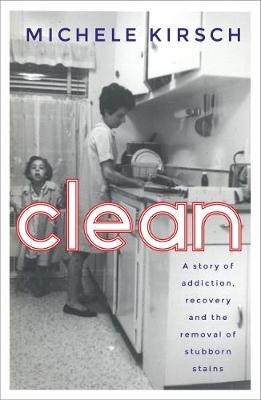
Several years back I was grousing to a pal about a new book by a clever and successful mutual acquaintance, a history that encroaches on territory I had one day hoped to stake out (but of course I have done nothing about this, since my pop timing is always terrible). My gripe is this: music writers endlessly re-interview the wrong people — or more precisely, never enough of the right people. Revisit the original moves and shakers and they mainly double down on what went over well the first the time, especially conceptually. Which is the way a moment of open possibility get congealed back into cliché. “If you want to know what a radical scene’s actually about,” I airily declared to my chum, “you should talk to the club’s hat-check girl.”
(The book in question did extremely well critically and commercially –– presumably because its targeted readers knew better than me what they wanted to read about this particular radical scene… )
Anyway, what’s valuable and lovely about Michele Kirsch’s Clean, I think, is how little attention it pays to the various movers and shakers she’s encountered, as a music writer in the 80s and after –– and how quite early on it turns out she WAS a hat-check girl, at a happening Boston punk club. As well as working in shops, on a switchboard, as a supply teacher, and latterly (per one meaning of the title) cleaning the flats and houses of exactly the kinds of comfortably successful people that pop stars and music writers mostly aspire to be (and now and then succeed). They stay largely off-stage as Michele tackles the grime in their very varied bathrooms, as anonymised sketches punctuating the narrative.
Which is instead an unsettling tale, deceptively wittily told, of unremitting anxiety since childhood, of grief as an unreliable lodestar, of industrial quantities of prescription Valium sometimes amplified by alcohol and other drugs –– and how (per another meaning of the title) you should quit all this, if you can. Since I first knew her 30-odd years ago, Michele has been a writer from her core to her fingertips –– and yet as an autobiography it’s not really about this at all. It begins with her childhood and youth, but says nothing of what she was reading then, or when she first picked up a pen, always pushing back into messier spaces, the ones often kept tidied away behind the pleasant nods to inspiration and aspiration. Around the time of the London Olympics, her decades as an addict had finally pulled both her chosen profession and a pleasant family domesticity out of her reach –– and the book’s framework is her learning to make a minimally liveable living as a cleaner.
At the NME in the mid-late 80s, Michele wrote funny, lively stories that arrived from odd angles –– odd because (to get them placed at all) they generally began life as this week’s promo pretext: pop stars (amusing, difficult, even –– whisper it –– dull) and what as writers we could make our tales of time spent with them. There was a tension here, and thus the chance to discover something about the forces shaping our world. And NME then still just about held a space open for anomaly, for curiosity, for voices and approaches not yet professionalised or routinised or market-narrowed out of their own sense of the shape of the world.

But this space was closing. Magazines were increasingly run by badly formed surveys about what readers felt they liked to read. And as writers and editors we had little idea, most of us, how to resist the pressures this created. By the late 80s, Michele was writing a column called ‘Mama K’s True Stories’ and it was of course terrific. And not like anything else at the time, at least in the UK (somewhere I have a folder full of cuttings from it). This was in the London listings magazine City Limits, a haven for the denizens of the closing space –– if anything under even more pressure to submit to market forces, to be more saleable than awkward, to drop what it had been (which had mattered so much) and to become what idiots thought it had to become.
Jump now to 1992: I’m re-fashioning The Wire from my predecessor Richard Cook’s template, into the kind of magazine I felt could survive without losing what had been so valuable. I got some things right –– the magazine did survive, and still does –– but why did I not see that ‘True Stories’ (which I loved!) fitted perfectly into this ambit and project? I wanted a greater diversity of writers! City Limits was in death spiral, there was much personnel overlap –– why didn’t I pick up the phone and ask Michele if she wanted to relocate? (We likely paid even less than CL, mind you… ) [Footnote 1]
Thinking this through (rueful and shamefaced that I didn’t realise before beginning this review) I realise it’s still a matter of what’s so good about this book, which was then much harder to see clearly (certainly harder for me, but surely not just me). And it goes back to congealment and concealment, who does what in the undiscussed spaces, what gets foregrounded and what gets left out when you’re making an argument in favour of something. Music is something Michele loves and knows about and finds invaluable in her life, and so what she writes about is her life. I was at that time mainly gathering writers who approached music as a series of battles (or as some would say, a history) of competing theories of value, popular vs vanguard vs past vs future vs rock vs rap vs jazz vs noise vs niche vs vector to the totality blah blah blah. Michele seemed untroubled by the routinised feuds and grand historical-definitional UK music-mag controversies of those times, at least in the usual feuding-freelancer-elbows-for-mannerist-space kind of a way — and this is exactly why I loved her writing. I wanted a mini-world in which less armoured voices could hold their own course, to thrive as an irreplaceable part of the whole, as respite from all the dramas of the central cultural cockpit and the theory-divas fighting for the largest slice of the attention available…
But such spaces and such voices are by nature and inclination tricky to weaponise, which is to say tricky to monetise –– and back then I wanted the battles at The Wire on the page (because I felt many of them were being crowded off everyone else’s pages) and also I wanted The Wire not to be losing so much money (lol). Obviously I’m delighted and gratified the magazine still with us — not least as a platform for small scenes that also just scrape by, as times get ever-tougher and spaces elsewhere just carry on blinking out. But all the available media models back then were flawed and flimsy, precarious and unsustainable, and they were all also about to get worse –- three accelerating decades of worse, seriously. The settlement some of us made with this –- the names some of us made -– came at a cost. There was no safety net and there were casualties…
… and by the time of the 2012 Olympics the comfortably successful people mostly left off-stage in this book are having their houses cleaned by those without voices, mostly, and without page-count. Those who found themselves slipping away back downwards after all [2], and those who never saw a way they’d be allowed up: who, trapped from the outset, never entertained ambitions professional or artistic, or set themselves transformative goals. There’s a tension often unexplored in the more stridently meritocratic versions of the tale of those who make it out (or back out, for rehab lit): that to reach the best realisations of yourself as author or artist, you’ve had to leave something behind and lock someone out. And so there’s a guilt alongside the relief –- and in fact a guilt either way. Because if your own flight is unsuccessful, you’re a failure too. These are the corrosive dooms we are constantly asked to internalise, the ideological impositions few entirely free themselves from.
What makes Kirsch such a funny writer is that just these conflicts play out as a kind of lucidly evasive dizziness, a constant misapprehension that’s very (as the internet would put it) “relatable”. She blames no one but herself for how things turned out, and makes a terrific comedy of self-deprecation: spaces left looking worse for her attempts to clean them, things she turned her hand to (professional journalism, parenting) as an obstacle race of absurdist unsuccess. It’s all often also an apology — to family and friends, most of them unnamed — and it’s charming and it makes you laugh, even the tough parts, and her voice remains light and clear, and this is excellent. But not everything in it needs any apology.
As one of the most readable of narrative forms, the classic puritan autobiography sees the present coinciding with the redemption, the means of rescue: we move through and down into the catastrophe, and back up out again. But despite a lightly skirted 12-steppish pass into religion, the redemptive circle in Clean doesn’t quite close — this is not that kind of autobiography. The most rewarding community way-station in her quest towards sobriety is when she becomes a cook in a little local East End café: the fond way this is described lets us know that Kirsch knows that re-arriving as a cap-W Writer is not going to be on a par with this, reward-wise.
The shadow-side of Kirsch’s journey has been a succession of jobs that mostly can’t be careers: hat-check girl, shopgirl, switchboard girl. And there’s a dismissive feel to this list (as I make it) precisely because they’re jobs that often go unnoticed, the stories historians too often don’t ask about. In this book, they take place within hat-checking distance of the movers and shakers we pay most of our attention to, to write about and argue about — and when youth and tactical dizziness hadn’t shut off any of Kirsch’s future mobility, across the counter as it were. You can line them up as “girlish” — as if this means impermanent or ornamental or frivolous — even as you conspire not to spot when they become the whole of the hard livings some have to make, and much too much of the life some have always to live. Even in the late 80s, such mobility still seemed plausible –– and writers still shared an impulse to be keeping doors open, or anyway to share glimpses of what this might still mean. But what if personal transformational achievement only takes decisive shape when the doors are closed? Your inspirational, aspirational triumph is only a broader political or a moral triumph if you can bring with you the best of what made you. The gentle strength of this book is the sense it leaves us with, of the caked-on dirt behind our sense of lifesaving self-rescue, of where the slamming doors may be, of what’s on the other side that we should never be forgetting…
FOOTNOTES:
1: For a recent reboot of Mama K’s True Stories, go here
2: At the book launch for Clean, I was told — to my great sadness — of the likely death last year of another colleague from back in the still-open days. I won’t name them because the internet doesn’t yet confirm the news, and I very much hope it’s untrue. The fact they’re more or less invisible on the internet is part of the story, though.
[If you like this post, please support my PATREON which will help me write more! Also let other people know that you think might enjoy it… ]
]]>(I wrote this up to place somewhere grown-up and get some traction, but no joy for one reason or another — the Camelot theme not entirely inapposite, esp.if you’ve read The Once and Future King. Kickstarter is still and closes Wednesday 27 July at 4.26pm UK time.)
We have an idea of the UK music press in the 70s — a notion of great names engaged in earthy debate about rock and pop, of fearless mockery of foolish or pretentious stars, of a generation of self-taught giants walking the earth in those golden black-and-white days. We can list names: Murray and Kent, Parsons and Burchill, Penman and Morley, Danny Baker, Garry Bushell, Jon Savage… With satisfaction (or amusement), we note that some of them have clambered up to the sustainably rewarded end of public chatter — which if nothing else suggests that their first professional gigs must have been an effective proving ground.
 It’s a picture distorted with hindsight, though. At the time, it was for the most part a much wider, quieter, almost invisible world. A cluster of titles that you engaged with as an intense subcultural doorway away from the routines of life: yes, there’d be a pop-star on the cover, major or rising or weird, but inside… well, inside you found all kinds of things. It reached a lot of people — sometimes as many as a million a week — and, unlike official culture, it didn’t shut them out. As writer-agitator and one-time label boss Liz Naylor puts it on one of the promo vids, “It was very difficult to access information in the 70s! The music press was my education…”
 The four weeklies were NME, Melody Maker, Sounds and Record Mirror. Echoes (sometimes Black Echoes) was a bi-weekly for black music — especially good on soul and reggae. There were several monthlies: Zigzag and Let It Rock and the superb, short-lived, much-lamented Street Life: precursors of Q or Mojo, you could say, but much much more than just this. Because — aside from the endless underfelt of free and alt.listings magazines — the music press had been where the spirit of the underground press had ended up: the brief strange countercultural spark of Oz, IT, Frendz, Ink, when late 60s youth had revolted against war and the technocracy, against racism, against timidity and prudishness, and for unfettered (yes chaotic, yes naive) expression. Writers and editors and designers — some extremely talented, but without a hope of rising far in the then-mainstream media — had crossed over out of this fervid, para-political subculture into the music press, partly because rock was the soundtrack of the counterculture, so that to make sense of rock you had to grasp the language and ideals and utopias of this teenage revolt, if only to wrangle with them, to rescue the good from the bad. And as a consequence this was a world full of curiosity about comics and cult films, liminal and radical politics, about musics and activities of communities and undergrounds from all over the world, America, the Caribbean, Europe, Africa — about everything in the world you couldn’t routinely access, which television skimped and normal newspapers didn’t remotely understand.
 Last year I ran a conference at Birkbeck, to explore some of this crossover and how it turned out, called Underground Overground: The Changing Politics of UK Music-Writing 1968-85 (scroll down for more). This year I’m running a kickstarter for a book called A Hidden Landscape Once a Week (subtitle “How UK music-writing became a space for unruly curiosity, in the words of those who made it happen”), which will anthologise extracts from last year’s panels with critical essays exploring issues raised — including the day-to-day practical backroom aspect of putting such a paper together. Panellists and contributors include Charles Shaar Murray, Val Wilmer, Richard Williams, Paul Gilroy, Paul Morley, Simon Frith, David Toop, Cynthia Rose and Penny Reel — people from a wide variety of backgrounds and perspectives and obsessions, which bohemian mix was key to the sensibility in question; “a conversation,” to quote the kickstarter blurb, “that musician, writer and reading fan all joined… a cheerful collective wrangling that echoes the crackles of dissent and tension in the songs it explores: the disputatiousness as well as the joy.” Alongside the hype and silliness, there was always a care and a fascination with possibility, with portals into all manner of other spaces hinted at in the music, and beyond it. For a decade and more, in a wider culture of stifled parochialism, this was a world of serendipity and surprise encounter. This will be a book that explores this world’s values and flaws, how it was established and maintained, and where its echoes can be found today — or rebuilt, in a very different, noisier, information-saturated context.
[ADDING: the “warring flaws” sub-head wasn’t on the piece I submitted — it didn’t have a heading at all — and only popped into my mind as I was fiddling with a framing to go here. What exactly do I mean by it (since it probably changes the tone and even the meaning of what follows)? Something like this: that what I think became dispersed — by all kinds of pressures, some extremely hard to fight — was a cast of mind in editing, which was, for a while, able to corral the impatience and rivalry and cattiness and worse that you always find among talented writers, into something unexpectedly collectively rich and generous. The mystery of where this came from — whose the design was, if design there was, and what the accident was, if it was accident — is one of the mysteries that brings me back to the subject. The Arthurian image implies that its virtues and its flaws are intextricably tangled: but I don’t know that this is actually so… ]
]]> Robin Carmody messaged me on FB to say he’d just been reading my le carré rereads on ilx, and enjoyed and agreed with them. Since one of my projects here is I guess to begin to centralise my boringly dispersed and rhizomatic self, I thought I’d link them here. This is the original, inset in a longer ilx thread: liveblogging Tinker Tailor Soldier Spy. This is the same excerpted at FT (i.e. all the rest of the entertaining ilx chatter cut away). This was intended as a liveblog of a reread of Smiley’s People, except things ran away with themselves and I ended up just posting some thoughts (on an ilx thread no one else ever contributed to).
]]>
Robin Carmody messaged me on FB to say he’d just been reading my le carré rereads on ilx, and enjoyed and agreed with them. Since one of my projects here is I guess to begin to centralise my boringly dispersed and rhizomatic self, I thought I’d link them here. This is the original, inset in a longer ilx thread: liveblogging Tinker Tailor Soldier Spy. This is the same excerpted at FT (i.e. all the rest of the entertaining ilx chatter cut away). This was intended as a liveblog of a reread of Smiley’s People, except things ran away with themselves and I ended up just posting some thoughts (on an ilx thread no one else ever contributed to).
]]> or, Maybe this is the best place for my mean little joke about why they called their fanzine “monitor” hoho
Little essay for FT on art, class and autodidacts: featuring Oasis, Joseph Beuys, Arthur Scargill and Richard Jobson, among others. Tom Ewing and Frank Kogan are already arrived in the comments on excellent form: my fantasy thread would eventually also include Mark E. Smith, Robin Carmody and Robert Christgau duking it out with Liam and Noel Gallagher and maybe even one of the Appleton sisters…
]]>(Via Geeta D on twitter, see you soon d00d)
ps apologies for non-presence here, i’ve been writing writing writing all summer: some blogging turned into an idea for a book, a chapter of which has escaped and all on its own turned back into a (book-length) blogpost… MORE SOON I THINK
]]>