(behind the clean door)"]]>
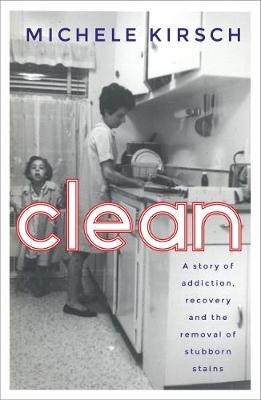
Reviewing “Clean –– One woman’s story of addiction, recovery and the removal of stubborn stains”, by Michele Kirsch (Short Books, ISBN 978-78072-381-5)
Several years back I was grousing to a pal about a new book by a clever and successful mutual acquaintance, a history that encroaches on territory I had one day hoped to stake out (but of course I have done nothing about this, since my pop timing is always terrible). My gripe is this: music writers endlessly re-interview the wrong people — or more precisely, never enough of the right people. Revisit the original moves and shakers and they mainly double down on what went over well the first the time, especially conceptually. Which is the way a moment of open possibility get congealed back into cliché. “If you want to know what a radical scene’s actually about,” I airily declared to my chum, “you should talk to the club’s hat-check girl.”
(The book in question did extremely well critically and commercially –– presumably because its targeted readers knew better than me what they wanted to read about this particular radical scene… )
Anyway, what’s valuable and lovely about Michele Kirsch’s Clean, I think, is how little attention it pays to the various movers and shakers she’s encountered, as a music writer in the 80s and after –– and how quite early on it turns out she WAS a hat-check girl, at a happening Boston punk club. As well as working in shops, on a switchboard, as a supply teacher, and latterly (per one meaning of the title) cleaning the flats and houses of exactly the kinds of comfortably successful people that pop stars and music writers mostly aspire to be (and now and then succeed). They stay largely off-stage as Michele tackles the grime in their very varied bathrooms, as anonymised sketches punctuating the narrative.
Which is instead an unsettling tale, deceptively wittily told, of unremitting anxiety since childhood, of grief as an unreliable lodestar, of industrial quantities of prescription Valium sometimes amplified by alcohol and other drugs –– and how (per another meaning of the title) you should quit all this, if you can. Since I first knew her 30-odd years ago, Michele has been a writer from her core to her fingertips –– and yet as an autobiography it’s not really about this at all. It begins with her childhood and youth, but says nothing of what she was reading then, or when she first picked up a pen, always pushing back into messier spaces, the ones often kept tidied away behind the pleasant nods to inspiration and aspiration. Around the time of the London Olympics, her decades as an addict had finally pulled both her chosen profession and a pleasant family domesticity out of her reach –– and the book’s framework is her learning to make a minimally liveable living as a cleaner.
At the NME in the mid-late 80s, Michele wrote funny, lively stories that arrived from odd angles –– odd because (to get them placed at all) they generally began life as this week’s promo pretext: pop stars (amusing, difficult, even –– whisper it –– dull) and what as writers we could make our tales of time spent with them. There was a tension here, and thus the chance to discover something about the forces shaping our world. And NME then still just about held a space open for anomaly, for curiosity, for voices and approaches not yet professionalised or routinised or market-narrowed out of their own sense of the shape of the world.

But this space was closing. Magazines were increasingly run by badly formed surveys about what readers felt they liked to read. And as writers and editors we had little idea, most of us, how to resist the pressures this created. By the late 80s, Michele was writing a column called ‘Mama K’s True Stories’ and it was of course terrific. And not like anything else at the time, at least in the UK (somewhere I have a folder full of cuttings from it). This was in the London listings magazine City Limits, a haven for the denizens of the closing space –– if anything under even more pressure to submit to market forces, to be more saleable than awkward, to drop what it had been (which had mattered so much) and to become what idiots thought it had to become.
Jump now to 1992: I’m re-fashioning The Wire from my predecessor Richard Cook’s template, into the kind of magazine I felt could survive without losing what had been so valuable. I got some things right –– the magazine did survive, and still does –– but why did I not see that ‘True Stories’ (which I loved!) fitted perfectly into this ambit and project? I wanted a greater diversity of writers! City Limits was in death spiral, there was much personnel overlap –– why didn’t I pick up the phone and ask Michele if she wanted to relocate? (We likely paid even less than CL, mind you… ) [Footnote 1]
Thinking this through (rueful and shamefaced that I didn’t realise before beginning this review) I realise it’s still a matter of what’s so good about this book, which was then much harder to see clearly (certainly harder for me, but surely not just me). And it goes back to congealment and concealment, who does what in the undiscussed spaces, what gets foregrounded and what gets left out when you’re making an argument in favour of something. Music is something Michele loves and knows about and finds invaluable in her life, and so what she writes about is her life. I was at that time mainly gathering writers who approached music as a series of battles (or as some would say, a history) of competing theories of value, popular vs vanguard vs past vs future vs rock vs rap vs jazz vs noise vs niche vs vector to the totality blah blah blah. Michele seemed untroubled by the routinised feuds and grand historical-definitional UK music-mag controversies of those times, at least in the usual feuding-freelancer-elbows-for-mannerist-space kind of a way — and this is exactly why I loved her writing. I wanted a mini-world in which less armoured voices could hold their own course, to thrive as an irreplaceable part of the whole, as respite from all the dramas of the central cultural cockpit and the theory-divas fighting for the largest slice of the attention available…
But such spaces and such voices are by nature and inclination tricky to weaponise, which is to say tricky to monetise –– and back then I wanted the battles at The Wire on the page (because I felt many of them were being crowded off everyone else’s pages) and also I wanted The Wire not to be losing so much money (lol). Obviously I’m delighted and gratified the magazine still with us — not least as a platform for small scenes that also just scrape by, as times get ever-tougher and spaces elsewhere just carry on blinking out. But all the available media models back then were flawed and flimsy, precarious and unsustainable, and they were all also about to get worse –- three accelerating decades of worse, seriously. The settlement some of us made with this –- the names some of us made -– came at a cost. There was no safety net and there were casualties…
… and by the time of the 2012 Olympics the comfortably successful people mostly left off-stage in this book are having their houses cleaned by those without voices, mostly, and without page-count. Those who found themselves slipping away back downwards after all [2], and those who never saw a way they’d be allowed up: who, trapped from the outset, never entertained ambitions professional or artistic, or set themselves transformative goals. There’s a tension often unexplored in the more stridently meritocratic versions of the tale of those who make it out (or back out, for rehab lit): that to reach the best realisations of yourself as author or artist, you’ve had to leave something behind and lock someone out. And so there’s a guilt alongside the relief –- and in fact a guilt either way. Because if your own flight is unsuccessful, you’re a failure too. These are the corrosive dooms we are constantly asked to internalise, the ideological impositions few entirely free themselves from.
What makes Kirsch such a funny writer is that just these conflicts play out as a kind of lucidly evasive dizziness, a constant misapprehension that’s very (as the internet would put it) “relatable”. She blames no one but herself for how things turned out, and makes a terrific comedy of self-deprecation: spaces left looking worse for her attempts to clean them, things she turned her hand to (professional journalism, parenting) as an obstacle race of absurdist unsuccess. It’s all often also an apology — to family and friends, most of them unnamed — and it’s charming and it makes you laugh, even the tough parts, and her voice remains light and clear, and this is excellent. But not everything in it needs any apology.
As one of the most readable of narrative forms, the classic puritan autobiography sees the present coinciding with the redemption, the means of rescue: we move through and down into the catastrophe, and back up out again. But despite a lightly skirted 12-steppish pass into religion, the redemptive circle in Clean doesn’t quite close — this is not that kind of autobiography. The most rewarding community way-station in her quest towards sobriety is when she becomes a cook in a little local East End café: the fond way this is described lets us know that Kirsch knows that re-arriving as a cap-W Writer is not going to be on a par with this, reward-wise.
The shadow-side of Kirsch’s journey has been a succession of jobs that mostly can’t be careers: hat-check girl, shopgirl, switchboard girl. And there’s a dismissive feel to this list (as I make it) precisely because they’re jobs that often go unnoticed, the stories historians too often don’t ask about. In this book, they take place within hat-checking distance of the movers and shakers we pay most of our attention to, to write about and argue about — and when youth and tactical dizziness hadn’t shut off any of Kirsch’s future mobility, across the counter as it were. You can line them up as “girlish” — as if this means impermanent or ornamental or frivolous — even as you conspire not to spot when they become the whole of the hard livings some have to make, and much too much of the life some have always to live. Even in the late 80s, such mobility still seemed plausible –– and writers still shared an impulse to be keeping doors open, or anyway to share glimpses of what this might still mean. But what if personal transformational achievement only takes decisive shape when the doors are closed? Your inspirational, aspirational triumph is only a broader political or a moral triumph if you can bring with you the best of what made you. The gentle strength of this book is the sense it leaves us with, of the caked-on dirt behind our sense of lifesaving self-rescue, of where the slamming doors may be, of what’s on the other side that we should never be forgetting…
FOOTNOTES:
1: For a recent reboot of Mama K’s True Stories, go here
2: At the book launch for Clean, I was told — to my great sadness — of the likely death last year of another colleague from back in the still-open days. I won’t name them because the internet doesn’t yet confirm the news, and I very much hope it’s untrue. The fact they’re more or less invisible on the internet is part of the story, though.
[If you like this post, please support my PATREON which will help me write more! Also let other people know that you think might enjoy it… ]
]]>This is a list of resources for migrants and refugees in the UK and Europe, and related organisations, originally crowd-sourced and storified on twitter by the redoubtable Daniel Trilling (@trillingual) and various excellent people in his timeline. It seems like a helpful moment to put the information into a user-friendly form. Some are charities, some are activist non-profits: quite apart from all the people who desperately need help, the official laws, techniques and institutions being developed to police borders and harm refugees and migrants will be quickly be exported to the rest of society, the poor and the vulnerable in particular, the establishment of border-patrol politics at all levels of daily life.
Order is alphabetic, in sections: UK-wide first, then UK local, then a scattering of Europe-wide orgs and some US ones too. Some are self-explanatory, some I’ve given a very brief description. It’s nowhere near exhaustive, obviously — just a start. I’ll probably give it a page of its own shortly — this is just my blog after all — but it seemed the common-sense place to start. If you can, donate or give your time and energy. And circulate this.
UK NATIONAL
Against Borders for Children, against border regimes within schools @Schools_ABC
Association of Visitors to Immigrant Detainees @AVIDdetention
Asylum Aid, @AsylumAid
Asylum Support Appeals Project helps people appeal their cases, get housing, avoid destitution
Bail for Immigration Detainees
Christian/Muslim refugee initiatives, local and national
City of Sanctuary network (UK & Ireland), encouraging communities to welcome refugees, branches nationwide (see below for a few of them) @cityofsanctuary
Counterpoints Arts, engaging with refugee and grant experiences @CounterArts
Detention Action supports people in UK immigration detention @DetentionAction
Doctors of the World: campaigning for refugees in UK to access healthcare, @DOTW_UK
Help Refugees UK @HelpRefugeesUK
Homes Not Borders @Homesnotborders
Homes for Syrians @homesforsyrians
Hope for the Young (formerly OMID International) @hopefortheyoung
Hope not Hate @hopenothate
Housing Rights (not just migrants and refugees)
How to ask your MP to expand UK refugee resettlement
Lesbians and Gays Support the Migrants
Lorraine Ayensu Refugee Arts fund @LARAfund
Médecin Sans Frontières @MSF, @MSF_Sea, @MSF_uk
Medical Justice: health rights for UK immigration detainees @MedicalJustice
Migrants’ Law Project offers strategic litigation against immigration detention @MigrantsLawProj
Migrant Voice, for migrant voices to be heard in the UK media @MigrantVoiceUK
Movement for Justice By Any Means Necessary @followMFJ
Music in Detention @MIDdetention
PlatformaArts and Refugee Network @PlatformaArts
Red Cross UK refugee support @britishredcross
Refugee Action @RefugeeAction
Refugees at Home, seeking hosts for refugees and asylum seekers in the UK @RefugeesAtHome,
Refugee Council @refugeecouncil
Safe Passage works to bring vulnerable refugees in Europe to Britain @Safepassageuk
UK Lesbian and Gay Immigration Group @uklgig
We Are Chatterbox: language and cultural training service by refugees @wearechatterbox
Women for Refugee Women campaigns (Yarl’s Wood and elsewhere) @4refugeewomen
Yarl’s Wood Befrienders @YWBefrienders
UK LOCAL
A useful map for local links @RefugeeWeek
London:
Croydon and NW London:
Young Roots: supporting young refugees and asylum seekers @weareyoungroots
East London:
Refugee and Migrant Forum of Essex and London @RAMFELcharity
Greenwich:
Greenwich Migrant Hub @GreenwichMH
Hackney:
Akwaaba social centre for asylum seekers, refugees and other migrants @akwaabahackney
Haringey:
Haringey Migrant Support Centre haringeymsc.org
Islington:
Islington Centre for Refugees and Migrants: English lessons, support, workshops, hot meals @IslingtonCentre
Lewisham:
Action for Refugees in Lewisham @Afril
North East London:
North East London Migrant Action: people left destitute by local council policies @NELMAcampaigns
Walthamstow:
Walthamstow Migrants’ Action Group
London-wide:
English for Action: English lessons in London @EFALondon
New North London Synagogue Drop-In Centre for Destitute Asylum Seekers
Praxis: advice, support, meeting place for migrants and refugees
Refugee Connection: helping refugees and Londoners get to know one another @RefConnection
Support network for people stranded in London by the #MuslimBan
Bradford:
Bradford City of Sanctuary @bradfordCoS
Brighton, Sussex and Surrey:
Brighton Voices in Exile @brightonvoices
Brighton Migrant Solidarity @BriMigSol
Bristol:
Bristol Refugee Rights @bristolrefugeer
Huddersfield:
Destitute Asylum Seekers Huddersfield
Hull:
Hull Help for Refugees @hullforrefugees
Leeds:
Leeds Asylum Seekers Support Network @lassnleeds
Leeds No Borders @leedsnoborders
Positive Action for Refugees and Asylum Seekers @PAFRAS_Leeds
Leicester:
After 18, a resource for migrants, refugees and asylum seekers entering adulthood @after18uk
Liverpool and Merseyside:
Asylum Link @asylumlink
Manchester:
Boaz Trust, serving destitute asylum seekers
Manchester Refugee Support Network
Newcastle:
Action Foundation provides housing and language support @actionFdn
Notts:
Nottingham and Nottinghamshire Refugee Forum @NNRF1
Oxford:
Asylum Welcome @asylumwelcome
Reading:
Reading Refugee Support Group
South Yorkshire:
South Yorkshire Migrants and Asylum Action Group @SYMAAG
Sheffield:
Assist Sheffield: challenging asylum destitution
Tyneside:
Newcastle Law Centre @NewcastleLC
North of England Refugee Service @NERSRefugee
West End Refugee Service
York:
Refugee Action York @refactyork
NORTHERN IRELAND:
Housing4All campaigns against destitution in Belfast @h4allni
Northern Ireland Community of Refugees & Asylum Seekers @NICRAScharity (refugee-led)
Horn of Africa People’s Aid Northern Ireland @HAPANI1 (refugee-led)
SCOTLAND:
Edinburgh:
Edinburgh City of Sanctuary @edinCoS
Welcoming Edinburgh @WelcomingEdi
Refugee Action Scotland: delivering aid to migrants freezing in the Balkans: @re_act_scotland
Glasgow:
Refuweegee: “we’re all fae somewhere”
Glasgow Unity Centre, which monitors and challenges deportations: @unitycentreglas
Positive Action: accommodation for destitute refugees @PositiveActionH
WALES:
Swansea:
Unity in Diversity: helping refugees and asylum seekers @uidswansea
REPUBLIC OF IRELAND:
Migrant Rights Centre Ireland @MigrantRightsIR
Contact your TD to ask them to oppose Trump’s ban
EUROPE
European Council of Refugees and Exiles @ecre
Welcome 2 Europe: information and contact lists country by country
Advice on Individual Rights in Europe @AIRECentre
Refugee Community Kitchen: food for migrants and the homeless in Dunkirk, Paris, Calais, London @RefugeeCkitchen
Refugee Rights Data Project @refugeedata
Red Cross EU @RedCrossEU
Caritas, “the helping hand of the Catholic Church” @iamcaritas
Food for migrants in the Balkans HERE and HERE
Connect Refugee: Phone credit for refugees in Europe, vital lifeline, sometimes literally
UNITED STATES
American Civil Liberties Union @ACLU
Southern Poverty Law Centre @splcenter
]]> A few weeks back, Marcello asked if I had any thoughts on this TPL post (about, among other things, Johnny Hates Jazz and The Wire as it was in 1986/87). Well, I did and I didn’t: I did because this era of my mentor Richard Cook’s project is very much the making of me, and I absorbed an enormous amount of his sensibility and thought a lot how to advance it best (whether or not I did is for others to judge; sadly he’s no longer with us for his perspective). But I didn’t (at least tactically, for now) because I have for most of this year been organising a conference on UK music-writing in the 60s, 70s and early 80s, trying to focus on how things had evolved from roughly 1968 (and the discussion of rock in the underground press) through to maybe 1985, when (in my judgment) Live Aid hit the inkies hard sideways, and changed their political ecology for good (Geldof’s revenge, you could call it). The serious social potential of pop began to be more and more of a topic for the tabloids and the broadsheets: the inkies began more and more to fold in into their own niche, exploring less and less. In this they were reflecting changes in the world, to be sure — but they were also amplifying and accepting these changes.
Richard’s was (to me, then) the smartest part of the counter-response to these shifts — The Wire considered as a magazine about all possible music and indeed all possible ways to write and think about music, including the free play of the most scholarly anti-philistines against pop’s and punk’s cheerful teenage school’s-out yawp (not to mention a phalanx of more studied anti-music and anti-art stances). Max Harrison alongside Val Wilmer alongside Biba Kopf alongside, well, me.*
Anyway, looking too long and hard at (meaning reassessing) all this right now means not just distracting me from a rolling reassessment of the earlier era — as I chat to the various likely participants in my conference, and recalibrate my understanding of how things were — but probably undermining my entire current provisional grasp of what I need to be grasping. So for now**, you should be boiling what I am (possibly) thinking out of here (where I outline the purpose of the conference and name the participants) or here (a Facebook page you can like and also share) (share it!) or here ( tumblr with some nice pictures and also rolling thoughts on what organising a conference entails) (grief! also joy! so far much more joy luckily… )
Here’s who’s confirmed (reverse alphabetical): Val Wilmer, Richard Williams, Mark Williams, Simon Warner, David Toop, Bob Stanley, Hazel Southwell (nee Robinson), Laura Snapes, Mark Sinker, Cynthia Rose, Penny Reel, Mark Pringle, Tony Palmer, Charles Shaar Murray, Paul Morley, Toby Litt, Esther Leslie, John (aka Jonh) Ingham, Barney Hoskyns, Jonathon Green, Beverly Glick (aka Betty Page), Paul Gilroy, Adam Gearey, Simon Frith, Nigel Fountain, Tom Ewing, Kodwo Eshun.
(Not quite confirmed but definite interest shown: Tony Stewart)
 Panel topics not entirely coalesced yet but will likely include: what the undergrounds knew that the mainstream was missing; rhetorics of outsider style; the changing make-up of bohemia; handling pressures on the playpen, professional and commercial; the rock press as a species of agit-prop samizdat; and legacy and lessons today…
You’ll need to register/book here but it’s free!
*Me (that is) as in the me just today delighted to be in receipt of the intelligence that (OMG LOL) Daphne & Celeste (@Daphne_Celeste) is now following you on Twitter!
**My rule-of-thumb back in the late 80s and early 90s, on ways to ensure The Wire really actually did have the widest possible scope, was to think of it as the mini-arena in early 80s NME jostled with mid-70s MM, allowing strategic space for sensibilities like Musics and Collusion, the late 80s Village Voice (a revelation to me) and even (bcz I have never not been a bit of a goth) Zigzag.

Holiday over and back in London (w/sister et al gone to their home), I have many many excellent friends, and more on-line, but the specific sense of solitude definitely welled up again this last week, especially in the evenings: because it’s not really about company as a cure, it’s about how you process your past — what’s gone and what remains.
One element of that past, when mum and dad were themselves young still, not yet dauntingly ill, not yet seriously disabled, was, basically, my army of monsters and spacemen, tirelessly gathered from toyshop cheapie shelves and gumball machines and (now and then) rescued off the pavement. Silly and small perhaps, but this is often where the intensity is concentrated.
Family notwithstanding — my sister in particular (we were close as kids and remain so now) — I was a pretty solitary kid: when I wasn’t reading I made my own amusement; fashioned and peopled my own worlds. There was an element here of compensatory activity and self-absorption: my dad was diagnosed with Parkinsons when I was 7; by 12, I was certainly actively/subconsciously distancing myself from committing to certain kinds of emotional bond — because I (half)knew and (semi)anticipated the pain of future loss that is always embedded in such bonds. Safer to stick with my wee rubber guys: at least until punk rock began to glint and beckon (I’m simplifying and cartooning, but not enormously).
So yes, this is a trivial indulgence; and yes, it’s something I evidently needed to do for a brief season — which brief season is probably not ended; and nor (I’m guessing) is this going to be the only manifestation.
(Crossposted at tumblr)
]]>(Via Geeta D on twitter, see you soon d00d)
ps apologies for non-presence here, i’ve been writing writing writing all summer: some blogging turned into an idea for a book, a chapter of which has escaped and all on its own turned back into a (book-length) blogpost… MORE SOON I THINK
]]> ]]>
]]> Vast Reuters info-diagram of China and how to understand it: not that I can actually get it to scroll down or anything
(courtesy jamie at blood and treasure, naturally)
]]>I wrote something in July about political grifters, left and right: an argument (over-compressed, over-allusive) that their adept way with words — their subtle deployment, and indeed understanding, of the elaborate shibboleths of the tribe — is by no means necessarily the conclusive tell for their motivation. The heart of a good con is that you’re hearing what you very much want to hear: the conman may or may not at some level also believe it himself (and please to note: they are by no means all men). The sentence “I love you” is not on its own proof that the speaker loves you (this powerful argument is Seth’s, by the way). Karl Rove and the Super-PAC American Crossroads; the people who built ORCA for Romney… what did these projects seem to say but “I love you” to those whose money they took, in such eye-wateringly large amounts?
This species of con is BY NO MEANS restricted to the moneyed right: though I think the equivalent on the left perhaps feeds more on moral-intellectual authority and celebrity and glamour than actual cash. (Though some of them do like cash.)
]]> Quick unedited notes the morning after (on just 4 hrs sleep)
1: the road-testing of the citizens united decision has not developed entirely to the 1%’s advantage
2: TRUMPBOT SMASH *trumpbot falls over on face in puddle of someone else’s vomit*
3: no one ever got rich betting against the continued stupidity of the US pundit class, but — and usually like emerson I am pro creative-transformative intuition and against the soulless bead-counting technocrat where’er he be — but Team Silver has surely helped ding the the current pundit-layer’s crappy jalopy, in a way that a mere unpredicted shock dem win would not have done
4: ratfuck report (relevant internal repug warfare): husted knew — because he could see on his master screen, the one with the knob that technologically flipped the votes — that ohio was gone beyond critical *before* the point where technological vote-flipping could be brought in to save the day; he told the Fox deciders and went home; he pointedly didn’t tell rove bcz FUCK TURDBLOSSOM
First posted at Unfogged, further thoughts at B&T (I had Caro on LBJ in mind here, and the fact that many voting machine companies are Repub-owned): note the Ranter’s response, in particular — my takeaway — the fact that all you need to depress the other guy’s voting (and voters) is for your claim to hold all the cards to be plausible. The loss of this plausibility can be the puncture in the balloon: the hole is small but it doesn’t self-heal. To over-estimate the scope of their control — I think of this as an anarchist failing, but that may just be my age and prejudice showing — is very much to hobble our own options.
]]>