(I wrote this up to place somewhere grown-up and get some traction, but no joy for one reason or another — the Camelot theme not entirely inapposite, esp.if you’ve read The Once and Future King. Kickstarter is still and closes Wednesday 27 July at 4.26pm UK time.)
We have an idea of the UK music press in the 70s — a notion of great names engaged in earthy debate about rock and pop, of fearless mockery of foolish or pretentious stars, of a generation of self-taught giants walking the earth in those golden black-and-white days. We can list names: Murray and Kent, Parsons and Burchill, Penman and Morley, Danny Baker, Garry Bushell, Jon Savage… With satisfaction (or amusement), we note that some of them have clambered up to the sustainably rewarded end of public chatter — which if nothing else suggests that their first professional gigs must have been an effective proving ground.
 It’s a picture distorted with hindsight, though. At the time, it was for the most part a much wider, quieter, almost invisible world. A cluster of titles that you engaged with as an intense subcultural doorway away from the routines of life: yes, there’d be a pop-star on the cover, major or rising or weird, but inside… well, inside you found all kinds of things. It reached a lot of people — sometimes as many as a million a week — and, unlike official culture, it didn’t shut them out. As writer-agitator and one-time label boss Liz Naylor puts it on one of the promo vids, “It was very difficult to access information in the 70s! The music press was my education…”
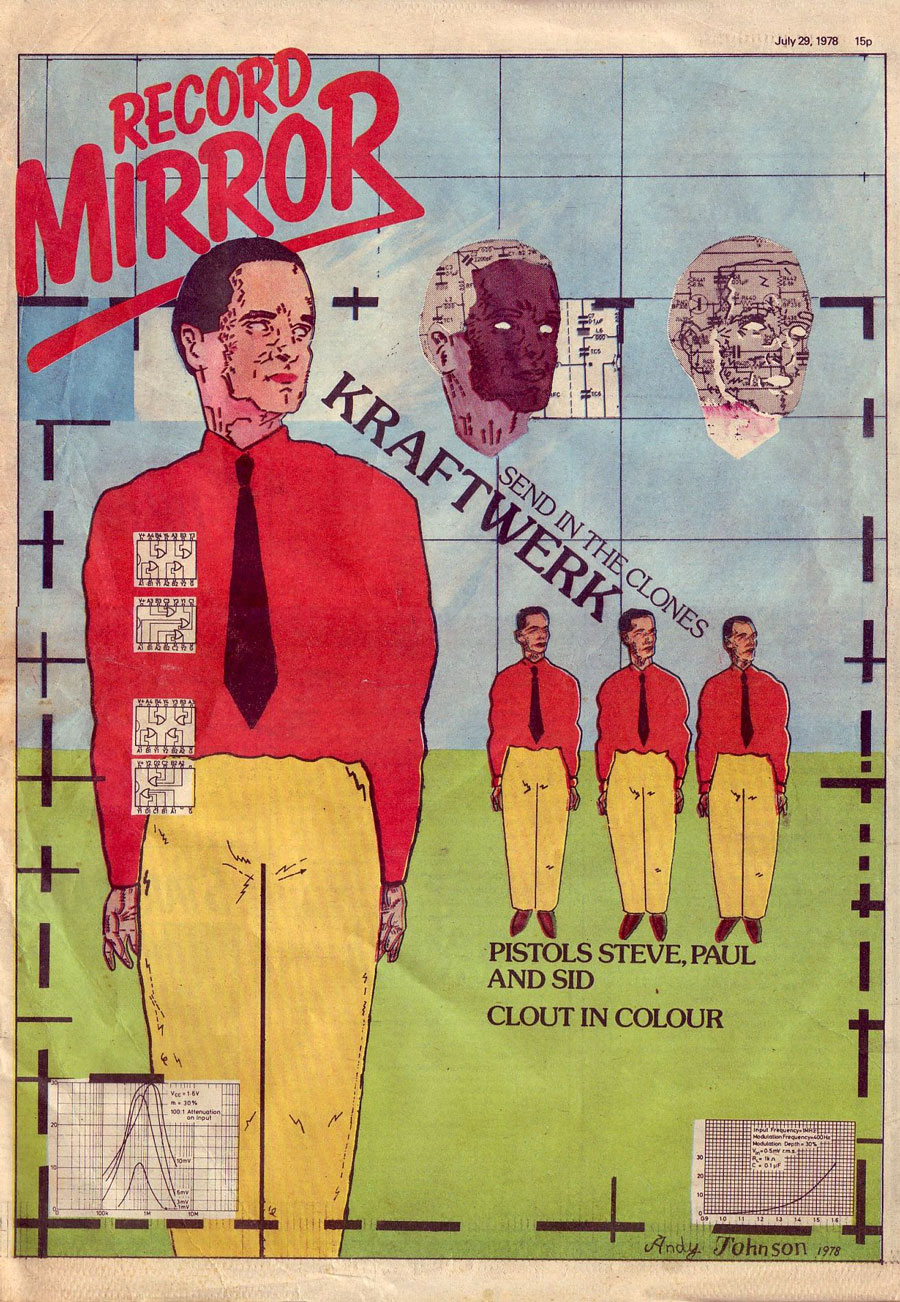
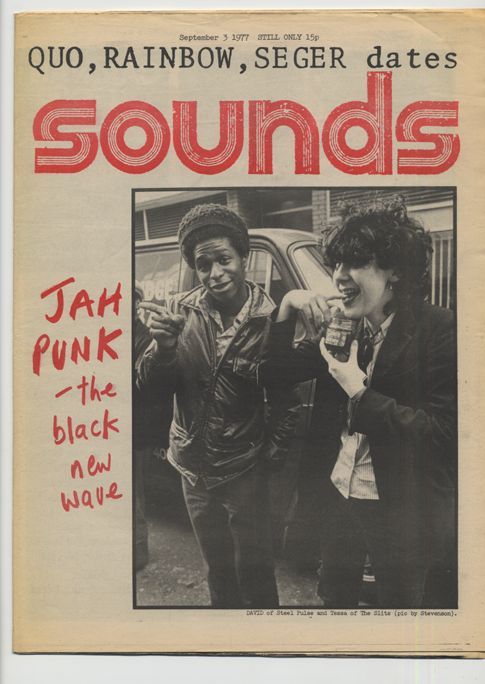
 The four weeklies were NME, Melody Maker, Sounds and Record Mirror. Echoes (sometimes Black Echoes) was a bi-weekly for black music — especially good on soul and reggae. There were several monthlies: Zigzag and Let It Rock and the superb, short-lived, much-lamented Street Life: precursors of Q or Mojo, you could say, but much much more than just this. Because — aside from the endless underfelt of free and alt.listings magazines — the music press had been where the spirit of the underground press had ended up: the brief strange countercultural spark of Oz, IT, Frendz, Ink, when late 60s youth had revolted against war and the technocracy, against racism, against timidity and prudishness, and for unfettered (yes chaotic, yes naive) expression. Writers and editors and designers — some extremely talented, but without a hope of rising far in the then-mainstream media — had crossed over out of this fervid, para-political subculture into the music press, partly because rock was the soundtrack of the counterculture, so that to make sense of rock you had to grasp the language and ideals and utopias of this teenage revolt, if only to wrangle with them, to rescue the good from the bad. And as a consequence this was a world full of curiosity about comics and cult films, liminal and radical politics, about musics and activities of communities and undergrounds from all over the world, America, the Caribbean, Europe, Africa — about everything in the world you couldn’t routinely access, which television skimped and normal newspapers didn’t remotely understand.
 Last year I ran a conference at Birkbeck, to explore some of this crossover and how it turned out, called Underground Overground: The Changing Politics of UK Music-Writing 1968-85 (scroll down for more). This year I’m running a kickstarter for a book called A Hidden Landscape Once a Week (subtitle “How UK music-writing became a space for unruly curiosity, in the words of those who made it happen”), which will anthologise extracts from last year’s panels with critical essays exploring issues raised — including the day-to-day practical backroom aspect of putting such a paper together. Panellists and contributors include Charles Shaar Murray, Val Wilmer, Richard Williams, Paul Gilroy, Paul Morley, Simon Frith, David Toop, Cynthia Rose and Penny Reel — people from a wide variety of backgrounds and perspectives and obsessions, which bohemian mix was key to the sensibility in question; “a conversation,” to quote the kickstarter blurb, “that musician, writer and reading fan all joined… a cheerful collective wrangling that echoes the crackles of dissent and tension in the songs it explores: the disputatiousness as well as the joy.” Alongside the hype and silliness, there was always a care and a fascination with possibility, with portals into all manner of other spaces hinted at in the music, and beyond it. For a decade and more, in a wider culture of stifled parochialism, this was a world of serendipity and surprise encounter. This will be a book that explores this world’s values and flaws, how it was established and maintained, and where its echoes can be found today — or rebuilt, in a very different, noisier, information-saturated context.
[ADDING: the “warring flaws” sub-head wasn’t on the piece I submitted — it didn’t have a heading at all — and only popped into my mind as I was fiddling with a framing to go here. What exactly do I mean by it (since it probably changes the tone and even the meaning of what follows)? Something like this: that what I think became dispersed — by all kinds of pressures, some extremely hard to fight — was a cast of mind in editing, which was, for a while, able to corral the impatience and rivalry and cattiness and worse that you always find among talented writers, into something unexpectedly collectively rich and generous. The mystery of where this came from — whose the design was, if design there was, and what the accident was, if it was accident — is one of the mysteries that brings me back to the subject. The Arthurian image implies that its virtues and its flaws are intextricably tangled: but I don’t know that this is actually so… ]
]]>“During the Conservative government of Edward Heath there were five declarations of emergency under this Act [viz the Emergency Powers Act 1920], by far the most any government. The first was in July 1970 over a dockers strike, the second in December 1970 over an electricians strike, the third in February 1972 over a miners strike, the fourth in August 1972 over another dockers strike and the fifth time in October 1973, which lasted for four months”
 So for last 18 months, my plan had been to launch the kickstarter for the book of the conference I ran at Birkbeck on the politics of UK rockwriting (1968-85). That’s a mock-up of the cover on the left (illustrations by the marvellous Savage Pencil): you can click on it to see a larger version, but if you don’t the title and subtitle read A HIDDEN LANDSCAPE ONCE A WEEK: how UK music-writing became a space for unruly curiousity, in the words of those who made it happen. Originally I had the kickstarter launch scheduled for May, exactly 12 months on from the symposium itself — but there were a lot of things to get ready, and, well, events intervened (it went live on Monday 27 June, just four days after the results of the eurovote sent everything in the UK into spiralling chaos). No one’s said so directly — most people have been very supportive — but if someone were to suggest it was frivolous or decadent or impertinent to be promoting such a project during such a crisis, well, I wouldn’t be entirely startled. And I wouldn’t feel they were entirely wrong.
 Despite this, I still think it’s right to carry on: and here’s why. The book will be an anthology — meaning that a variety of voices will speak (it will contain extracts from the panels on the day, with additional essays from those involved). It is a regathering of people involved in an informal, improvised cultural space that came into being at some point in the 60s (perhaps even earlier), coalescing around 1970 out the counterculture and other existing sources, some radical, some fannish — which existed in real time for some years, with ripples that continued to travel long after that. In its multiform, provocative, naive way, it was something that stood somewhat athwart the grim turbulences of the 70s, even if (from time to time) it also reacted to them and expressed them. It was about possibility, and about community: about how a community gets to define itself and to move out into the wider world.
The kickstarter is here: and what I say about it on that page is this (click through for further detail, and to support it to make it happen):
Once upon a time — for a surprisingly long time— the UK music-press was a lot more than just the place to catch up with singles or album release news, with interviews with chart-topping figures and the antics of gobby rockstars. Week on week in its heyday — the mid 60s to the early 80s — a young reader could also go to it to find out about everything from comics to cult films to radical politics, as well as an extremely wide range of non-chart musics from all over the world. Hiding in plain sight, it was the communal improvisation of ways to process an unprecedented tumult from every quarter, of new sounds and dances, startling ideas and visions all battling for attention. It took place in such high-street titles as NME, Melody Maker, Sounds, Record Mirror, Echoes, Street Life, Let It Rock, Zigzag, Black Music; but it had fermented in the undergrounds — Oz, IT, Frendz, Ink — and a significant alt/free/listings press including Time Out, City Limits, the anti-racist agit-prop paper Temporary Hoarding, and the redoubtable feminist magazine Spare Rib. As well, from the mid-70s, there was a burgeoning underfelt of fanzines, notably Nick Kimberley and Penny Reel’s legendary reggae zine Pressure Drop, plus Bam Balam, Sniffin’ Glue, Ripped and Torn, London’s Burning, London’s Outrage, Out There, and many many more.
 It would be absurd to argue that its ideals — insofar as it even understood them clearly — have come to be irrevocably enacted: incorrect, if sometimes tempting, in the late 90s; simply fatuous in the light of recent weeks, when everything that it was not has broken back hard against it. It was always fragile: a serendipity, a moment. I want to argue that it was something more. That something useful to us right now can be drawn out of it. I’m not even sure yet what this is — I have ideas, which I might write more about, but for now I just want to make it possible to re-open the conversation.
]]>“To articulate what is past does not mean to recognize ‘how it really was’. It means to take control of a memory, as it flashes in a moment of danger… The only writer of history with the gift of setting alight the sparks of hope in the past, is the one who is convinced of this: that not even the dead will be safe from the enemy, if he is victorious. And this enemy has not ceased to be victorious.”
 A few weeks back, Marcello asked if I had any thoughts on this TPL post (about, among other things, Johnny Hates Jazz and The Wire as it was in 1986/87). Well, I did and I didn’t: I did because this era of my mentor Richard Cook’s project is very much the making of me, and I absorbed an enormous amount of his sensibility and thought a lot how to advance it best (whether or not I did is for others to judge; sadly he’s no longer with us for his perspective). But I didn’t (at least tactically, for now) because I have for most of this year been organising a conference on UK music-writing in the 60s, 70s and early 80s, trying to focus on how things had evolved from roughly 1968 (and the discussion of rock in the underground press) through to maybe 1985, when (in my judgment) Live Aid hit the inkies hard sideways, and changed their political ecology for good (Geldof’s revenge, you could call it). The serious social potential of pop began to be more and more of a topic for the tabloids and the broadsheets: the inkies began more and more to fold in into their own niche, exploring less and less. In this they were reflecting changes in the world, to be sure — but they were also amplifying and accepting these changes.
Richard’s was (to me, then) the smartest part of the counter-response to these shifts — The Wire considered as a magazine about all possible music and indeed all possible ways to write and think about music, including the free play of the most scholarly anti-philistines against pop’s and punk’s cheerful teenage school’s-out yawp (not to mention a phalanx of more studied anti-music and anti-art stances). Max Harrison alongside Val Wilmer alongside Biba Kopf alongside, well, me.*
Anyway, looking too long and hard at (meaning reassessing) all this right now means not just distracting me from a rolling reassessment of the earlier era — as I chat to the various likely participants in my conference, and recalibrate my understanding of how things were — but probably undermining my entire current provisional grasp of what I need to be grasping. So for now**, you should be boiling what I am (possibly) thinking out of here (where I outline the purpose of the conference and name the participants) or here (a Facebook page you can like and also share) (share it!) or here ( tumblr with some nice pictures and also rolling thoughts on what organising a conference entails) (grief! also joy! so far much more joy luckily… )
Here’s who’s confirmed (reverse alphabetical): Val Wilmer, Richard Williams, Mark Williams, Simon Warner, David Toop, Bob Stanley, Hazel Southwell (nee Robinson), Laura Snapes, Mark Sinker, Cynthia Rose, Penny Reel, Mark Pringle, Tony Palmer, Charles Shaar Murray, Paul Morley, Toby Litt, Esther Leslie, John (aka Jonh) Ingham, Barney Hoskyns, Jonathon Green, Beverly Glick (aka Betty Page), Paul Gilroy, Adam Gearey, Simon Frith, Nigel Fountain, Tom Ewing, Kodwo Eshun.
(Not quite confirmed but definite interest shown: Tony Stewart)
 Panel topics not entirely coalesced yet but will likely include: what the undergrounds knew that the mainstream was missing; rhetorics of outsider style; the changing make-up of bohemia; handling pressures on the playpen, professional and commercial; the rock press as a species of agit-prop samizdat; and legacy and lessons today…
You’ll need to register/book here but it’s free!
*Me (that is) as in the me just today delighted to be in receipt of the intelligence that (OMG LOL) Daphne & Celeste (@Daphne_Celeste) is now following you on Twitter!
**My rule-of-thumb back in the late 80s and early 90s, on ways to ensure The Wire really actually did have the widest possible scope, was to think of it as the mini-arena in early 80s NME jostled with mid-70s MM, allowing strategic space for sensibilities like Musics and Collusion, the late 80s Village Voice (a revelation to me) and even (bcz I have never not been a bit of a goth) Zigzag.
 It was called Virtual Space and there was just one issue, “issue zero: place-kicks”. We made less than 20 copies, mostly by hunting round town for a photocopier with an A2 bed. It was an experiment, a mockup for a magazine, and it had no date appearing anywhere on its pages. (But it was early 1989, I’d just quit NME and wasn’t on-staff yet at The Wire.) We were serious: we went looking for funding. The other of the two being designer Paul Elliman, who’d just left The Wire. (Note to self: I haven’t seen Paul in an age and must call him up.)
The media momentum in the mid-80s was very much towards the elective affinity niche: people who took themselves to be anti-system dissenters* had pioneered the communication micro-cluster as a supposed zone of resistance (the indie label, the avant-garde movements, the specialist journal, the theoretico-critical discipline), but the system they declared they were resisting was actually not at all unhappy with this development. Self-balkanised geometries relocate (and quickly muffle) dissent. Freedoms of choice; freedoms of association: knowledge and intelligence arrive and evolve as a consequence — of course — of a degree of unfreedom in both choice and association. There was a knot here, a contradiction inside a conflict inside a conundrum: fuzzily but very strongly, I wanted start from the established reactive niche to push in another, much wider direction, against the encroaching self-quarantine around me; to shake up all the little comfort zones of specialisation. What would a magazine look like that covered everything, from every perspective? What would its production routines and technical shortcuts be? How would this ethos shape its editorial tactics and strategies?
(I should write this whole story up properly. Actually I have been writing it up properly, in the guise of a review of a record no one likes, including me and its makers. Read it when I finish it aka THE INDEFINITE FAR FUTURE dot dot sigh #smh)
Anyway, like Paul I too left The Wire, my project not at all finished — luckily with a few professional skills I could barter into a (much less ambitious) working life. For a decade or so, from c.2000, I had been giving a good part of my time — and surely more significantly my emotional energy — to my parents’ welfare: they were increasingly old and increasingly ill, and I owed them the best of me. Now that this duty is properly discharged, I’ve been returning to the projects of my youth, and wondering again — pretty ludicrously, given all the changes in media and how you get paid — about running some kind of magazine. Knowing full well that I have neither the resources (time/money) nor (in certain basic ways) the temperament, lessons I learnt the hard way the first time round. What should I be doing instead? The internet very much suits my temperament and habits, in good and bad ways. How can I shape these into a thing that’s useful — or anyway beguiling — for others (as I like to believe I briefly did, long ago, in the aftermath of Virtual Space issue zero, which helped get me an editorial role at The Wire).
At a minimum, I’d like to be pointing readers to the various writers that I routinely turn to, and see what transpires. If I could even get people squabbling debating in the comments-threads here, and attract traffic as a consequence of the smell of blood in the water quality of the discussion…
Have fun starting arguments? Light the blue touchpaper and lean in? No: those may have been my mottos at The Wire more than 20 years ago, but I don’t think they helpfully apply any more. Firestarting is hardly the problem on the internet: it’s how to bring together mutually inflammatory material and not set off exhausting flamewars. It’s something patiently grown-up, not something cheekily adolescent. Grown-up but enticing; catching, even. Hmmmm.
Let’s pick a scatter of who I might mean, and you the reader can do the math. Bearing in mind that my attentions will shift from month to month — I read a lot, and I likeread more a lot more than I hateread (though as you’ll see this somewhat means I merely hateread vicaroiously). I’m a magazine journalist: by definition I honour my boredom as hidden critique. If the butterfly-brained refusal to settle is the manifestation of one kind of symptom, incessant re-appearance at the same spot is another. This would be a very rough sketch of a possible ground; let’s just say that, and not pay attention to the clangour of everything that isn’t here.
• Marcello Carlin (here being nice about me). We are pals, of course. Whatever the thing is that I’m building, it can’t be hostile to fellowship or intimacy; and so must take into account the issues that can arise from this.
• Frank Kogan: here with an oldie that adverts to a tradition of writing and thinking which is not so distant from what I have in mind. Aside from the late Richard Cook, the two figures whose aesthetic I most wanted to fuse at The Wire (or clatter against each other, as a way to talk about all kinds of music) were Greil Marcus and Frank. I wasn’t really there long enough (and also hadn’t entirely had my head round Frank’s thinking, I suspect).
• Seth Edenbaum, and a PDF of a work-in-progress. In some form this should already have been a published book (for several years). As with Marcello and Frank, a friend — and I feel a slight squirmy degree of embarassment that I’ve haven’t been able to do more to draw proper attention to his work, and to him. I used to be good at this; or at least, I once briefly had a platform I hoped to do this kind of broadcasting with. Which some people remember fondly.
(Already we possibly recognise an underlying question: what is wrong with the cultural world we face, that these three are all basically outlier minds, their marginality less a function of their own often daunting rigour than of the failure of what — further up — I termed the routines and shortcuts and tactics and strategies of editorial practice and production?)
Plus some more (rather younger) names: outsider I’d guess more by choice than unspoken decree.
• Alex Harrowell, the Yorkshire Ranter.
• That Tasmanian Devil of prose Hazel Robinson (who is also my extremely close friend off the net as well as on).
• isabelthespy, writing a streak on Britney just before xmas.
And for now I’m stopping at just six. Because I’m imagining even just these guys in a room, debating I don’t know what, and I can no longer hear myself think >:D >:D >:D Though the project would certainly also include the blog I started with Tallita Dyllen, if we work out a way to encompass doing it while living in London and Beirut respectively; and any material that Victoria DeRijke writes, once she frees herself from the horrible clutches of academia. sadface emoticon.
I’d only want to do it — but do what? I literally have no idea how to realise this practicably — if it could be a space bending towards curiosity, generosity, mischief and so on. Is it doable? Is it something you’d like to see, or be part of?
]]> For a while now I’ve been wondering about the feasibility and the need for a project: which for want of a better term I’ve been calling the “co-operative archive”. When my friend Martin Skidmore died last year, his wish was that those who knew and loved him gathered at his flat and divided up whatever of his collections — of comics, records, books, art catalogues and more — that we variously wanted. It struck most of us that day, I think, that there was something more than just sad about splitting up what he’d put together so carefully, over many years: he was a highly intelligent man, a scholar, in fact, especially when it came to comics. Was there a way this archive could be maintained?
But there wasn’t time: the practicalities — where could we find to store it all? — intervened. His colleagues in the comics world were adamant that his comics be rescued as an important resource, but much of the rest, inevitably, was scattered to wherever unwanted books and CDs go.
Anyone my age, in my trade, will have experienced something similar, I imagine, when that friend passed on who’d filled his flat or house with curiosities, sometimes going back decades. And sometimes it’s a collection that’s focused and specific enough that official institutions — museums, libraries, universities — can be persuaded to take it, preserve it, make it available for future study; especially if the collector was an artist or author or anyway a “person of note” whose work will likely generate research. But these institutions are all under enormous funding pressure — public libraries especially — and what I suppose I’m getting at anyway is material that would tend to fall outside an ordinary museum’s or library’s archival remit. Or — to put it slightly more polemically — would possibly stretch the institutional or bureaucratic imagination beyond its (fund-finding) limits.
One person I chatted with was semi-seriously wondering if his large collection of obscure films taped off the telly wasn’t a resource — and of course it probably is. Yes we live in a time of apparent cultural plenty, with “everything” in instant reach — but it really ISN’T everything, quite a lot has quietly been left out of the easy-access cornucopia. And the cornucopia is only possible through quite rigorous formatting and pre-emptive categorisation, and both these can strip out historical context and (for want of a better term) the traces of social curation; the why of the original gather, the principles of use-value in the first quirky instance. And it’s the latter that nags at me: that put in mind the idea of the co-operative archive. Of some sort of resource of this kind of material, “curated” — in the sense of gathered together and kept safely, somewhere where it could be accessed when needed — in some kind of (yes, massive handwave here) crowd-sourced fashion.
The basic problem for orthodox public archiving is space: suitable buildings are expensive, and need extensive staffing. Because space and funding is limited, there’s a constant process of triage — things not being selected, things being deselected, prey to exactly the streamlining decisions, about value to the public and such, that will cull the material I’m imagining being archived. My tentative proposal is what’s already having to happen be what’s further encouraged and enabled: that these collections, though they have to be dispersed physically, will be moved into spaces owned by friends, colleagues, admirers, and looked after there.
But they will all also remain linked on a centrally maintained database: which contains details of the original collector, what’s being held and where. The masterlist of items would be public searchable and accessible — the specific details of where held perhaps to subscribers, along with message-boards for information exchange and discussion, and potential for enquiry and suggestion — ways people can be put in touch with one another. There’d be a cost to maintaining it, certainly — accurate inputting is dreary and timeconsuming and should be appropriately reimbursed, but this cost is nothing to the problem of housing the material. There’d be issues of security for some items perhaps — though the point I’d stress here is that this is largely (by self-selection) material which has value in the setting provided, but very little once split away from it.
Could this be kickstarter-funded? Would it be a charity? How would it work? Could it work? Does it already exist? What haven’t I thought of? Who would be interested in participating? Do people know of material that might fit this? (Tell me in comments!) I see it as a map of eccentric passions, a crowd-sourced network of minor wunderkammern — inevitably incomplete, partial, skewed towards the relevant interests of those likely to become involved (the self-documenting classes?) but this would be a strength rather than a weakness. Not excluding records or books or quite ordinary items, if there was something interesting about the mind behind the collection, and that mind’s world, that’s apparent in the collection. Is there something to this?
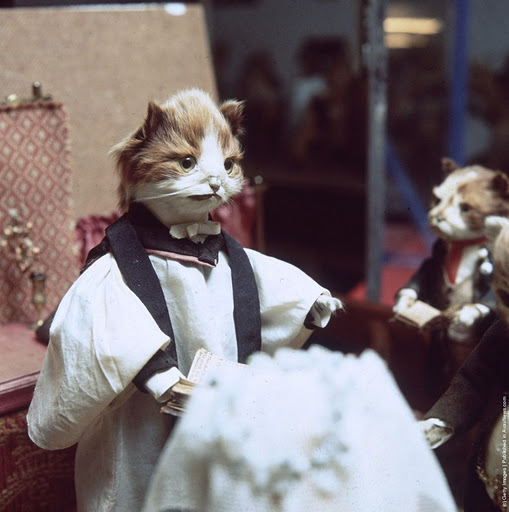 (Kitten’s Wedding (detail), from eccentric Victorian taxidermist Walter Potter’s Museum of Curiosities: my friend Dr Vick took me to this in Cornwall a few months before it was closed, its items unexpectedly split up and sold off — Damien Hirst had wanted to buy the whole collection and keep it in one piece, but for reasons both melancholy and unclear this didn’t happen.)