(behind the clean door)"]]>
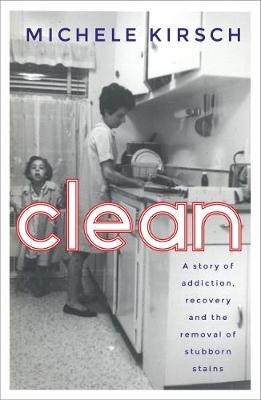
Reviewing “Clean –– One woman’s story of addiction, recovery and the removal of stubborn stains”, by Michele Kirsch (Short Books, ISBN 978-78072-381-5)
Several years back I was grousing to a pal about a new book by a clever and successful mutual acquaintance, a history that encroaches on territory I had one day hoped to stake out (but of course I have done nothing about this, since my pop timing is always terrible). My gripe is this: music writers endlessly re-interview the wrong people — or more precisely, never enough of the right people. Revisit the original moves and shakers and they mainly double down on what went over well the first the time, especially conceptually. Which is the way a moment of open possibility get congealed back into cliché. “If you want to know what a radical scene’s actually about,” I airily declared to my chum, “you should talk to the club’s hat-check girl.”
(The book in question did extremely well critically and commercially –– presumably because its targeted readers knew better than me what they wanted to read about this particular radical scene… )
Anyway, what’s valuable and lovely about Michele Kirsch’s Clean, I think, is how little attention it pays to the various movers and shakers she’s encountered, as a music writer in the 80s and after –– and how quite early on it turns out she WAS a hat-check girl, at a happening Boston punk club. As well as working in shops, on a switchboard, as a supply teacher, and latterly (per one meaning of the title) cleaning the flats and houses of exactly the kinds of comfortably successful people that pop stars and music writers mostly aspire to be (and now and then succeed). They stay largely off-stage as Michele tackles the grime in their very varied bathrooms, as anonymised sketches punctuating the narrative.
Which is instead an unsettling tale, deceptively wittily told, of unremitting anxiety since childhood, of grief as an unreliable lodestar, of industrial quantities of prescription Valium sometimes amplified by alcohol and other drugs –– and how (per another meaning of the title) you should quit all this, if you can. Since I first knew her 30-odd years ago, Michele has been a writer from her core to her fingertips –– and yet as an autobiography it’s not really about this at all. It begins with her childhood and youth, but says nothing of what she was reading then, or when she first picked up a pen, always pushing back into messier spaces, the ones often kept tidied away behind the pleasant nods to inspiration and aspiration. Around the time of the London Olympics, her decades as an addict had finally pulled both her chosen profession and a pleasant family domesticity out of her reach –– and the book’s framework is her learning to make a minimally liveable living as a cleaner.
At the NME in the mid-late 80s, Michele wrote funny, lively stories that arrived from odd angles –– odd because (to get them placed at all) they generally began life as this week’s promo pretext: pop stars (amusing, difficult, even –– whisper it –– dull) and what as writers we could make our tales of time spent with them. There was a tension here, and thus the chance to discover something about the forces shaping our world. And NME then still just about held a space open for anomaly, for curiosity, for voices and approaches not yet professionalised or routinised or market-narrowed out of their own sense of the shape of the world.

But this space was closing. Magazines were increasingly run by badly formed surveys about what readers felt they liked to read. And as writers and editors we had little idea, most of us, how to resist the pressures this created. By the late 80s, Michele was writing a column called ‘Mama K’s True Stories’ and it was of course terrific. And not like anything else at the time, at least in the UK (somewhere I have a folder full of cuttings from it). This was in the London listings magazine City Limits, a haven for the denizens of the closing space –– if anything under even more pressure to submit to market forces, to be more saleable than awkward, to drop what it had been (which had mattered so much) and to become what idiots thought it had to become.
Jump now to 1992: I’m re-fashioning The Wire from my predecessor Richard Cook’s template, into the kind of magazine I felt could survive without losing what had been so valuable. I got some things right –– the magazine did survive, and still does –– but why did I not see that ‘True Stories’ (which I loved!) fitted perfectly into this ambit and project? I wanted a greater diversity of writers! City Limits was in death spiral, there was much personnel overlap –– why didn’t I pick up the phone and ask Michele if she wanted to relocate? (We likely paid even less than CL, mind you… ) [Footnote 1]
Thinking this through (rueful and shamefaced that I didn’t realise before beginning this review) I realise it’s still a matter of what’s so good about this book, which was then much harder to see clearly (certainly harder for me, but surely not just me). And it goes back to congealment and concealment, who does what in the undiscussed spaces, what gets foregrounded and what gets left out when you’re making an argument in favour of something. Music is something Michele loves and knows about and finds invaluable in her life, and so what she writes about is her life. I was at that time mainly gathering writers who approached music as a series of battles (or as some would say, a history) of competing theories of value, popular vs vanguard vs past vs future vs rock vs rap vs jazz vs noise vs niche vs vector to the totality blah blah blah. Michele seemed untroubled by the routinised feuds and grand historical-definitional UK music-mag controversies of those times, at least in the usual feuding-freelancer-elbows-for-mannerist-space kind of a way — and this is exactly why I loved her writing. I wanted a mini-world in which less armoured voices could hold their own course, to thrive as an irreplaceable part of the whole, as respite from all the dramas of the central cultural cockpit and the theory-divas fighting for the largest slice of the attention available…
But such spaces and such voices are by nature and inclination tricky to weaponise, which is to say tricky to monetise –– and back then I wanted the battles at The Wire on the page (because I felt many of them were being crowded off everyone else’s pages) and also I wanted The Wire not to be losing so much money (lol). Obviously I’m delighted and gratified the magazine still with us — not least as a platform for small scenes that also just scrape by, as times get ever-tougher and spaces elsewhere just carry on blinking out. But all the available media models back then were flawed and flimsy, precarious and unsustainable, and they were all also about to get worse –- three accelerating decades of worse, seriously. The settlement some of us made with this –- the names some of us made -– came at a cost. There was no safety net and there were casualties…
… and by the time of the 2012 Olympics the comfortably successful people mostly left off-stage in this book are having their houses cleaned by those without voices, mostly, and without page-count. Those who found themselves slipping away back downwards after all [2], and those who never saw a way they’d be allowed up: who, trapped from the outset, never entertained ambitions professional or artistic, or set themselves transformative goals. There’s a tension often unexplored in the more stridently meritocratic versions of the tale of those who make it out (or back out, for rehab lit): that to reach the best realisations of yourself as author or artist, you’ve had to leave something behind and lock someone out. And so there’s a guilt alongside the relief –- and in fact a guilt either way. Because if your own flight is unsuccessful, you’re a failure too. These are the corrosive dooms we are constantly asked to internalise, the ideological impositions few entirely free themselves from.
What makes Kirsch such a funny writer is that just these conflicts play out as a kind of lucidly evasive dizziness, a constant misapprehension that’s very (as the internet would put it) “relatable”. She blames no one but herself for how things turned out, and makes a terrific comedy of self-deprecation: spaces left looking worse for her attempts to clean them, things she turned her hand to (professional journalism, parenting) as an obstacle race of absurdist unsuccess. It’s all often also an apology — to family and friends, most of them unnamed — and it’s charming and it makes you laugh, even the tough parts, and her voice remains light and clear, and this is excellent. But not everything in it needs any apology.
As one of the most readable of narrative forms, the classic puritan autobiography sees the present coinciding with the redemption, the means of rescue: we move through and down into the catastrophe, and back up out again. But despite a lightly skirted 12-steppish pass into religion, the redemptive circle in Clean doesn’t quite close — this is not that kind of autobiography. The most rewarding community way-station in her quest towards sobriety is when she becomes a cook in a little local East End café: the fond way this is described lets us know that Kirsch knows that re-arriving as a cap-W Writer is not going to be on a par with this, reward-wise.
The shadow-side of Kirsch’s journey has been a succession of jobs that mostly can’t be careers: hat-check girl, shopgirl, switchboard girl. And there’s a dismissive feel to this list (as I make it) precisely because they’re jobs that often go unnoticed, the stories historians too often don’t ask about. In this book, they take place within hat-checking distance of the movers and shakers we pay most of our attention to, to write about and argue about — and when youth and tactical dizziness hadn’t shut off any of Kirsch’s future mobility, across the counter as it were. You can line them up as “girlish” — as if this means impermanent or ornamental or frivolous — even as you conspire not to spot when they become the whole of the hard livings some have to make, and much too much of the life some have always to live. Even in the late 80s, such mobility still seemed plausible –– and writers still shared an impulse to be keeping doors open, or anyway to share glimpses of what this might still mean. But what if personal transformational achievement only takes decisive shape when the doors are closed? Your inspirational, aspirational triumph is only a broader political or a moral triumph if you can bring with you the best of what made you. The gentle strength of this book is the sense it leaves us with, of the caked-on dirt behind our sense of lifesaving self-rescue, of where the slamming doors may be, of what’s on the other side that we should never be forgetting…
FOOTNOTES:
1: For a recent reboot of Mama K’s True Stories, go here
2: At the book launch for Clean, I was told — to my great sadness — of the likely death last year of another colleague from back in the still-open days. I won’t name them because the internet doesn’t yet confirm the news, and I very much hope it’s untrue. The fact they’re more or less invisible on the internet is part of the story, though.
[If you like this post, please support my PATREON which will help me write more! Also let other people know that you think might enjoy it… ]
]]>(I wrote this up to place somewhere grown-up and get some traction, but no joy for one reason or another — the Camelot theme not entirely inapposite, esp.if you’ve read The Once and Future King. Kickstarter is still and closes Wednesday 27 July at 4.26pm UK time.)
We have an idea of the UK music press in the 70s — a notion of great names engaged in earthy debate about rock and pop, of fearless mockery of foolish or pretentious stars, of a generation of self-taught giants walking the earth in those golden black-and-white days. We can list names: Murray and Kent, Parsons and Burchill, Penman and Morley, Danny Baker, Garry Bushell, Jon Savage… With satisfaction (or amusement), we note that some of them have clambered up to the sustainably rewarded end of public chatter — which if nothing else suggests that their first professional gigs must have been an effective proving ground.
 It’s a picture distorted with hindsight, though. At the time, it was for the most part a much wider, quieter, almost invisible world. A cluster of titles that you engaged with as an intense subcultural doorway away from the routines of life: yes, there’d be a pop-star on the cover, major or rising or weird, but inside… well, inside you found all kinds of things. It reached a lot of people — sometimes as many as a million a week — and, unlike official culture, it didn’t shut them out. As writer-agitator and one-time label boss Liz Naylor puts it on one of the promo vids, “It was very difficult to access information in the 70s! The music press was my education…”
 The four weeklies were NME, Melody Maker, Sounds and Record Mirror. Echoes (sometimes Black Echoes) was a bi-weekly for black music — especially good on soul and reggae. There were several monthlies: Zigzag and Let It Rock and the superb, short-lived, much-lamented Street Life: precursors of Q or Mojo, you could say, but much much more than just this. Because — aside from the endless underfelt of free and alt.listings magazines — the music press had been where the spirit of the underground press had ended up: the brief strange countercultural spark of Oz, IT, Frendz, Ink, when late 60s youth had revolted against war and the technocracy, against racism, against timidity and prudishness, and for unfettered (yes chaotic, yes naive) expression. Writers and editors and designers — some extremely talented, but without a hope of rising far in the then-mainstream media — had crossed over out of this fervid, para-political subculture into the music press, partly because rock was the soundtrack of the counterculture, so that to make sense of rock you had to grasp the language and ideals and utopias of this teenage revolt, if only to wrangle with them, to rescue the good from the bad. And as a consequence this was a world full of curiosity about comics and cult films, liminal and radical politics, about musics and activities of communities and undergrounds from all over the world, America, the Caribbean, Europe, Africa — about everything in the world you couldn’t routinely access, which television skimped and normal newspapers didn’t remotely understand.
 Last year I ran a conference at Birkbeck, to explore some of this crossover and how it turned out, called Underground Overground: The Changing Politics of UK Music-Writing 1968-85 (scroll down for more). This year I’m running a kickstarter for a book called A Hidden Landscape Once a Week (subtitle “How UK music-writing became a space for unruly curiosity, in the words of those who made it happen”), which will anthologise extracts from last year’s panels with critical essays exploring issues raised — including the day-to-day practical backroom aspect of putting such a paper together. Panellists and contributors include Charles Shaar Murray, Val Wilmer, Richard Williams, Paul Gilroy, Paul Morley, Simon Frith, David Toop, Cynthia Rose and Penny Reel — people from a wide variety of backgrounds and perspectives and obsessions, which bohemian mix was key to the sensibility in question; “a conversation,” to quote the kickstarter blurb, “that musician, writer and reading fan all joined… a cheerful collective wrangling that echoes the crackles of dissent and tension in the songs it explores: the disputatiousness as well as the joy.” Alongside the hype and silliness, there was always a care and a fascination with possibility, with portals into all manner of other spaces hinted at in the music, and beyond it. For a decade and more, in a wider culture of stifled parochialism, this was a world of serendipity and surprise encounter. This will be a book that explores this world’s values and flaws, how it was established and maintained, and where its echoes can be found today — or rebuilt, in a very different, noisier, information-saturated context.
[ADDING: the “warring flaws” sub-head wasn’t on the piece I submitted — it didn’t have a heading at all — and only popped into my mind as I was fiddling with a framing to go here. What exactly do I mean by it (since it probably changes the tone and even the meaning of what follows)? Something like this: that what I think became dispersed — by all kinds of pressures, some extremely hard to fight — was a cast of mind in editing, which was, for a while, able to corral the impatience and rivalry and cattiness and worse that you always find among talented writers, into something unexpectedly collectively rich and generous. The mystery of where this came from — whose the design was, if design there was, and what the accident was, if it was accident — is one of the mysteries that brings me back to the subject. The Arthurian image implies that its virtues and its flaws are intextricably tangled: but I don’t know that this is actually so… ]
]]> Quite apart from anything else, the past — even the very recent past, maybe especially the very recent present — is a mass of detail that’s hard to take in and process (not least because you have to push away the immediate present to do so). My conference produced a little over 12 hours of conversation in one large (often quite hot, by the end quite airless) room, and the discussion has continued elsewhere, in nearby pubs or bars after the two days of debates; also here at ilm, here at Freaky Trigger, and here and here on tumblr. Resonance 104.4FM broadcast it nearly in full on 25 May and have put the eight extracts up on their mixcloud site here (I don’t know how long for).
If I say the commentaries so far have been partial, I mean three things. First, that several of the commentators (Tom Ewing and Hazel Southwell in particular) are very good friends, co-conspirators even; they’re partial to me! Second, that with a couple of exceptions, almost no one commenting attended the whole thing: I actually agree with plenty Laura Snapes says, but she was only in attendance for her own session; purely as a description her account can only reflect that final 100 or so minutes (and the fact that she definitely had the pointy end of the Q&A, in the jaded final minutes of a long tiring day). And third, so much seemed to be touched on over the two days that wasn’t pursued, as is the nature of these events; certainly it’s going to take me a long time to dig down into what I actually now feel, less about the conference than about the era it claimed to explore, what this era meant and means, and why (or indeed if) it still matters at all. On the whole, I’m enormously pleased with how it turned out, just because I think such a lot has been gathered together and set down for future scholars and scoundrels to play with. (Transcripts of the panels are to be gathered into a book along with further memoir and commentary by those who attended and those who couldn’t: this is the plan, anyway. Though I’m taking a bit of a break first.)
Here’s an extract from the report I wrote for Birkbeck:
Underground/Overground:
The Changing Politics of UK Music-Writing 1968-85
This was a two-day symposium (15-16 May) at London’s Birkbeck Institute for the Humanities, consisting of panel discussions and Q&As. Run by Mark Sinker, former editor of The Wire, it brought together writers, editors and readers of the underground and trade music presses of the 1970s and 80s, to explore their own experiences academics and other media commentators. The first day looked at the period when UK rockwriting emerged out of the conflict between a rising generation’s counterculture and the embattled establishment in the late 60s and early 70s. Through the witness testimony of participants, and the overview of historians of the era, panels examined the evolution of a critical outsider voice in the UK, as inflected through the rock papers between these dates. We learned what the underground press felt like to write for, how the mainstream press responded to rock music and its social penumbra, and how the trade press reached out for some of these writers — notably Charles Shaar Murray, who had written for the notorious schoolkids issue of Oz as a schoolkid — and what it was like moving over to the trade press. We heard from those in the editorial backroom about what it felt like being on a weekly responding to stories in pop and politics, how decisions were made and what the pressures were: Cynthia Rose noted that this was a time when striking miners’ wives from Kent came to the NME office to discuss stories run on them.
On day two, we heard more from voices outside these offices and these times, as a kind of counterpoint to the more canonic stance perhaps established on the first day. Val Wilmer, a veteran of the music papers in the 60s, recounted what it was like as a woman — in the very male milieu of jazz writing— bringing back stories from the radical black underground. There was a panel exploring punk’s often difficult relationship to the underground that helped birth it, and another on those constituencies not so well served by the music papers at this time, looking at black music and dance music especially. Finally a somewhat turbulent panel attempted to answer the tricky question of legacy — how much does this history help or even affect writers today?
In the course of the two days, we heard from well known voices but also from people who have not often had the chance to enlarge on their perspective. An enormous amount was touched on that will be of interest to scholars in various fields, from popular music and media studies to sociology and political aesthetics. Some myths were exploded, others perhaps further entrenched.

One thing I always hoped to do as an editor — and it turns out being a conference runner is not dissimilar, in its joys as well as its frustrations — is to bring voices together that didn’t normally get converse in the same space: as at The Wire in the early 90s for a couple of years, so at Birkbeck in mid-May 2015 for a couple of days. In both cases, I was especially keen — as discussed in this earlier post — that the past and the present creatively encounter one another, perhaps on slightly different terms than they do ordinarily, in music-writing or anywhere else. So as well on critical writing on the various contemporary streams, rock and pop and soul and rap and dance and the electronic avant-garde, blah blah blah, I following my predecessor Richard Cook in deliberately encouraging contributions from the best voices from the old guard, voices talking about (at that point) some 70 years of jazz, and some nine centuries of composed music.
Did I succeed? At the time I thought no: I felt that this particular exchange, between the best of the present and the best of the past, was still a dialogue of the deaf. Few in the various territories I was yoking together seemed at that time curious enough to explore the interests of rivals sympathetically or insightfully. And of course in practice The Wire had a super-tiny budget, and our bat-signal was primarily attended to by those with nowhere else to go when they wrote on x or y, the high quality of their commentary notwithstanding. Writers who are experts in their own specific (sometimes small and embattled) fields tend to hunker down and play defence when they encounter enthusiasts for very different fields and tendencies and perspectives.
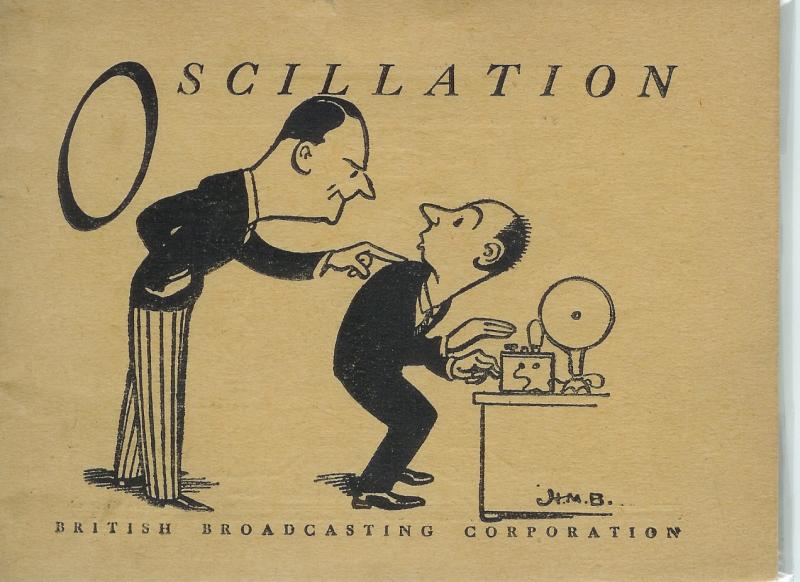
Then again — for this or other reasons — I wasn’t editor for very long. Because the ways to combine the perspectives, or use them creatively against one another, are generally worked out by readers, not least when or if they in turn become writers a few years down the line. An editor’s job is ultimately — in various different ways — to be a kind of idealised reader. And one element of this ideal is the plain fact that readers can enjoy a piece by one writer, and get a lot from — then turn the page and do the same with the first writer’s mortal scornful foe. From the thread discussion that hangs from Tom’s FT review, a theme emerges that I absolutely recognise, summed up by a useful word that hadn’t occurred to me: “oscillation”. Just in the territory the conference covers (but also in my conception of the role of The Wire in the early 90s), there seem to be a proliferation of essential oscillations between this or that or the other opposed cultural ethos*. Not just the way rock rubs against jazz on one side and pop on the other, and punk likewise; not just (as Frank Kogan notes on the FT comments thread) the way critical journalism rubs against investigative journalism, or the way that both rub against history; not just my overall theme of underground and overground, and how inside track and outside pressure work against one another; but the ancient uneasy dances of music with noise, and of order with desire; and of course of age with youth… If “1968-85” is my shorthand for the era of the self-consciously all-encompassing ‘outsider’ magazine [adding: in the UK] — “1968-94” only if you include Richard’s and my time at The Wire — then this is the era when technology and happenstance combined to fashion a clustered territory where readers were encouraged to enjoy and think about conflicting things; to move backwards and forwards between stances and traditions, in and out of close-read trust as they turned pages.
The potential of this world arose from the richness of this dividedness: and the refusal of any of the divisions to map simply onto the economic or racial or gender seperations and hierarchies that structure the larger world. And underneath — or above? — all these is the refusal of the not-quite division of music from the spoken or written world to settle into anything easily summarised, whatever the fashionable pressures of niche-marketing at target demographics. On one hand, all the splintered and shifting currents of music present a map of the real in its infolded complexity; on the other, there’s no music that doesn’t also manifest as a rhetoric of potential utopian togetherness: on one hand, there’s just the fact of the unpredictable constituent shape of any gathered crowd at any show; on the other, the potentially mutable readability of music itself, its last-instance combination of concrete sensuous quiddity and, well, untranslateability. We may occasionally agree what the words of a song mean, but all we can actually agree we agree on in the bits of music that aren’t words (i.e. re the meaning of this harmony, that chord change, this blue note, that grace note, this fill, that grunt…) is that we likely don’t agree. That’s the point: we’re gathered here together in part because we like that we won’t read it the same, and that’s the fun and the risk.
(Unlikely and probably unsustainable analogy: the Bible shared in a shared language you mostly didn’t understand enabled religious unity; however — and Lollardry notwithstanding — the Bible translated into a shared language you DID understand meant a splintering into warring sects…)
The panel I was secretly most pleased to have convened — because it dug into the kinds of backroom work that people who never worked in print-age newspaper or magazine offices rarely understand, however closely they’ve read the output — was the final one on Friday, which Tom ran: The encroachment of professionalisation on a generational playpen — What were the pressures in a music paper’s editorial office, and what was the potential? Half-joking about the working conditions, Cynthia Rose used the term “plantation journalism”: the papers themselves were really make a LOT of money, but little of it reached the editors and stringers, hired to deliver a Stakhanovite output day after day (these were cheaper times to live, for sure, but there was still no margin to put by even a penny of every pound you earned). Tom reaches for a rather different metaphor: “… [T]he sense of the work on an underground or weekly mag – the circus of sheer effort involved in bringing the bastard to land each week, that was grand to hear about, like a hundred years ago you might have heard men talk about life on a whaler…” This was a small, shared world, baffling and perhaps worse to those who come long after, beleaguered by surging pressures but united by task into intense group loyalty, its reward mainly a very local prestige, with (lurking at once just over the horizon but also, unmentionable, within the crowded quarters) the terrific Moby-Dick shaped leviathan of, well, what, exactly? The implicit politics of the craft of this long-vanished music-writing worldlet?
There are plenty of other very smart things that could be quoted in that thread. But this is me writing, so right now instead I’m going to quote myself, because I think this is relevant: “We live in a time of extremes of proximity, not just between cultural blocs formerly more safely distanced (or so it seemed, in the metropole), but also between present and strong representation of elements of the past […]: I think negotiating these proximities has become a *lot* more perilous, but we actually do have to negotiate this situation (and not just wish it away as a symptom); which inevitably means become expert in far more things than we perhaps formerly believed we signed up for.” The internet has collapsed distances, and not just between the many militant faiths and political stances as they exist in the once-wide world today: we are more than ever, every day, hard up against idealised echoes of the past, and more than this echoes of various rival idealised pasts, making very strong demands on us. We castigate those who wish to return us to such-as-such a point in the past — arguing (generally correctly) that they have no strong sense of what it was actually like — and then we turn round and lament that such-and-such an organisation or institution is not what it was, and will only return to relevance when it rediscovers and reanimates its earlier principles and purpose. At which moment, others naturally castigate us. In other words, how we address and draw from the past is as live and tricky an issue as it’s ever been: even “where’s that jetpack I was promised!?” is an appeal to a past mode of futurism. As time passes, revolutionary purists more and more become original-intent reactionaries: one thing we ought to have learned from punk is the inextricable tangle that year-zero vanguardists get themselves into as they thrust us to the future: “rip it up to start again” is an intrinsically conflicted demand…
A conference organised to cover 1968-85 can (just about) get away with being eight panels and roughly 30 people: probably not representative of those involved, but not quite out of sight of it. As Hazel said to me at some point, how would you even begin to select people represent the last 15-odd years? You’d need 20 panels with 50 people on each. An ocean so full of vessels, and indeed wrecks of vessels… In their physical and structural make-up, the seas we sail have changed utterly. To quote myself again (this time from a 2009 essay for a collection on Afrofuturism that rather irritatingly still hasn’t appeared: A Splendidly Elaborate Living Orrery: Transplanetary Jazz: Further Thoughts on Black Science Fiction and Transplanetary Jazz):
With the internet, the discursive cosmos can seem inverted, matter for emptiness, emptiness for matter: a multitude of isolated geocentric bubbleworlds, planets and asteroids dragged into their neutron gravity, the heavens become a dense, grinding press of shattered astral matter… Encounters are still possible: to tunnel to this or that bubble isn’t rocket-science. But no gorgeous sunflare or night glow through velvet dark to call us, magnets to the romantic eye all broiled to cinders. And history — that painstaking reconstitution of real-time fragments — seems harder than ever. Stargazing has become a shuttered archeology of the hardscrabble crystalline sky.

A friend who sat though the whole thing, both days, described it afterwards as being the tale of a long battle utterly lost. And half of me sadly says yes to that; and half of me stubbornly thinks no. In practical terms, of course we can’t reinvent the music-press of the 70s and early 80s: it was never less than a curious serendipity, a confluence of a great many unrepeatable things; it was rooted in technologies that no longer exist and a society that has very much mutated. As a format, it was as highly unstable as it was path dependent: it didn’t make much economic sense, and very few writers made their fortune from it (a few made their fortunes escaping from it). Maybe for a while it was possible for a select few, with the right gifts but also the correct attributes, to make an inexpensive living from it (which I never did; my entire working life I’ve made my living basically correcting other people’s spelling). Many many people were unable to break into that select few — I made a point of inviting some people who were outsiders at the time, even if they momentarily had their foot in the door; who don’t ordinarily get to join in the retrospectives. There’s no dearth of good writers today, that’s not the problem at all (OK don’t get me started on good editors). But we haven’t found a way of making the current set-up pay for itself, in a way that’s remotely fair to the majority of the writers battling their way through it.
But it was also always after all a tale of the belief in the benefits that accrue by unleashing the unlettered urchin glee of the young on the wider world — on cultural legacies till then beyond their ken — and then battling with the problem of how things fell out when this wider world, as it always did and always will, began (a) to return the not-unpoisoned compliment, and (b) to include the past. As for (a), the urchin cheek now flows both ways, and now and then respectful tact flows with it also, and the two are needed, going in both directions, for adult relationships to survive that that aren’t lifeless or toxic reverence.
 But (b) is much tougher to trust in — the past only ever has unbiddable parity when it manifests as a stony unchanging weight, the return of the dead as a forbidding monument. Yes, perhaps the designated crew can journey out to it the way we did with Afropop in the 80s or KPop over the last few years, with care as well as insolence, with fannish fascination as well as straightforward well intentioned inquisitive ignorance — but with Afropop and with KPop at least there was potentially a case that a similar counterflow might push back, to challenge the errors and rude liberties taken. That the implicit problem of “who’s this WE, white man?” could one day dissolve or transform in the encounter, to everyone’s benefit. But how can the past push usefully back in like fashion?
Journalism, including cultural journalism, is of course primarily about the now — it’s called NEWS for a reason. And part of working out what’s actually significant now includes a recognition of the relevant force and quality of the various flows. I’ve paid tribute to these music-magazine and weekly paper offices of long ago because — by the serendipity of the times — they saw a coming together of writers and editors from very different backgrounds, responding to very different calls. And that’s part of the complex, contradictory weave that I value, or mourn, if that’s the appropriate word. But now I think of it, the best of the writing exhibited the same characteristic: every writer’s indiviudal style that I admire from then (and also now, because this hasn’t vanished) was and is a crackling codeshifting weave also, of threads that come from very different sources. (Because good writers are always readers, and these were always wideranging readers, and listeners too…)**
And as codeshifters get older, their involvement to history — the one I’m obscurely worrying at throughout this rambing post — of course grows in and out of their relationship to their own youth; to their memory; to the values they set out with long ago; all this is bound into what they do and who they are. And some people settle into this badly, because they can shift themselves into a place of comfort and shallow complaisance. And others, well, others find they’re always already been embedded in a world that has cultured such negotiations and such oscillations reasonably effectively: they maintain curiosity, self-awareness, self-irony, amusement, kindness, anger, the ability to manage simultaneous contradictory status and pressure and pull. The trapdoors and the timebombs, they’re coded right into us, if we know how to listen — and of course we learn to listen to our inner pirate crew by learning to listen to others; others often not at all like us, insofar as we’re even like ourselves. How we address the popular, how we prioritise the semi-popular, how we respond to the unpopular or the plain unknown, these are ever-more linked into our relationship to the past, recent or deep: and this is not going to change; if anything it’s going to intensify.***

*The world seems to be divided on what a correct plural of the noun ethos is: ethe or ethea or (the incorrect but greeky) ethoi or (the anglicised but silly) ethoses. In the mood of the moment, I choose to take this to be telling…
**I’m going to defend the mixedness of this overall metaphor as further evidence of what it is I value: gallimaufry, salmagundy, macaronics: pie itself gets its name from the mixed jumble of items found in a magpie’s nest…
***There’s a peril in dredging up the carcasses of the vessels of the past, and probably more than one, especially if you do it collectively. Collapsed across the treasures you hoped to re-acquaint yourself with is the bony evidence of crimes you’d hoped perhaps to forget, and so on. But the discussion of all that is for the future, now, when the book starts to be made. For now, I want once again to say a powerful and heartfelt THANK YOU to everyone who participated and attended, and advised or helped in ways large and small. It was what it was, and what it’s going to be, who can say?

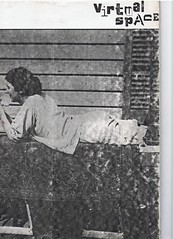 It was called Virtual Space and there was just one issue, “issue zero: place-kicks”. We made less than 20 copies, mostly by hunting round town for a photocopier with an A2 bed. It was an experiment, a mockup for a magazine, and it had no date appearing anywhere on its pages. (But it was early 1989, I’d just quit NME and wasn’t on-staff yet at The Wire.) We were serious: we went looking for funding. The other of the two being designer Paul Elliman, who’d just left The Wire. (Note to self: I haven’t seen Paul in an age and must call him up.)
The media momentum in the mid-80s was very much towards the elective affinity niche: people who took themselves to be anti-system dissenters* had pioneered the communication micro-cluster as a supposed zone of resistance (the indie label, the avant-garde movements, the specialist journal, the theoretico-critical discipline), but the system they declared they were resisting was actually not at all unhappy with this development. Self-balkanised geometries relocate (and quickly muffle) dissent. Freedoms of choice; freedoms of association: knowledge and intelligence arrive and evolve as a consequence — of course — of a degree of unfreedom in both choice and association. There was a knot here, a contradiction inside a conflict inside a conundrum: fuzzily but very strongly, I wanted start from the established reactive niche to push in another, much wider direction, against the encroaching self-quarantine around me; to shake up all the little comfort zones of specialisation. What would a magazine look like that covered everything, from every perspective? What would its production routines and technical shortcuts be? How would this ethos shape its editorial tactics and strategies?
(I should write this whole story up properly. Actually I have been writing it up properly, in the guise of a review of a record no one likes, including me and its makers. Read it when I finish it aka THE INDEFINITE FAR FUTURE dot dot sigh #smh)
Anyway, like Paul I too left The Wire, my project not at all finished — luckily with a few professional skills I could barter into a (much less ambitious) working life. For a decade or so, from c.2000, I had been giving a good part of my time — and surely more significantly my emotional energy — to my parents’ welfare: they were increasingly old and increasingly ill, and I owed them the best of me. Now that this duty is properly discharged, I’ve been returning to the projects of my youth, and wondering again — pretty ludicrously, given all the changes in media and how you get paid — about running some kind of magazine. Knowing full well that I have neither the resources (time/money) nor (in certain basic ways) the temperament, lessons I learnt the hard way the first time round. What should I be doing instead? The internet very much suits my temperament and habits, in good and bad ways. How can I shape these into a thing that’s useful — or anyway beguiling — for others (as I like to believe I briefly did, long ago, in the aftermath of Virtual Space issue zero, which helped get me an editorial role at The Wire).
At a minimum, I’d like to be pointing readers to the various writers that I routinely turn to, and see what transpires. If I could even get people squabbling debating in the comments-threads here, and attract traffic as a consequence of the smell of blood in the water quality of the discussion…
Have fun starting arguments? Light the blue touchpaper and lean in? No: those may have been my mottos at The Wire more than 20 years ago, but I don’t think they helpfully apply any more. Firestarting is hardly the problem on the internet: it’s how to bring together mutually inflammatory material and not set off exhausting flamewars. It’s something patiently grown-up, not something cheekily adolescent. Grown-up but enticing; catching, even. Hmmmm.
Let’s pick a scatter of who I might mean, and you the reader can do the math. Bearing in mind that my attentions will shift from month to month — I read a lot, and I likeread more a lot more than I hateread (though as you’ll see this somewhat means I merely hateread vicaroiously). I’m a magazine journalist: by definition I honour my boredom as hidden critique. If the butterfly-brained refusal to settle is the manifestation of one kind of symptom, incessant re-appearance at the same spot is another. This would be a very rough sketch of a possible ground; let’s just say that, and not pay attention to the clangour of everything that isn’t here.
• Marcello Carlin (here being nice about me). We are pals, of course. Whatever the thing is that I’m building, it can’t be hostile to fellowship or intimacy; and so must take into account the issues that can arise from this.
• Frank Kogan: here with an oldie that adverts to a tradition of writing and thinking which is not so distant from what I have in mind. Aside from the late Richard Cook, the two figures whose aesthetic I most wanted to fuse at The Wire (or clatter against each other, as a way to talk about all kinds of music) were Greil Marcus and Frank. I wasn’t really there long enough (and also hadn’t entirely had my head round Frank’s thinking, I suspect).
• Seth Edenbaum, and a PDF of a work-in-progress. In some form this should already have been a published book (for several years). As with Marcello and Frank, a friend — and I feel a slight squirmy degree of embarassment that I’ve haven’t been able to do more to draw proper attention to his work, and to him. I used to be good at this; or at least, I once briefly had a platform I hoped to do this kind of broadcasting with. Which some people remember fondly.
(Already we possibly recognise an underlying question: what is wrong with the cultural world we face, that these three are all basically outlier minds, their marginality less a function of their own often daunting rigour than of the failure of what — further up — I termed the routines and shortcuts and tactics and strategies of editorial practice and production?)
Plus some more (rather younger) names: outsider I’d guess more by choice than unspoken decree.
• Alex Harrowell, the Yorkshire Ranter.
• That Tasmanian Devil of prose Hazel Robinson (who is also my extremely close friend off the net as well as on).
• isabelthespy, writing a streak on Britney just before xmas.
And for now I’m stopping at just six. Because I’m imagining even just these guys in a room, debating I don’t know what, and I can no longer hear myself think >:D >:D >:D Though the project would certainly also include the blog I started with Tallita Dyllen, if we work out a way to encompass doing it while living in London and Beirut respectively; and any material that Victoria DeRijke writes, once she frees herself from the horrible clutches of academia. sadface emoticon.
I’d only want to do it — but do what? I literally have no idea how to realise this practicably — if it could be a space bending towards curiosity, generosity, mischief and so on. Is it doable? Is it something you’d like to see, or be part of?
]]>I wrote something in July about political grifters, left and right: an argument (over-compressed, over-allusive) that their adept way with words — their subtle deployment, and indeed understanding, of the elaborate shibboleths of the tribe — is by no means necessarily the conclusive tell for their motivation. The heart of a good con is that you’re hearing what you very much want to hear: the conman may or may not at some level also believe it himself (and please to note: they are by no means all men). The sentence “I love you” is not on its own proof that the speaker loves you (this powerful argument is Seth’s, by the way). Karl Rove and the Super-PAC American Crossroads; the people who built ORCA for Romney… what did these projects seem to say but “I love you” to those whose money they took, in such eye-wateringly large amounts?
This species of con is BY NO MEANS restricted to the moneyed right: though I think the equivalent on the left perhaps feeds more on moral-intellectual authority and celebrity and glamour than actual cash. (Though some of them do like cash.)
]]> The heavy lifting in this story has been undertaken, and the added value introduced, by someone who will not be paid for it.
]]>
The heavy lifting in this story has been undertaken, and the added value introduced, by someone who will not be paid for it.
]]>