(behind the clean door)"]]>
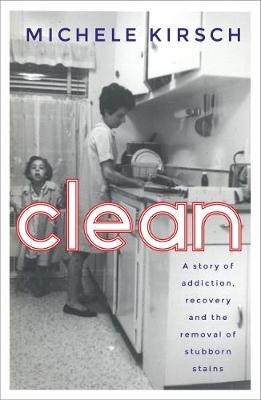
Reviewing “Clean –– One woman’s story of addiction, recovery and the removal of stubborn stains”, by Michele Kirsch (Short Books, ISBN 978-78072-381-5)
Several years back I was grousing to a pal about a new book by a clever and successful mutual acquaintance, a history that encroaches on territory I had one day hoped to stake out (but of course I have done nothing about this, since my pop timing is always terrible). My gripe is this: music writers endlessly re-interview the wrong people — or more precisely, never enough of the right people. Revisit the original moves and shakers and they mainly double down on what went over well the first the time, especially conceptually. Which is the way a moment of open possibility get congealed back into cliché. “If you want to know what a radical scene’s actually about,” I airily declared to my chum, “you should talk to the club’s hat-check girl.”
(The book in question did extremely well critically and commercially –– presumably because its targeted readers knew better than me what they wanted to read about this particular radical scene… )
Anyway, what’s valuable and lovely about Michele Kirsch’s Clean, I think, is how little attention it pays to the various movers and shakers she’s encountered, as a music writer in the 80s and after –– and how quite early on it turns out she WAS a hat-check girl, at a happening Boston punk club. As well as working in shops, on a switchboard, as a supply teacher, and latterly (per one meaning of the title) cleaning the flats and houses of exactly the kinds of comfortably successful people that pop stars and music writers mostly aspire to be (and now and then succeed). They stay largely off-stage as Michele tackles the grime in their very varied bathrooms, as anonymised sketches punctuating the narrative.
Which is instead an unsettling tale, deceptively wittily told, of unremitting anxiety since childhood, of grief as an unreliable lodestar, of industrial quantities of prescription Valium sometimes amplified by alcohol and other drugs –– and how (per another meaning of the title) you should quit all this, if you can. Since I first knew her 30-odd years ago, Michele has been a writer from her core to her fingertips –– and yet as an autobiography it’s not really about this at all. It begins with her childhood and youth, but says nothing of what she was reading then, or when she first picked up a pen, always pushing back into messier spaces, the ones often kept tidied away behind the pleasant nods to inspiration and aspiration. Around the time of the London Olympics, her decades as an addict had finally pulled both her chosen profession and a pleasant family domesticity out of her reach –– and the book’s framework is her learning to make a minimally liveable living as a cleaner.
At the NME in the mid-late 80s, Michele wrote funny, lively stories that arrived from odd angles –– odd because (to get them placed at all) they generally began life as this week’s promo pretext: pop stars (amusing, difficult, even –– whisper it –– dull) and what as writers we could make our tales of time spent with them. There was a tension here, and thus the chance to discover something about the forces shaping our world. And NME then still just about held a space open for anomaly, for curiosity, for voices and approaches not yet professionalised or routinised or market-narrowed out of their own sense of the shape of the world.
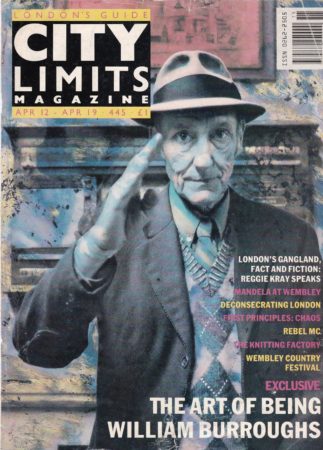
But this space was closing. Magazines were increasingly run by badly formed surveys about what readers felt they liked to read. And as writers and editors we had little idea, most of us, how to resist the pressures this created. By the late 80s, Michele was writing a column called ‘Mama K’s True Stories’ and it was of course terrific. And not like anything else at the time, at least in the UK (somewhere I have a folder full of cuttings from it). This was in the London listings magazine City Limits, a haven for the denizens of the closing space –– if anything under even more pressure to submit to market forces, to be more saleable than awkward, to drop what it had been (which had mattered so much) and to become what idiots thought it had to become.
Jump now to 1992: I’m re-fashioning The Wire from my predecessor Richard Cook’s template, into the kind of magazine I felt could survive without losing what had been so valuable. I got some things right –– the magazine did survive, and still does –– but why did I not see that ‘True Stories’ (which I loved!) fitted perfectly into this ambit and project? I wanted a greater diversity of writers! City Limits was in death spiral, there was much personnel overlap –– why didn’t I pick up the phone and ask Michele if she wanted to relocate? (We likely paid even less than CL, mind you… ) [Footnote 1]
Thinking this through (rueful and shamefaced that I didn’t realise before beginning this review) I realise it’s still a matter of what’s so good about this book, which was then much harder to see clearly (certainly harder for me, but surely not just me). And it goes back to congealment and concealment, who does what in the undiscussed spaces, what gets foregrounded and what gets left out when you’re making an argument in favour of something. Music is something Michele loves and knows about and finds invaluable in her life, and so what she writes about is her life. I was at that time mainly gathering writers who approached music as a series of battles (or as some would say, a history) of competing theories of value, popular vs vanguard vs past vs future vs rock vs rap vs jazz vs noise vs niche vs vector to the totality blah blah blah. Michele seemed untroubled by the routinised feuds and grand historical-definitional UK music-mag controversies of those times, at least in the usual feuding-freelancer-elbows-for-mannerist-space kind of a way — and this is exactly why I loved her writing. I wanted a mini-world in which less armoured voices could hold their own course, to thrive as an irreplaceable part of the whole, as respite from all the dramas of the central cultural cockpit and the theory-divas fighting for the largest slice of the attention available…
But such spaces and such voices are by nature and inclination tricky to weaponise, which is to say tricky to monetise –– and back then I wanted the battles at The Wire on the page (because I felt many of them were being crowded off everyone else’s pages) and also I wanted The Wire not to be losing so much money (lol). Obviously I’m delighted and gratified the magazine still with us — not least as a platform for small scenes that also just scrape by, as times get ever-tougher and spaces elsewhere just carry on blinking out. But all the available media models back then were flawed and flimsy, precarious and unsustainable, and they were all also about to get worse –- three accelerating decades of worse, seriously. The settlement some of us made with this –- the names some of us made -– came at a cost. There was no safety net and there were casualties…
… and by the time of the 2012 Olympics the comfortably successful people mostly left off-stage in this book are having their houses cleaned by those without voices, mostly, and without page-count. Those who found themselves slipping away back downwards after all [2], and those who never saw a way they’d be allowed up: who, trapped from the outset, never entertained ambitions professional or artistic, or set themselves transformative goals. There’s a tension often unexplored in the more stridently meritocratic versions of the tale of those who make it out (or back out, for rehab lit): that to reach the best realisations of yourself as author or artist, you’ve had to leave something behind and lock someone out. And so there’s a guilt alongside the relief –- and in fact a guilt either way. Because if your own flight is unsuccessful, you’re a failure too. These are the corrosive dooms we are constantly asked to internalise, the ideological impositions few entirely free themselves from.
What makes Kirsch such a funny writer is that just these conflicts play out as a kind of lucidly evasive dizziness, a constant misapprehension that’s very (as the internet would put it) “relatable”. She blames no one but herself for how things turned out, and makes a terrific comedy of self-deprecation: spaces left looking worse for her attempts to clean them, things she turned her hand to (professional journalism, parenting) as an obstacle race of absurdist unsuccess. It’s all often also an apology — to family and friends, most of them unnamed — and it’s charming and it makes you laugh, even the tough parts, and her voice remains light and clear, and this is excellent. But not everything in it needs any apology.
As one of the most readable of narrative forms, the classic puritan autobiography sees the present coinciding with the redemption, the means of rescue: we move through and down into the catastrophe, and back up out again. But despite a lightly skirted 12-steppish pass into religion, the redemptive circle in Clean doesn’t quite close — this is not that kind of autobiography. The most rewarding community way-station in her quest towards sobriety is when she becomes a cook in a little local East End café: the fond way this is described lets us know that Kirsch knows that re-arriving as a cap-W Writer is not going to be on a par with this, reward-wise.
The shadow-side of Kirsch’s journey has been a succession of jobs that mostly can’t be careers: hat-check girl, shopgirl, switchboard girl. And there’s a dismissive feel to this list (as I make it) precisely because they’re jobs that often go unnoticed, the stories historians too often don’t ask about. In this book, they take place within hat-checking distance of the movers and shakers we pay most of our attention to, to write about and argue about — and when youth and tactical dizziness hadn’t shut off any of Kirsch’s future mobility, across the counter as it were. You can line them up as “girlish” — as if this means impermanent or ornamental or frivolous — even as you conspire not to spot when they become the whole of the hard livings some have to make, and much too much of the life some have always to live. Even in the late 80s, such mobility still seemed plausible –– and writers still shared an impulse to be keeping doors open, or anyway to share glimpses of what this might still mean. But what if personal transformational achievement only takes decisive shape when the doors are closed? Your inspirational, aspirational triumph is only a broader political or a moral triumph if you can bring with you the best of what made you. The gentle strength of this book is the sense it leaves us with, of the caked-on dirt behind our sense of lifesaving self-rescue, of where the slamming doors may be, of what’s on the other side that we should never be forgetting…
FOOTNOTES:
1: For a recent reboot of Mama K’s True Stories, go here
2: At the book launch for Clean, I was told — to my great sadness — of the likely death last year of another colleague from back in the still-open days. I won’t name them because the internet doesn’t yet confirm the news, and I very much hope it’s untrue. The fact they’re more or less invisible on the internet is part of the story, though.
[If you like this post, please support my PATREON which will help me write more! Also let other people know that you think might enjoy it… ]
]]>or how the puffin club
turned me into a punk rocker"]]>
This is a lightly edited extract from a piece I wrote for Frank Kogan’s fanzine WHY MUSIC SUCKS (#11, pub.June 1997). The topic was “My First Record”; some of the tone is me not quite sure at that time who I am as a writer any more, especially in this context. All the square-bracket interpolations and footnoted annotations are new.
[…] The first LP I bought was almost certainly Slapp Happy’s Slapp Happy [in 1976]. It was on bargain offer in a local shop, and I remember the grins on the faces of the shop girls when I took it off their hands. But it was very nearly – which would have been hilarious – Metal Machine Music, which was in the same bargain bin. For some reason I decided against MMM. I think that I decided it was too popular: or – since this makes no sense – that someone I knew would have bought it, so I didn’t need to.
Between these points [i.e. 1967-76], ten years of what? [Footnote 1] Growing up in the depths of England’s rural midlands, isolated from kids my own age [2]. My parents aren’t puritans; I was forbidden nothing [3]; but living in the deep country I had no access, except to books, and no idea of what I was missing. I spent my time reading reading reading, till places like Narnia and Moominvalley seemed real and familiar, and the outside world grey, pale, without energy.
[When I got to secondary school] and began to hang out with kids who talked about rock, my solution to not being up to speed was straight out of Alien Nation [4]. The off-worlder studies the host culture’s ways diligently, committing all trivia to memory, just in case. Soon he can pass as human: or will some ridiculous detail be his downfall?
I bought a book in 1977: The NME Book of Rock, a chubby little pulp-encyclopaedia of pop [5], and read it cover to cover, committed it to memory, and turned myself into a little book-based expert [i.e. on records and in music I wouldn’t actually hear for years]. More importantly, though, I read in it that a man called Tony Palmer (a British TV director in the 60s) who’d heard no rock until 1967, when he read about Sgt Pepper in The (London) Times, had asked a friend for Ten Essential Albums, and become a professional national rock critic within the year. [6]
I decided to do the same. But I went further, polling maybe 30 people. NOT all in my immediate gang, and several not even close to being friends. I ended up with a list of maybe 100 records [7]: all LPs (a fact of significance, though I didn’t yet know this). I had no record player, but my sister did have a little tape-recorder/cassette player. Everyone played tapes then anyway – it was the era of the portable cassette-machine. I borrowed tape after tape, writing careful critical notes — subjective? ignorant? innocent? pure? — marking everything out of five. When they played stuff at school on their little machines, it had to be quiet (it was school). At home, I played things even more quietly. Some of this rock stuff sounded very nice; very little hit me particularly hard (all those touches of classical imitation). Three exceptions: Patti’s Horses, 666 by Aphrodite’s Child, Camembert Electrique by Gong.
Mainly there was a central cluster of Progressive Rock: the gang’s median taste, its mainstream: Pink Floyd, Yes, Genesis, Purple, Rainbow, ELP, Barclay James Harvest, Wishbone Ash. I was also now listening to John Peel – very very quietly – every night (on a tiny little radio, under the bedcovers), and reading the weekly rock papers, as assiduously as Talmud. There were then four in the UK: NME, Melody Maker, Sounds, and Record Mirror [8].
[From the four weeklies and Peel] I learnt that prog rock had gone out of fashion, very suddenly, about six months before I began this project. Just as I began my big daft quest, punk had invaded. Though mostly younger than me, the gang I had till then imagined hipper than me were already beached by history — and I was beginning to exchange this briefly desired companionship, of those to hand at my school, for the idea of a gang I knew was better. A virtual gang, an imagined community: a mass movement without local representatives (except for me, of course). This was easier than it may sound. [9]
Rock-paper language was just then full of praise for punk because it spoke “ordinary language” about “everyday, relevant things”. But urban rage wasn’t ordinary or relevant to my initial gang — nor to me [10]. This was a rhetoric my to-hand gang resisted: you could even say they saw through it. ’ But I loved it for its non-ordinariness, and bought straight into it. I entirely convinced myself that, as Simon Frith would say, reality was what happened elsewhere. [11]
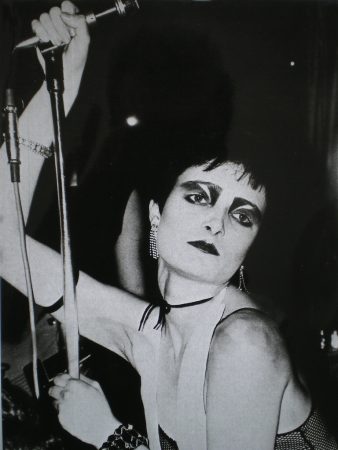
My secret reason for finding punk both comforting and alluring was its yen for absolute moral conflict: when I gazed at grainy photos of dark rooms full of odd-looking people and occasional shiny gleaming things (guitars, mike stands, Siouxsie Sioux’s eyes), I was thrown straight back into a world I was already perfectly familiar with, and happy in. Children’s books are thick with absolute moral conflict, odd-looking people, occasional shiny gleaming things (swords, stars, Lúthien Tinúviel’s eyes).
I loved the idea that somewhere in the world, far away, were people whose “ordinary everyday” shared tone and texture with my utterly personal totally bookish world of moral quest and the innocent but determined defeat of evil, of small bands of small folks against the dark forces. Goblins didn’t exist, but Johnny Rotten did. I might even meet him [12].
However this gang-transfer did not happen immediately. [13] It was preceded, or in fact accompanied, by a failed transfer into a rival virtual community. One established less by reading than by listening; but again one that demanded I gravitate to the real, familiar energy of the imagined, and retreat from the pale grey failure of my immediate surroundings. [14]
The poll returns that intrigued me most even then were the ones that failed to fall into any pattern, the replies of those without group allegiance, the bands who the rock papers seemed to have little or no [current] attitude towards. Lone votes for Sabbath, Tull, Bethnal [15], Rory Gallagher, the Groundhogs. And beyond this, the eccentric – because so casual and so ill-considered – votes of a guy called Peter, who everyone called Tool. [16] He’d voted for the only three records he knew. He brought them to school, but he didn’t own them; they were his sister Nora’s: In Hearing of by Atomic Rooster, 100 Ton Chicken by Stan Webb’s Chicken Shack, Camembert Electrique by Gong. The first two were very minor BritBluesBoom groups, just as it began shading into Prog Rock (Christine Mcvie, then Christine Perfect, later of Fleetwood Mac, sang for Shack; co-founded by Carl Palmer, Rooster were an offshoot of The Crazy World of Arthur Brown, though Palmer had left for ELP by Hearing-time).
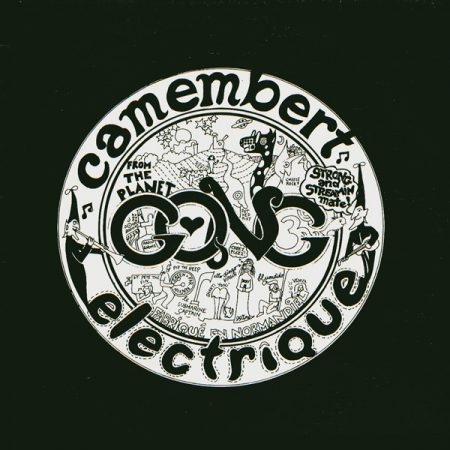
But Gong were completely different. For a while (c. 1971-72) France’s most popular avant-garde free-rock group, they were pluperfect Euro-hippy anarchists, playing disorderly spacerock that would have been jazz-rock if they hadn’t been so out of it. (Indeed, the more time passed, the duller and more jazzrocky Gong became.) They lived in a chateau-commune in rural France (there was a picture on the sleeve: it looked like a shabby mountain farm). They gave themselves cartoon names (sax and fluteplayer Didier Malherbe was Bloomdido Bad de Grasse: the only one I can remember), and there was some elaborate though never-explained mythology involving the moon, Tantric sex, weed, teapots, pixies, and the poet John Donne. Their bossman was an already aging Australian ur-beatnik called Daevid Allen, who had been buddies with minimalist tape-looper Terry Riley and also a founder of Soft Machine. This particular record you could find all over the place in those days: it sold for 99p only, when LPs were £3.99 or £4.99. I didn’t buy it at the time: we just played Pete’s copy (including playing frisbee with it and walking on it).
I never met Pete’s sister Nora. Her taste intrigues me.
With its black-and-white hand-drawn sleeve, handwritten song titles, fuzz of marginal jokes, Camembert Electrique was a fabulous detailed microworld to me: an explosive little 1968 in my own heart. It wasn’t the drug references, which meant nothing to me: it was the sense that this cartoon world was extended and internally consistent (as subsequent exploration proved it wasn’t) [17], that you could leave the beckoning dreary straight world, and make off into this alternative space. I wanted to hang around and do nothing and grow my hair really long and have a funny cartoon name in a Chateau in France. Under the paving stones, the Chateau.
Most of the record was formless, shapeless, draggy wandering, with funny little sound effects (a sort of chuggy clockwork object panned slowly across the stereo-image at one point). Allen couldn’t sing – he kind of spoke ‘poetry’ in a mimsy way. But there was also this one perfectly simple, hypnotic, unforgettable bassline, which I loved then, and love now (everyone loved it who heard it). I gave the record five out of five. No one seemed to understand why. (Even Pete didn’t like it that much. He voted for it because it was his, not because it was good.) I know why, now: I knew that one day I would love and understand as much as I did that bassline all the bits of the record that irritated and puzzled me. I wasn’t ready: but with study this understanding would come.
If people thought this polling project was weird at the time, they never said so. Of course, for years, I thought it was: I never spoke about it, never liked to think about it. It was proof that my rock roots were none too deep, and startlingly inauthentic. [18] The getting of wisdom demands that the mechanism of its attainment be rejected. […]
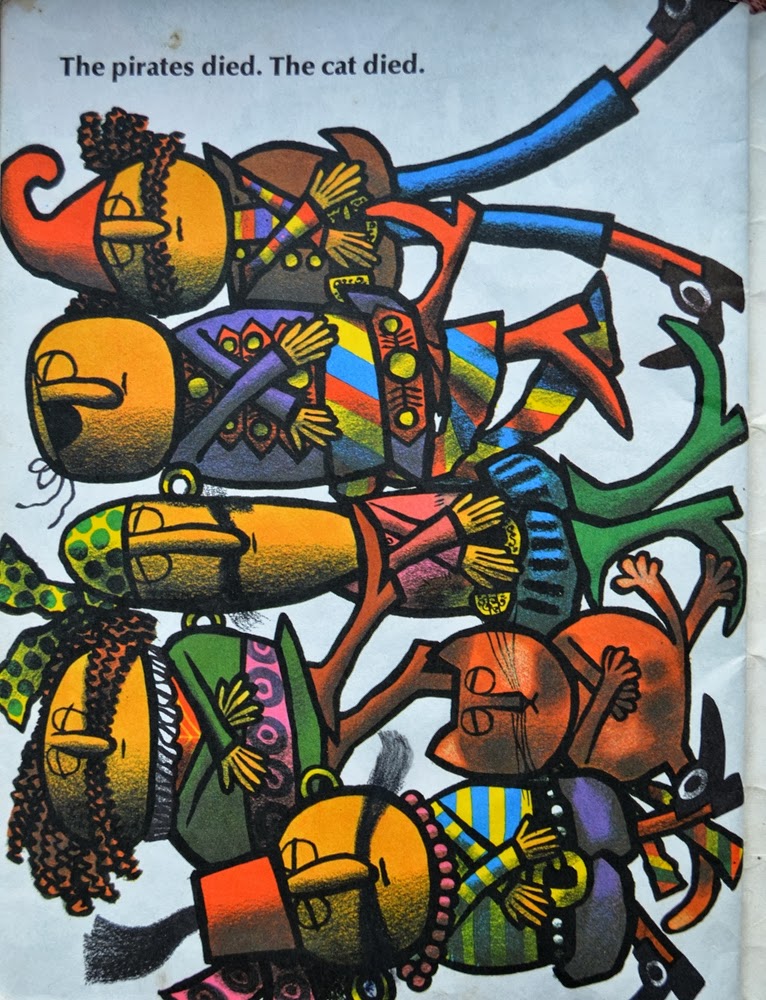
FOOTNOTES:
1: The 10-ish years covered the time from the first LP that mattered to me, though bought by my dad for my mum: Sergeant Pepper. Here’s a post on that.
2: Isolated by geography, not temperament: welcome to the countryside, where your closest schoolfriend lives 10 miles away.
3: This seems an odd thing to say: like they always inatantly bought me a pony and a sportscar and every double album I desired. What I mainly meant was they they didn’t at any point seem to disapprove of my interests and sense of life-direction as a writer. (And for “aren’t” read “weren’t”: mum died in 2005, dad in 2010, and I miss them.)
4: lol does anyone even remember this TV series, once salient and much-discussed? Probably a more exact reference for the thing I’m talking about is The Man Who Fell to Earth — at least people have actually seen it in living memory.
5: There were three editions of the NME Book of Rock: 1975 (Star Books, ed.Nick Logan and Bob Finnis); Feb.1977 (Star, ed.Logan and Bob Woffinden); Nov.1977 (Salamander, large format, ed.Logan and Woffinden). I own the second and third, now in terrible condition (no covers, some outer pages vanished). The late Bob Woffinden had a fascinating and exemplary second act to his career as a rock journalist.
6: Tony graciously agreed to participate in my Birkbeck conference in 2015, on an entertaining panel with Jonathon Green and Mark Pringle about how well or badly mainstream media tackled rock culture in the 1960s.
7: I wish I still had the documentation that went with this poll, not to mention the results, but it went missing long ago. A hundred seems a lot!
8: Those four weeklies in order of my engagement with them:
A: NME every week from August 1977 — I ended up writing for it and only stopped when I angrily quit in 1988 (a story I’ll tell properly another time) .
B: Sounds most weeks 1977-79: I was driven off by reviewers who seemed not to get post-punk, as it wasn’t yet called: mainly Garry Bushell and his quasi-political thuggishness, then still nominally leftwing, but also Dave McCullough’s bad review of the first Raincoats LP (grrrr). McCullough was actually an interesting writer, generally simpatico with things I liked then — The Fall — and I often wonder what became of him.
C: Melody Maker: dipped in for a while in 1977, only very occasionally thereafter. It was regarded as the most grown-up and serious, but to be honest (aged 17) I found it a bit of a chore, and its page design was pretty terrible. Bascially it had a bad punk wars and I largely missed its late 70s reflowering under Richard Williams.
D: Record Mirror: this by contrast I felt at the time was a little young for me and hardly ever looked at, which I now regret.
9: If this essay has a moral, it’s that this kind of identification can be much deeper, and more life-shaping, than the impact of the seemingly more immediate world around you (your school, your town).
10: We were rural or small-town middle-class kids. Not all my friends were middle-class — but the ones that weren’t mostly weren’t at that school.
11: This phrase was from memory, and as a result misquoted in this piece. It’s the final sentence of Simon Frith’s ‘Playing with Real Feeling: Making Sense of Jazz in Britain’ (collected in both Music for Pleasure and Taking Popular Music Seriously). The full passage is worth quoting: “To understand why (and how) the worlds of jazz (and rock) are young men’s worlds we have, for example, to understand what it means to grow up male and middle-class; the understand the urgency to ‘authenticity’ we have to understand the strange fear of being ‘inauthentic’. In this world, American music — black American music — stands for a simple idea: that everything real is happening elsewhere.” I knew this quote (and was alluding to it, even if I got it slightly wrong) because Frank Kogan had explored it in an earlier issue of Why Music Sucks. Versions of this discussion can be found in his book Real Punks Don’t Wear Black: Music Writing by Frank Kogan, in the three-page essay ‘The Trouble with the Sociology of Pop’ but also at the start of the epic 47-page (nearing 30,000-word) essay-memoir ‘Roger Williams in America / The What Thing’. Where too many present-day music-writers jump to scorn the notion of authenticity (as risible goal and reliable index of bad music), Kogan explores how the fear could be social and artistically useful and fruitful, and hence not “strange” all. There’s a reason we can’t shed it as a topic, and a reason it seems constantly to return in new form (see also footnote 18).
12: So far I never met him.

13: Since age 10 I had been a member on the distant edges of the Puffin Club. If I now began scouring NME and Sounds for details of how punk worked as group I belonged to, I was simply switching my habit away from Puffin Post, a magazine run by a children’s publisher, a monthly full of interviews and stories and competitions you could enter, and club picnics for members (which never took place in Shropshire). There was an extensive reviews section, in which insider kids got to detail in print the upcoming paperbacks they’d been given to enthuse about. I very badly wanted to be one of these insiders, and tell the world why a book I liked was good.
14: “pale grey failure…” With hindsight I’m a bit out of sympathy with this back-projecting sorry-for-myself flourish. I didn’t feel a failure as a teenager at all — I was excited and stubborn and quietly driven — and now I distrust this attempt at self-deprecation. I want to say that the late 90s is when I most felt a failure: certainly much more than the mid-70s. Probably I’ll change my mind about this too though.
15: Bethnal were a low-tier, now-forgotten pop-punk band, featuring one George Csapo on vocals and violin. Pete Townshend-approved, they made two LPs, Dangerous Times and Crash Landing. The voter in my poll also played violin.
16: This sounds mean, and how I continued it in the original makes it worse: “(because he was one”). In fact he was a sweet friendly somewhat dozy kid whose main defence mechanism was playing the clown. He was teased ruthlessly and seemed not to mind. I hope he actually genuinely didn’t mind.
17: In other words the kind of conceptual continuity that pulls people into Zappa’s world, or Pedro Bell’s cartoons on the Parliament and Funkadelic sleeves — though I never warmed to Zappaworld when I later encountered it.
18: “Startlingly inauthentic”. But startling to who? Inauthentic how? Looking back — halfway across my writing life, I guess — it’s maybe telling that this is the phrase I wave uneasily: “lol authenticity, lol young me?” What exactly is bundled up into it? What was the “unrealness” of musical and/or writerly understanding that I was claiming to find about my early anxious self, in this late-90s stab at describing my mid-80s anxieties about my 70s (teenage) self.
To wander off into a minefield of thinking aloud, it’s two things: the extent of my knowledge, and the mode of its arrival — as in, do writers ever actually understand anyone else?
(A): Was I the kind of obsessive record-collecting scholar I was surrounded by in the mid-80s? Well, no (impostor syndrome klaxon): I knew a lot, almost all gained by reading.
(B): how was this way into and what it means not just entirely at odds with the world of the cap-p Proper pop or rock or soul or jazz fan (black or white). Who had surely somehow directly absorbed the relevant language from their own local community or anyway their older siblings, or else from some bewitched engagement with “the music itself” on radio or (sometimes) TV? Or via obsessive gathering of 45s and 33s (despite 33s at this juncture being somewhat deprecated) 33?
In fact, of course (C): most strong music writers come to writing by reading. By my late teens something about it — the access it gave to something, something I still haven’t quite worked out — it had evolved into a passion, a commitment I couldn’t and didn’t sidestep. Aged 20 or so, it seemed all too belated, but being slow to get things (or to accept things?) isn’t something I’m faking, that’s for sure. In small doses with big gaps and often poor access, I’ve been listening to pop all my life.
As a teen, I wanted to know what it was about music that bound my acquaintances into groups, and could it work for me? In retrospect running a poll seems to me like a pretty smart way of tackling the not-knowing-much aspect — and as a one-off also not the worst stab at critical practice. Evidence if any were needed that being some sort of analyst of matters pop-cultural was already baked in — that it was actually what I was always meant to be. If I felt I was the wrong kind of person from the wrong kind of place back then, I stopped thinking this long ago: this is just who I am.
(D): The key for me here and now is the degree to which music-listening (and collecting and whatever other interaction is involved) bumps sideways into a world shaped by words and refashions it. A lot, a little? Does it challenge it or firm it up? Thee days I prefer always to argue for the former — the disjunction is what a critic shd be hunting for — but the latter remains common (because it seems more normal?) and this (for non-writers?) functions as “the real”. Of course Kogan’s argument here would be the value of the feeling of fakeness — the worry that as a rockwriter I’m not a real rockwriter — is that wrestling with it is what helps drive you towards superior work.
How real is “superior work” though?
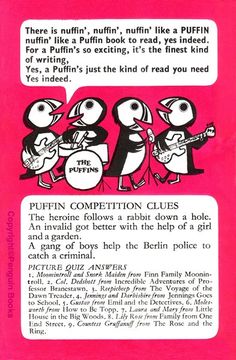
No amount of politics or philosophy or theory or backstory or practical musical experience — knowing how to play the changes for ‘Giant Step’s, knowing what they “mean” — are going to resolve the issue of the Correctness the Mix you hit on realness (the genuine emotional or intellectual effects) versus imagined cosplay potential, in yr stance or method or self-presentation. After all punk really did exist, albeit not as I hoped, and ditto Gong and the puffineers. And they’d gone by the time I arrived on any relevant scene. But my dream version stuck around long after, affecting all kinds of other stuff. The abiding panic that you’re getting the mix WRONG is what helps the writer to be smarter or better or deeper or more _ or more _
(Puffin Club artwork and lettering is largely and very memorably by the late Jill MacDonald… )
[If you like this post, please support my PATREON which will help me write more! Also let other people know that you think might enjoy it… ]
]]>
Like many teenagers in the UK 40+ years ago, my non-school culture was basically two things: the music weeklies and strikes. One time my late colleague Steven Wells was reviewing a biography of Richard Branson for NME (Mick Brown’s I assume, published in 1988). “The 70s were a bad time for strikes,” said the book. No! wrote Swellsy, angrily and hilariously, the 70s were a BRILLIANT time for strikes. Management wrong, workers right, the side without resources flexing its collective muscle, the three-day week, no electricity for days on end, no one clears away the rubbish or even the dead… sorry, but for any distrustful, easily distracted young person this was all just great, as well as perfectly and morally correct. The grinding stand-in-the-cold-street banner-waving fact of a strike, the sense of a community re-inventing itself, plus no weekly routine you could entirely rely on. The quotidian could turn topsy-turvy any day now — the world is not what you think it is, in the blink of an eye we can remake it what we will of it.
For more than two months in 1973-74, the newly appointed editor Nick Logan had to put together an issue of NME every week not knowing if it would actually hit the streets. Back when a printer wasn’t just a cranky add-on for your computer, thousands of them were out on strike all across the country [Footnote 1]. At this most militant of moments, Logan’s team was busily changing the model of the rock weekly: writers from the underground press encouraged to slide into this trade pop magazine and invent what would become a new market leader, an engaged, funny, utopian, sceptical rock paper sharply at odds with the mainstream world. Yet even here, on the wildest title, reader loyalty is shored up via continuity: not appearing for several issues is a significant test of that. Yet right here at the dawn of a new dispensation, fully nine weeks went missing. I like that the stoppage didn’t give the incoming readership pause: in the worldview being fashioned, there was somehow already an imagined solidarity to get everyone past quite an obstacle.
In fact 1980 was the first time I noticed a stoppage (I wasn’t yet reading NME at all in 1973, and the three one-week no-shows in 1976 had apparently passed me by). IPC’s NUJ chapel — headed I believe by someone who worked at New Scientist — had come out over freelancer pay, and the paper’s staffers struck in sympathy: no NME for six weeks, a big deal in several ways [2]. Former Oz publisher Felix Dennis put out a spoiler title, New Music News, to pick up readers desperately jonesing for their fix, unable to wait out the dispute in sympathy. It was mostly a mess as I recall, but I was just too loyal an NME reader then to consider myself a fair judge now — and certainly it helped break the habit for some, as people began to shop around [3]. Sounds went all in on its metal coverage at this point for example — NME in 1980 rather disdained metal. The cover of NME‘s back-to-school issue featured Joy Division, and the (belated) news of Ian Curtis’s suicide, which sold all too well. But post-punk was almost by definition a specialised taste, full of unbiddable suspicion about the uses of popularity, and this was the highest circulation would be for some years.
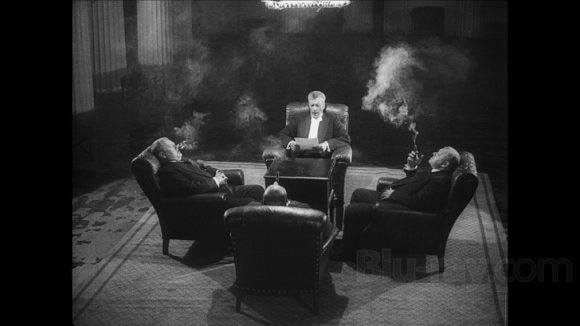
NME’s IPC stablemate was Melody Maker: it too went on strike in 1980. Editor Richard Williams had for two years been repositioning the paper after the hit it had taken from punk, as the most solidly grown-up of the weeklies, serious and genre-pluralist — in fact a major redesign was due, to mark the change. Management wanted him to put out a scab issue; he refused and quit. Instead of grown-up, MM clumsily attempted to consolidate in the glossy new pop market — never previously its strong point — and flailed badly for several seasons [4].
The following year, when Sounds — not an IPC title — went on strike, management did put out a scab issue — with the result that every PR company in town could finally get its most despised acts in the paper, while the editorial team manning the pickets couldn’t stop them. Result: Sounds lost hard-won critical authority. It’s one thing not getting your copy of a Wednesday — quite another getting a copy full of rubbish never meant for you. Readers didn’t make allowances, because why would you? And anyway, by this point, new options really were arriving in all directions. (To name only the ones founded founded and edited by Nick Logan, Smash Hits was now soaring and The Face had debuted in May 1980, poaching readers who enjoyed clubbing and strikingly designed colour spreads.)
If I was still just a besotted NME reader and wannabe in 1980, by late 1983 it was actually running my copy (I’m guessing my earliest reviews were bad: I’m not going to go look to check). In 1984, in June and July, it went on strike again, this time for eight weeks. I was still a very junior and minor stringer, and don’t remember anything particularly clearly about this stoppage — mostly that some still not very good book reviews of mine got spiked during the missing weeks, which I was afterwards quite relieved about.
Also lost to history — in the sense that I’ve never found it on the internet — is X.Moore’s rather more substantial two-part piece in NME in support of the miners’ strike that same year [UPDATE: a reader kindly sent me a photocopy]. At the conference Cynthia Rose remembered that the Kent Miners’ Wives Support Group came up to the Carnaby Street office more than once. And management — so subsequent office rumour ran — became ever-more convinced that editorial was a “nest of Trots”. This was silly: there were two members of the SWP, Moore (real name Chris Dean), and Swellsy, though they didn’t overlap for long and also detested one another. But both were freelancers, and of course neither controlled editorial. Still, even foolish boardroom paranoias can have consequences. When Neil Spencer decided to quit in 1985 — tired after eight years of fending off the higher-ups — his deputy Tony Stewart stepped up… and wasn’t appointed. He suggested, again at the conference, that IPC had seen him on the picket line and weren’t having it. Besides, they’d been trying to get an outsider in for some time (see footnote 3). They hired a Melody Maker writer called Ian Pye — and a significant tranche of NME’s senior editorial quit, some following Stewart when he left to run Sounds. The incoming team had many ideas to counter the challenge from the proliferation of glossies and general reader-bleed, not all bad at all, but little collective experience shouldering off corporate interference or defusing internal conflict in a team that had often been bolshy and feud-prone but was now also seriously demoralised. The HipHop Wars began here: more than anything they were a product of weak and naive leadership.
I should probably add that Pye and his new team were soon commissioning longer work from me, and much more often. They quite soon (1987) blundered into a far worse error, though, as part of an anti-censorship issue. To illustrate a story of a Dead Kennedy’s LP cover that had already nearly bankrupted Alternative Tentacles, a postage stamp-sized, highly pornographic image of H.R.Giger’s Penis Landscape was run, and soon after that Pye and two others no longer worked there. Alan Lewis, formerly of Sounds, was brought in, with Danny Kelly continuing as deputy.
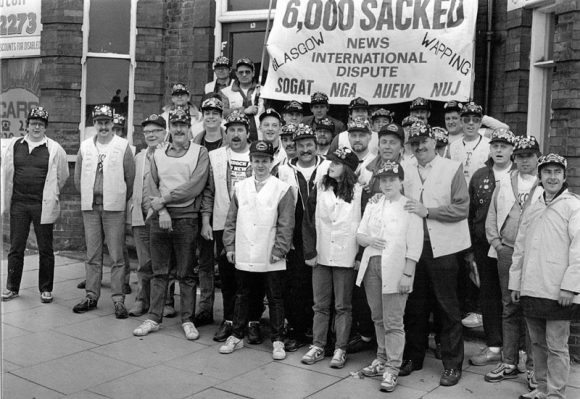
In 1988, a tiny picket — from NME and the ever-militant New Scientist — stood wanly outside Kings Reach Tower, the pretext a management plan to hire staffers only via private contracts, shutting them out from union representation. No one from Melody Maker joined their colleagues — and the sad truth is IPC had already won this war, since editors Lewis and Kelly sat within scrobbling an entire issue together just the two of them. This time zero weeks went without an issue. Lewis was promoted up into the management layers, so when Kelly left to edit Q a couple of years later, IPC chose MM’s Steve Sutherland as editor. Despite crossing their picket line, Kelly was liked and respected by his staff: Sutherland — who had loudly despised the rival title and frequently attacked it in print — was cordially loathed, and yet another clutch of contributors quit. Like Tony Stewart before him, Kelly’s deputy editor James Brown believes what doomed him for consideration was being seen manning even such a paltry picket — except unlike Stewart, he wasn’t even offered the courtesy of an interview. (He went off to launch Loaded.)
The weapon that defeated the strikers in publishing was digital technology. It made many things possible — me writing this and you reading it! — but it made some things immeasurably harder. Back in the 70s, printing and publishing was full of guild-like specialist knowledge, easy to protect because easy to withhold: this was the era of “Spanish practices”, so-called, much-mocked as a problem and a piss-take, but the key to firewalling the power the workers in the trade had over their hard-won conditions. Digital gradually stripped out the many industrial layers required to get words from the typewriter and images from the camera out onto pages in every newsagent in the land. With desktop publishing, you basically had to get goodish at every stage of the process, and this simultaneously reduced and scattered the class-base of the profession. What’s more, every mass-excursus of a staff — in sympathy with a mistreated editor or deputy editor, for example— was a loss of several kinds of wisdom. Collective knowledge is never simple, and arguably its most important dimension is how everyone involved negotiates this complexity. [5]
Certainly there had been victories — freelancer pay was at no time princely but once upon a time we were not held to ransom as we routinely are today, exploited and stressed and too vulnerable not to be pliable. With the miners and the printers, union militancy had been crushed. And because this affected how we wrote, it gradually affected what was written [6]. Flooding the trade pop press with strange undergrounder weirdos was never going to end in a stable-state system, even when the resulting cultural mayhem appealed to the readers and sales rose. The two worlds could never simply combine — and this was good, and a medium that recognised and traded off the noise of the wrangling was a medium that made sense and appealed, in the mid-70s, when instability and conflict were taken as social facts, often exhausting, often exciting. The crackle of difference was the routine, alongside the battle to bring past and future (tradition and experiment) together onto the same page, to interact. All this had put the immediate present under its full tensile pressure — and yes, the papers sold. But the arrival of the new technology allowed for the reassertion of stability-at-speed, via the banishment of many kinds of argument, political or cultural.
And all the while management was also chipping away at editorial independence and decision-making and intention, and also at any kind of personal writerly trust in content. I know what I feel, you might be thinking, and so I know there’s readers out there who’ll get it — with your pitch to your editor as the first test of such a hunch. But if there’s someone higher up smarmily pointing at the so-called numbers all the time, and overriding your instincts, well, things begin to flatten out. The bolshiest began to shear off and self-publish; others saw how best to embed the new technologies within the larger media bubble, for sure, but this layer also seemed to neutralise the frictions of the 70s and early 80s largely by internalising them. Shortcuts become habits, market assumptions become truths, the soul — which is to say the collective jabber — diminishes, and so does the overall quality. To this day outlets still discover and publish good writers, of course, but the context seems now to muffle and diminish everything. What if precise and instant outreach, but too much? Is it even possible any more to cut through the seamless sameness of the machinery?
Or anyway that’s how I read it all, having lived through it, somewhat off to the side as a cog in the quieter reaches of the machinery. That final sad little industrial twitch in the tale at NME is evidence — even if only part of the reason — for the general decline in the 90s in the quality of the music press as a collective platform with an implicitly semi-political stance. Of course I wasn’t personally much in tune with what NME had become by the end of the 80s, and had quit round this time for reasons seemingly unrelated to industrial action, angry enough simply to be thinking let it all burn. And off I went to reconstruct some of what was being lost at The Wire (see footnote 5): to re-fashion artificially what had been modernised away so glibly grumble grumble [7].
FOOTNOTES:
1: With some personal memories, I’m mostly retelling the tale as set out in the late Pat Long’s useful History of the NME: High Times and Low Lives at the World’s Most Famous Music Magazine — any anecdotes he got wrong I’ve probably also got wrong. Long says the union leading the strike was the National Graphical Association, but doesn’t mention why it had been called. Long’s book is largely interview-based, and exact details of the industrial action of that time may well be misremembered by participants — though the dates of the stoppage can be confirmed on the Wikipedia page detailing NME’s covers down the years, a quick and helpful way to track when no issue came out.
2: Neil Spencer says 10 weeks in Paul Gorman’s In Their Own Write: Adventures in the Music Press, but Wikipedia says just six. This was a National Union of Journalists strike: in fact the only freelancers’ strike called in the NUJ’s history, so the IPC chapel has reason to be proud! Worth adding here I guess that the editors of the music papers — and I think some staffers? — were not in the same union, and hence not duty-bound to come out: that in fact they were deployed as management to negotiate with (and browbeat?) the strikers, even if their natural loyalties lay with their writers against management…
3: NMN was edited by Mark Williams, and perhaps he had a grudge? IPC had lined Williams up for the job of editor when Nick Logan quit in 1977, but lost their nerve when Williams was busted for drugs — and the job went to Logan’s dep ed Neil Spencer. (I haven’t been able to determine how long NMN lasted: several months at least I think.)
4: Richard Williams: not to be confused with Mark Williams, even though I put them on the same panel in my conference. Both feature in the book. Several of RW’s very strong writing team moved on to NME at this point (including Cynthia Rose and Chris Bohn), which began to deliver its own version of his project, expanding its genre remit, in particular the jazz that MM had entirely dropped. But the true upshot of MM’s deliquescence would be being the making of The Wire, a tiny quarterly put out on a wing and a prayer from around 1982. From around 1985 it started to flourish: unlike Melody Maker, it’s still going strong, its values undimmed, its mission undaunted.
5: This is a lightning sketch for the effects of digital, less a history than the collapse of my observations into my speculations. I use the words “trade” and then “profession” — much can be made, I think, of the social shift from the first to the second, as a mark of the narrowing of the class base on the producer side. On the consumer side, there was huge pressure in the 80s to target hard by narrowing the catchment, and this also reduced and scattered the base I think. There were more publications, but niche demographics meant each reached much narrower constituencies, which in turn had an effect on pre-publication crosstalk within anyway smaller editorials. Titles were also increasingly encouraged to plan their cover stories months out, for marketing purposes, which inevitably resulted in safety and stasis and lack of surprise.
6: And here’s the companion piece, to be read AFTERWARDS, if at all…
7: I’m wondering about other stoppages not so close to my personal timeline, as Pat Long’s book only deals with NME, the only weekly I wrote for for any length of time. There were five music weeklies in 1973/74, for example: NME, MM, Sounds, Record Mirror and Disc (formerly Disc and Music Echo). Did the strike affect the others also, and how? Did Melody Maker come out alongside NME for the 1984 strike at IPC? Was the 1981 strike at Spotlight the only time Sounds came out?
[If you like this post, please support my PATREON which will help me write more! Also let other people know that you think might enjoy it… ]
]]>“Sing great song, down inna Babylon, show them your culture, down inna Babylon” — ‘M.P.L.A.’, Tapper Zukie
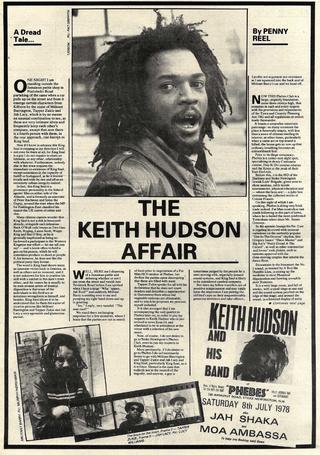
It was October 1978, and the NME interview-feature was titled ‘The Keith Hudson Affair: A Dread Tale’. It was written by Penny Reel, it was about this same singer-producer, Keith Hudson — who had of course worked with Ken Boothe, John Holt, Delroy Wilson and King Tubby’s toaster-DJ U-Roy, as well as Big Youth — and it launched into itself as follows:
“ONE NIGHT I AM standing outside the Jamaican pattie shop in Portobello Road partaking of the same when a car pulls up on the street and from it emerge certain characters from Kilburn by the name of Militant Barrington, Tapper Zukie and Jah Lacey, which is by no means an unusual combination to see, as these are very intimate idren and frequently keep each other’s company, except that now there is a fourth person with them in the rear approach, one known as King Saul.
“Now if I know in advance that this King Saul is stepping in my direction I will not even be there at all, for King Saul is a guy I do not require to share an intimate relationship with whatever. Furthermore, nobody else in this town requires the immediate co-existence of King Saul, except sometimes in the capacity of bailiff or bodyguard, as he is known locally and far and wide by one and all as an extremely callous integrity indeed.”

Some decades later, I was myself trying to describe the effect on a reader — not least this one, born in the very sheltered agricultural West Midlands — of a first encounter with this mode of prose, in such a context: “No one writes better lists than Penny Reel. His jewel-like essays for New Musical Express in the late 70s, describing the work and travails of such figures as Jimmy Cliff, Dennis Brown, Keith Hudson, Culture’s Joseph Hill, and… Boney M, were startling for their highly individual style, every sentence rigorously set in the historic or dramatic present (a device adapted from Damon Runyon), and the immense knowledge of reggae and its precursors knit together into lists that… were intimations of gorgeous mysteries still to be unpacked and explored. The NME in those days was a clearing house for serendipitous arcana of many unlikely kinds, highly variable in quality: and if one kind was Reel’s topic, another was his unmistakeable voice.”
This was the spring of 2015, and I was about to run a conference at Birkbeck on just this zone of media, the UK music press in the 60s, 70s and 80s, and what there was to be discovered there, as topic and as perspective. And I very much wanted Penny to be part of it. He seemed historically remarkable and stubbornly unique — given to feuds, some said, a little sour now and then about other participants (though by no means all of them), but also, as I found him, generous, interested and I think entertained by it all. I had a plan to sit down with him afterwards and ask a great many questions about his voice — how he’d come by it, his choices and intuitions, the reasons behind all the masks, the deft fictionalisation in its detailed surround of fact — but caught up in the admin of the anthology that’s followed, I never got round to it. As the years pass, time speeds up and you slow down — and suddenly he was gone, in the middle of August. He was 70.
Reading the tributes on Facebook and on message boards, I realised that even now there were people who hadn’t realised he was a man; that Penny Reel was a pseudonym derived from a traditional folk song become ska and made famous by Eric Morris: “Long time me never see you, Penny Reel-o/And you owe me little money, Penny Reel-o/And you no have it there to gimme, Penny Reel-o”… Always there was a dance going on here, between this register of address both striking and disorientating, and the self-disparaging, almost self-mocking storyteller, slight and off to the side and almost out of frame, yet somehow also always unbiddable, even indomitable. Of course given the glamour and the absurdity of gangsters, the jump — from the spheres of song and stage in Runyon’s Broadway during Prohibition to the same in Kingston or even Dalston in the 60s and 70s — was not so vast if you were familiar with Runyon. But many reading the pop weeklies then likely weren’t — which is where the jump turns from literary conceit into a sleight-of-hand conjuration. How exact to fact even was this King Saul anecdote? The uninitiated reader found themselves plunging right in and also (I think) holding just back a little — and this ambivalence was key to Reel’s allure, and to his mastery of his tone.
I mentioned his masks: Penny Reel was just one. Another was Observer, derived from a mid-70s song by the producer Niney (Winston Holness). Fusing man and medium, Reel became ‘Observer Station’, as if his column (and later his DJing) were his own rebel broadcast. It suggests a preference for standing back, not interfering. But the need for an observer tells us there’s an urgency to the situation, and dangers we should be kept abreast of.
For many, the 70s was decade of unhappy exhausted retreat and worse, of course — but I think there’s a particular emergency closer to mind. Reel was born Peter Simons in the first year of the Windrush arrivals, 1948, in working-class Shacklewell in East London. Falling hard for ska in his early teens, he had found friendship and places to linger in and around the clubs and record shops that catered to such a taste. By the early 60s, as with many drawn to such things, he was a mod, or anyway distinctly mod-adjacent. By the mid-late 60s this had led him and others like him to the Round House and the UFO Club, and to the crucible of a utopia: the underground press, the locus of the British hippie dream, and the possibility of a world rid of racist and class division. Which had always already been Penny’s dream.

He had also, though he’d quit school the first moment he could, always known he would be a writer. Here suddenly — wildly experimental, ungatekeepered, extremely middleclass — was a space that offered this opportunity. But the underground press was always doomed — some wanted it shut down, pretty much the only money coming in was from record company ads, and it paid its contributors in drugs, if at all. Around 1973, in the wake of the Oz trial, when the doors were slamming, a gaggle of undergrounders fled towards the music weeklies, at that time flailing in the face rock’s sudden, to-them inexplicable pre-eminence: a generational playpen of idealists and chancers fomenting the revolution from the heart of the entertainment-industry beast. From the mid-70s for more or less a decade, Penny was a writer and sub-editor at NME, until the music press began to convulse again, adapting to the new pressures of the new times, and he was marginalised, then exiled. Did some of the urgency come from a prophetic inkling this expulsion was always on its way, that reasons were always already being found?
For a not very disguised version of this tale, read his Up the Dreary Slope: A Novel by Thomas Horace Whitmer, the book I was reviewing for The Wire (Whitmer yet another of Reel’s panoply of masks). Here’s how I wrote it up: “There’s a malicious fun to be had from these sections, especially if you were faintly involved: but for those not so unlucky the more important takeaway of these passages, in their intensity and barely veiled dislike, are the glimpses of the unfolding of a class war within media, as synecdoche for a wider story about changing London. Both the underground press and the trade press, in the 60s and 70s, were come-as-you-are spaces where people of all backgrounds could mingle and make their way; where quite unexpected voices could find a platform for a season. But by the 80s, as the rock press gained visibility and even respectability, this was under threat, from editorial tailored to demographics and niche-marketing. Contributors did still arrive brandishing self-made fanzines, but as the sector expanded, diversified and fragmented, upper-level editors increasingly swerved towards the ideals of middle-class university-nurtured professionalisation. The narrator spits this story out almost in passing, and in highly partisan fashion, husbanding far more expansively affectionate space for topics he thinks matter more – but his perspective, of someone present throughout, a proud, well read, highly intelligent, more or less self-taught artisan, is as unusual as it’s invaluable.”
In the 70s in the UK, everyday life in this parochial and decaying post-imperial nation felt meagre and limited — and for many, routes of escape, real or imagined, mattered greatly. Imagine a time when all the world’s information didn’t hourly bear down on us, as relentless distorted promise and threat, in which discovery could be a matter of quiet and patient care, a choice not a hideous defensive pressure. It may sound bliss now; stranded on the far side of it, it seemed less so then — and the UK music press was a cultural lifeline, as voices of many backgrounds improvised squabbling alternatives, with at least the chance that you too could become a contributor to the debate.
This was the promise and the lure: rock and rock-writing as a way for the young of the 70s to negotiate the fact of the existence of others not at all like them, and to find purchase on the many clashing forces shaping the day. Above all, they were an encounter with an extended family set of black musics, African American, Afro-Caribbean, Afro-Latin, even a little African African. Rock was of course largely a mutant form of electric blues and 50s R&B, fumbling towards comment on those aspects of life locally repressed: desire, dissatisfaction, disdain, the glamours of ritual and performance, reaches of politics still untouched by more grown-up outlets.

In the film The Blues Brothers, the absurd white hipster doofus comes to the rescue of the helpless black genius. Good-hearted in its silly way, the film half-knowingly parodies rockwrite’s sense of mission. A self-regardingly benign cartoon, and not the reality some were battling against. In my review of Up the Dreary Slope, Penny told me, I failed at all to mention the “mass coverage given to colonial white music and the way in which great black music is mostly ignored.” A key message “hammered throughout” the length of the book, as he sternly put it (closing as ever with his benevolent sign-off, “Ites, Reel”).
In 1975-76, with Nick Kimberley, he had published two issues of a fanzine, Pressure Drop (“the world’s first reggae read”), with stories on Tapper Zukie, Big Youth, the Maytals, Delroy Wilson, Niney, Studio One and more. Full of deeply researched material about backstory and record releases and labels and context, and very engagingly written, the abiding tone is a trust in its own seriousness. There’s no melodrama, no hyped-up justification — it absolutely believed in the self-motivated curiosity of its readers. And it was breakthrough-important because of this diligent care. The music was beginning to be covered in the weeklies, yes, but there was a tart editorial note: “Superficial knowledge has been allowed to pose as authoritative.”
There’s an obvious story to tease out here, about voices amplified and voices muffled in the rockwrite zone — about who will top the never-ending bill and enter the general canon, and who will be shuffled away into the specialist cellar-archives. There’s another subtler story too, and another cleavage: I’ve mentioned class war at work in these papers; Penny talks of the struggle against “colonial music”. The model of his utopian space was much more street-based than any magazine office, with its rivalries and management agendas and page quotas. In his own obdurate sensibility, the poor, black and white and all the others, had already fashioned a togetherness — and this, as the music so often insisted, was the message to be carried everywhere.
Be the delivery never so unofficial, he was a self-taught working-class scholar — and scholarship was becoming a class-inflected issue, in an insidious new way. By the late 70s a dreary gradient was being inked back in. Know-nothing rage was suddenly the only acceptable proletarian face: bookishness and informed care were the bailiwick of the better-born and those who aspired to their affectations. Proud at first of its admiration for its black sources, UK white rock had for a time shown a certain goofy regard for learning and autodidact craft. Punk in its belligerent narcissism baulked at this. A noisy and often undemanding DIY hemmed in the underdog energies it fed off, until everything was pseudo-heroic fabulation and quasi-authentic pose.
And Penny’s narrator-character was a performance too, of course it was. But it was a performance — set as it was in this dense, highly stylised, fabulous prose — that protected what it cherished from cliché and oversimplification. Here was dub, for example, its structurally avant-garde technique offset with old testament warning, toasting rhythms gleaned from the King James rendering of the Hebrew, the whole sutured together from just the prettiest Jamaican pop, some of it gleaming, some of it rough and ready. It isn’t an accident that dub is recognised today as the sheer clashing essence of a future sublime — Reel helped us to this realisation.
By contrast, perhaps there’s Mod: contrast because, as an iteration of yesterday’s street modernism, he was unable entirely to shield it from history’s lazy distortions. ‘The Young Mod’s Forgotten Story’ is his (very funny) 1979 memoir of life on the early 60s London scene, a corrective dropping just as the film Quadrophenia pushed this waning subculture back into the public eye [note: the version at this link for some reason cuts off rather suddenly some way from the end]:
“Not only is [Beardy Pegley] the first guy I ever see wear hair lacquer and lipstick, but he is also the earliest on the scene with a pink tab-collar shirt, a grey crew neck jersey, knitted tie, scarlet suede jacket with matching leather collar, navy blue crombie overcoat, white half-mast flares and candy-stripe socks, as well as being the first mod to sing the praises of Laurel Aitken, James Brown, the Pretty Things, the Flamingo Club in Wardour Street, Lawrence Ferlinghetti and marijuana, insult Eden Kane in the Chez Don and is still the only guy I ever meet who owns a pair of bright emerald green fur booties, all this circa 1962.”
The description is exact: this striking dandy who approves Reel’s tastes in records, but whose company and penchant for violence Reel deplores and would prefer to avoid. It celebrates a style and a time, draws out its dangers, but also draws in its unexpected connections. Here, wittily drawn and socially acute, is the crime that puts Pegley inside (Mod mini-boss shooting a Ted leader in the chest in an amusement arcade on Mare Street in 1965): “Later, a fully recovered Buttons Walsh goes on to become commander in chief of the UK Hells Angels and ends up alongside Flann O’Brien, Damon Runyon and Anita Loos in Picador Books, who publish his autobiography Buttons in the 70s.”
On one hand, you had to work to engage with non-local sensibilities in those pre-internet days. On the other, it was sometimes just a long walk away. Picador Books, for example: cheap paperback editions of every kind of past classics and present scandal, right there to be opened in a nearby bookshop. And Penny’s own voice, a weekly page-turn away in almost every newsagent in the land.

Reel trusted you to allow yourself be led deep into spaces you were entirely unfamiliar with, full of words and ideas only sometimes quickly decodable — and there was something intoxicating and affirming about all this, especially to any whose sense of adventure came wrapped in shyness. Here was a way in, to the places where ska or bluebeat or soul or reggae were made or played or sold, and an introduction to the people there, very much as themselves, that neither presumed on this community’s welcome, or offended against its interests. Here was a voice that wove the romance and the fascination and the deep knowledge of a milieu, its energy, its humour, its joys, into a subtly ironised critical grasp of its troubles and its fears and its surprises and its tangle. There was something kind-minded about his deep moral care, and how, as a guide, he allowed you to move your own way through your anxieties towards a complex understanding and enjoyment. His head was a vast redoubt of facts — not itself unique in the record-nerd universe, perhaps, but in others something that often also entails walling yourself in from politics. Penny always absolutely and very radically had a politics. I’ve retold this story casting readers like me as his foremost concern, but this really wasn’t so: he was a man widely loved in the reggae community itself, and trusted. Boldly and brilliantly and cunningly — and just a tiny bit cheekily — he fashioned his voice and his superb ear from elements borrowed (Runyon, the high millenarian cadences of 70s reggae), and from what he found just wandering round the London he loved best of all. London is everywhere, in everything he wrote.
There was a lively discussion a while back, about today’s working writers and their backgrounds: about who now gets to make a living as a journalist, and where they’ve arrived from. Could someone like Simons, whose official education ended the moment he was able to end it, break through now? Yes, he had enormous talent and a cussed, wily persistence — and he absolutely seized his moment, and made what he could of it. And yes, of course he had an ego — all writers have an ego — which very much manifested as an unwillingness to bend towards approved inflections and official shared beliefs and registers. His self-abnegating poetics of care and curiosity, his rich and strange obliqueness of approach — it’s hard imagining something like it threading or battering its way through the present-day maze of needless professional credentials. He invented his own credentials — who can even do that now? He was one of a kind, and I’m glad I met him and knew and worked with him a little. I miss him. All Hackney misses him. All London and all writing miss him.
RIP Penny Reel (1948-2018)

[If you like this post, please support my PATREON which will help me write more! Also let other people know that you think might enjoy it… ]
]]>
A week or three back, my old ilxor pal Kerr put up a list of jazz genres on FB and asked his followers who could define them. And bcz we’re dicks, we gave him a dusty answer (mine, in full, was “I can!”). We played mean games; we suggested he google. And so he did — fair play — and of course the joke was on us, bcz the results (wikipedia!) were terrible, full of error and sententious assumption. Some true claims — especially in the endless lists — mixed in with much confused nonsense and (wikipedia!) inapposite citation.
My dusty answer wasn’t just about being a dick: Kerr’s question had landed right on top of something that’s bothered me for decades. Which is why people often write so badly about jazz — including people who know a lot about it (a lot more than me anyway). They can get the facts right — the chords, the analysis — but then miss the point. They write well about the players’ lives and character, and about the feel. But when they write about what the musicians actually think they’re doing, and think about what they’re doing, it all goes cock-eyed and dull — as if being fully conversant with musical technique and terminology acts as some kind of huge mental block.
And some of this is because music is hard to write about! And because a lot of jazz since the 1940s has been a kind of “music about music” — musicians playing to and at musicians, in other words, to excite or entertain or to baffle them, to engage or surprise them (if a paying public just about keeps up, buzzed or puzzled in turn, that’s a bonus more than a goal).
Anyway, instead of a glib too-quick FB-type response, I wanted actually to dig deeper, and talk through and shake out some of the problems as I answered the question — because I think the problems are also a part of the answer.
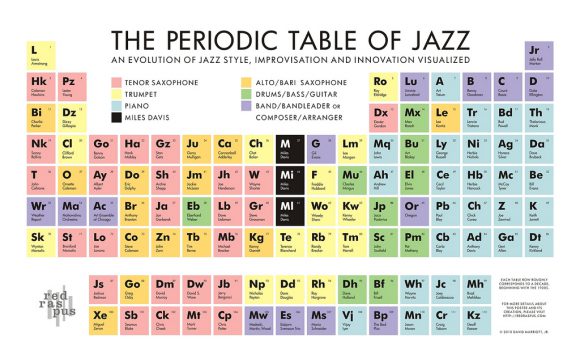
Kerr’s full list was this: BOP, MODAL, HARD BOP, SOUL JAZZ, POST-BOP, FREE JAZZ, JAZZ FUNK and AVANT GARDE. Well, I have books on my shelves which take hundreds of pages to cover the relevant half century usefully. To keep my answer short (lol), I’m going to break the timespan in two (40s to mid-60s), and run through bop aka bebop, hard bop, modal and soul jazz (in this order bcz there’s not much to be gained from breaking historical chronology; the rest in a later piece) (maybe). And this is also an experiment in describing the micro-branchings of genre — the when and the which and the why — and an exploration of what’s actually at stake for the musicians themselves without assuming too much prior knowledge of the technical language that musicians use at one another. Possibly the experiment will merely irritate those already fully in the know (schooled players and composers), but it at least affords a space for someone similarly frustrated (me) by much of what we routinely get (written and on-screen) to think through how to offer those very much wishing to be in the know (like Kerr) the beginnings of a sense of where and how to start thinking about such things. You can to tell me afterward how successful it’s been…
TALKING ABOUT GENRE: In and out of jazz, there are several ways to unpack genre. None are bad, but all have limits and drawbacks…
A: The first and easiest is basically lists: of relevant performers and (recorded) performances. You reel out a bunch of names and titles and entirely leave it to the listener to join the dots and attempt the correct generalisations about the aspects that in fact matter. Which is little help to any would-be listener who already feels lost or daunted or overwhelmed or incapable or unworthy. Not least because the more precise you feel you need to be, the longer the lists become, and it’s this unmanageable length that’s so fearsome and dreary, as antithetical to the spirit of the music itself as summer holiday homework. Stamp-collectors (some would-be listeners will definitely begin resentfully to feel) seem to grasp everything except why…
B: The second blends soap-opera biography with sociopolitics, the sounds so-and-so made as the expressive backdrop to a clickbait morality tale about their life and times. And the politics often become a too-broad generalisation blurring everything into everything else (“the blues is an outpouring of SUFFERING”) while the the romantic biopic is surprisingly routinely an erasure, of those colleagues whose lives and voices just didn’t unfold flamboyantly tragically; of those they worked with in the exact same milieu whose luck — and whose character perhaps — was just different. Which is kind of the point and the problem: large swatches of the process of art-making is the opposite of soap opera. It’s actually quite clerical. It’s unrealistic to imagine soap opera will never intrude – some musicians be being divas — and yes, mood-painting is some of what’s going on, though in jazz it’s nearly always collective and thus conflicted (lol “dialogic”) (lol lol “dialectical”), and as often as not it’s pushing hard away from the corny clichés of hand-me-down just-so-stories. Which is why these sketch portraits, even when they’re meticulous rather than tabloid, can deliver music analysis that that’s simple-minded, impoverished, or (per the current trend in music documentaries) fundamentally anti-musical.
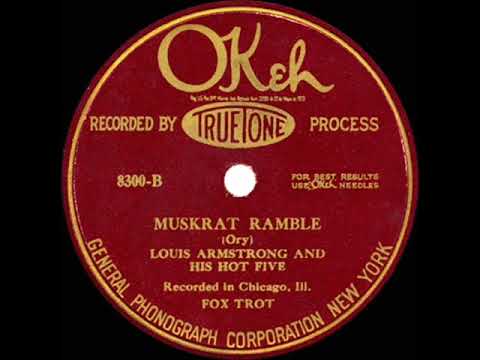
C: The third is production history, the exploration and awareness of how record companies and record shops have packaged certain musics at certain moments, to direct it to the attention of they hope will buy it. Genre necessarily combines generalisation (the words are related), plus how you use examples pulling against one another to sketch limits (when so-and-so is a bebop player and when he isn’t). And for marketing purposes the algorithms of sameness (“if you liked x you’ll like y”) often have to interact with the happenstance of variation (“you’ll learn stuff from y you didn’t find in x”): if only because they want to keep buying (and you won’t if the early stuff supplies everything you need). Musicians often greatly resent this — not always out loud. Miles disliked the word “jazz” altogether — for a variety of reasons, including the fact that he felt it came from an insulting and dismissive root, but mainly in the end because he thought it limited his potential listenership. Some people arrived were coming expecting a thing he didn’t quite do, he felt, and left annoyed — while others never arrived at all, bcz they thought they knew what he did (“jazz”) and never found out what he did do. Meanwhile Louis Armstrong (or possibly Ellington) famously said “There’s only two types of music, good and bad… “
D: Fourth, of course, is full-on scare-the-horses musicology, complete with scales and key changes, types of harmony, families of chords, cadences, modulations, modes and more, much more — the technical insider-speak that composers and musicologists and many performers can’t avoid communicating within. Even unschooled musicians that don’t read will develop their own in-group shorthands — because this jargon is often very necessary, and cumbersome (as we’ll see shortly) to sidestep. It lets players work out how to be in the same place at the same time, moving in an agreed-on direction — all things that could take forever to describe other ways. If you want locate yourself in a landscape, and find the stuff you care about (nice churches, good fishing, whatever it is), a map is useful! Learn to read maps! But hold a map forever in front of your eyes and anything unexpected in that landscape stays hidden. Or you’re watching football for the very first time and you don’t really follow what just happened then, or why it’s good (or bad). Here’s what won’t help: being handed a copy of the official rules. [Footnote 1]
BEBOP (early 40s to maybe mid-50s) Or just bop. It starts as a post-show activity at Minton’s in New York, for hopped-up musicians to tweak and challenge one another, playing the stuff that wasn’t allowed yet on yr average swing bandstand. It was pretty anti-punter — its audience was other musicians. The fun was leaving behind the corniness, stylistic and emotional, that musicians felt the club crowd mostly wanted. The relentlessness of night-on-night performance needed to make rent in New York City means things quickly get old — and thus boring — and these guys (they were nearly all guys) needed a change of game.
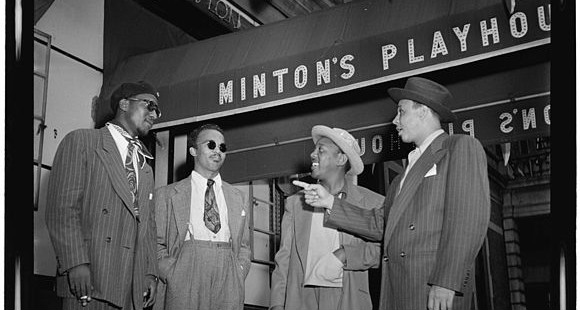
© William P. Gottlieb
Cutting contests was already a thing in African American culture, of course — from “the dozens” (first recorded by sociologists in the 40s but decades older) to the good-humoured stride-piano shows where James P. Johnson battled with Willy “The Lion” Smith to be virtuoso boss on the night.
Bop was more of the same, and from the off not unlike surreal-meme twitter — jagged and quick-fire and weird, full of shared in-gang gags to gather the in-crowd in, and keep the dullards at bay. “Martian” was a term unconvinced outsiders used of it, and impenetrability was the hook. The tunes were frenetic and off-centre, technically hard to master as rhythms and as notes, with unexpected accents dropping like disorientation bombs. Its harmonies were demanding at best — not just because the speeds — and in the hands of some plain peculiar. Monk’s (for example) were just undecodable for years afterwards: you had to accept them and trust him and adapt. This was a micro-world of young ambitious men in mid hyper-competitive musical banter, their solos are full of intensely topical quotes, tricky almost catchphrase-ridden figures, wild top-this runs, absurdist shapes and arabesques and, frankly, zings. The tune was the message-board thread’s OP, and off they charged, owning one another and goosing everyone else present, the fastest, the hippest, the weirdest. Highspeed high-wire stuff — not really party or dance music at all, but a young crowd opening out a new art-music language. “Always radical in the context of formal American culture,” said Baraka of (all) jazz in the early 60s. Looking back from the late 80s, Greg Tate tagged this “always radical” as a pure sci-fi charge injected by jazz into the rest of art, via a practical learnable record-based aesthetic that combined delirious speculation with delirious intensification.
So anyway, I’m setting the scene and throwing around a ton of adjectives here — good and correct ones, to be sure — but I’m not yet getting into the deep nitty-gritty musically. How much harmony-homework-for-dummies would I have to set? Bebop was an angry and a joyful and a deeply learned inversion of norms — and some of those norms probably need to be described, in music composition and in the other stuff musicians do, the stuff that isn’t treating the composer as the absolute cause of the result. Here’s one of those norms: in most composition, melody comes first. Ignoring some very out-there (and very recent in 1940) composed music (hi Bartok!), harmony was practically speaking the structure you build around the melody. Perhaps you found counter-melody that fit, and then the chords this created (any two notes not identical are the start of a chord), and then the colour. Of course in jazz — at least until the 50s — you were improvising on a pre-decided song (yours or from rep): so while the melody in the song came first, the melody that was the improvisation arrives after the agreed harmonic sequence. With bop — and we can make an entire topsy-turvy aesthetic politics of this — harmony is a pre-built obstacle course you writhingly hurtle through, and the wriggles of melody are no longer per se always the emotively central element (trying whistling Dizzy’ ‘Bebop’ in a lyrical manner) [2].
BUT: “There’s no such thing as a wrong note,” said Art Tatum. Isn’t this the opposite of chords-as-obstacles? What if we — to get way ahead of ourselves — argue with Art that any note might make sense against any given chord, if only the notes and runs and turns before it and after it gave it the right meaning at the right moment? The obstacle-free obstacle course! But most ordinary players — Tatum was the epitome of extraordinary — people only really began to adapt to this idea when they started looking back at bebop from a newly argued perspective. [3]
HARD BOP (mid-50s-mid-60s) Bebop didn’t last very long in its earliest formulation. First, as problems got solved, solutions became formulas (there are only so many permutations of possible sequences of chords, and of set moves that let you wriggle through those chords) . Second, because it was being recorded, others could listen and learn at their own leisure. Third, the war ended and the shapes of all jazz changed to adapt to a new, far less frenzied and anxious economy. Fourth, those involved grew older and evolved, some (notably Miles) moving implacably off in their own direction. Fifth, sad to say, Charlie Parker died…
And so the after-hours fuck-you texture dissipated, and the charged and experimentally anti-audience attitude dwindled. Art-musicians (many of them white) moved in to explore the abstract concert-hall dimensions of this boldly self-conscious stab at art, and the formalism got a lot less ornery for a while. While the need to play (the joy of playing) at at dances or wild parties re-emerged, along the practicalities of making music that got played on jukeboxes everywhere. A somewhat black pop sensibility reasserted itself a bit, stepping back into jazz from other streams.

Pianist Horace Silver had a Portuguese dad and a mom who sang gospel — he loved blues and jump and latin music. With drummer Art Blakey — a man who eventually devoted himself to schooling several generations of players in the quiddities of effective performance (the exact opposite of “fuck you”) — Silver helped a squad of players explore vibed-up blues-turned mood, joyful or sexy or melancholy or (now and then) thoughtful. He played with his hands close-set — not stride, not the fantastical architectures of a Tatum or a Powell — in a style that was more longer groove than abrupt obstacle avoidance. An earlyish Silver song is called “Opus de Funk”, and the joke in that early use of the word in a title is deliberate: this was still excitingly demanding music, particularly for the players, but the demands on the listener are no longer so cerebral.
Hard bop kept to the same wide harmonic spectrum — players got a buzz from testing themselves this way, and the buzz arrived as energised style and a showmanship of technique. But the head tunes became less fantastical and the ruling mood was body movement — brain maybe moved back behind feeling in the pecking order of musical logics. In place of hurtling virtuosity or quizzical Monkish strangeness, something much more colloquial and convivial.
Minton’s had been the club that birthed bebop; Birdland is where the Jazz Messengers made their bones — but honestly the founding site of hard bop is Rudy van Gelder’s studio, and the deep warm sound he developed for Blue Note’s sessions. Blue Note more or less being the Motown of jazz: this small-scale, tightly run and curated, strikingly industrious factory-line for a rich but narrow sensibility, designed to be better than serviceable any time you turned to them. The Beatles dropping out of nowhere in 1964 was what did for hard bop: a young person’s music that never over-fetishised youth, it found no ways to adapt its routine to rock’s quite different ecologies of distortion-based tonal colour and showing off.
MODAL JAZZ (^^^arrives with a husky trumpet peal in 1959 after early bookish flickers):
To people who don’t play — who don’t have the landscape of scales in their heads, or the feel of them in their fingers — modes are hard to explain! The first point is this: after the age of bebop, the best way to understand structure is that scales are what matter, not chords any more. And the second, well, remember the obstacle course without obstacles? And how any note’s OK if the stuff surrounding it makes it right? If you ignore the folderol of technical theory, this is what “modal” really actually practically amounts to. The hardcore theory is not wrong, but it mostly gets very deep into the mixolydian weeds of how to rewire a trained musician’s head, to get them to perform as if they always thought in this old-new way.
Bebop chords had become so complex and all-encompassing that they often now included or implied all the notes of a scale: full implied chord as opened-out and out-of-sequence scale. [4]. Pre-bop, we suggested the melody came first, with the harmony to be fitted round it afterwards; with bop, the harmony came first and the improvisation fitted around it. Now, via modes, the two merge. The chord is the scale; the scale is the chord. The centre — to get ever so slightly mystical-sounding — is now the entire piece as it unfolds. Musical meaning no longer derives from an-imagined-but-absent pre-set skeleton — the chord sequence filed in a player’s head — but from what everyone (players and audience) are hearing right now.
(Which is not to say the music never had pre-composed pre-sets: but they could well be tiny, fragmentary ideas, and often were…)

Theorist-composer George Russell pioneered all this in 1953, in a large book with an amazing, absurd, theory-as-killer-robot name: The Lydian Chromatic Concept of Tonal Organization. This set out the argument in its daunting entirety — an analysis of the entire history of music so far — but its force almost certainly came less from its precision than from a kind of all-encompassing vagueness. And then Miles hopped on the train, because (a) it allowed him to do exactly what he wanted, and (b) it showed him a way to underlay improvisations with flamenco-derived scales in ways that were (c) strikingly complex emotionally, and therefore (d) not at all corny.
(The last is by far the most important: if Miles abandoned quickly bebop, he stayed loyal to its most militant turn-yr-back-on-the-audience fuck-everyone attitude… )
Of course, since everything — including all jazz so far — was always (on Russell’s reading) already modal, you could just carry on as you were and be (inadvertently) hip to it. But while it didn’t forbid any of bop’s obstacle courses, it allowed you to invert everything conceptually, like the duck-rabbit — to see obstacles as freedoms more than constraints. And it allowed you to consider the idea that the rules of any given piece emerged from that piece.
What do we even mean by rules now? What we’re talking about is sense of pressure and release: real feelings, produced partly by familiarity, possibly also by in-built responsive tendencies in the way we hear. This feeling of a pressure to movement is ordinarily supplied by a tonal centre: a home chord that harmonies are turned away from or towards; a home note that melodies are turned away from or back towards. A point of return and resolution, like the concluding moments of a hymn. You’ve been ferried out on a journey and now you’re back at a point of rest. Hymns are a very strong version of this — but much classical music and pop works this way too, as does plenty of jazz, complete with departure and return, momentary to-and-fro, and the potential journey-over-adventure-done-and-relax that marks the close of a piece.
Bebop’s hyperquick scribbles also seemed to have home chords and home notes — though perhaps more from habit than need? Certainly bop was full of push-and-pull and to-and-fro — but an agitated restlessness was also part of its politics: happy ease and adventure-done maybe never entirely honest parts of the story of being black in America in the mid-20th century. Blues too has a general sense of a falling back towards a place of rest, but deep blues harmonies and structures are ambivalent kinds of tings, and any resting place seems temporary and uneasy. Modernist composed music also often favoured the non-ending sense-of-an-ending (Anton Webern possibly the emperor of this particular ice-cream).
Modal thinking means just whole fleets of mobile homes: a temporary sense of pull or rest, as conjured up by drones or pedal notes or repeated shapes like ostinatos. So that you feel caught between places of easement. Miles’s late 50s work — ‘Milestones’, followed by Kind of Blue, both well at an angle from what was busily going on around it in hard bop, despite employing frontline hard-boppers like Coltrane and Cannonball Adderley — saw long pre-composed long passages where the underlying harmony doesn’t itself move: it stops being the primary motivating element. (No surprise maybe that his concept emerged first from the soundtrack to as bleak a film as it sounds: Ascent to the Scaffold.)
As a player, Miles uses drift and drag to to render chords and structure somehow permeable: as if they’re blockages to pull against or to refuse. Faster players — Coltrane obviously — have an armoury of techniques, because they can move so far so deftly, but again, within the speed, the sensation often becomes one of being caught within a framework (you never felt trapped in bebop; you often do in Coltrane, early or late). A pianist like McCoy Tyner uses repeated chordal patterns that don’t imply a scale (or sometimes imply more than one), and then play runs and line and patterns against these patterns — as if they’re more a prison or an impediment than a home — or else of course lets the other musicians play runs and line and patterns against them. “I tell them,” said Miles in his great 1985 NME interview with Richard Cook, “don’t fuck around trying to find a tone centre.” As a result (this attempt at removal of something a musician’s ear is likely very deeply trained to be hunting for) is why modal jazz as a sensibility — setting aside its generalised rules or techniques — is often this feel almost of an ominous thickened glue to the air, even when the composed sound is open as you like.
(There’s a whole technical territory of how modes lie across scales, relating to note-starting points that aren’t the same as the scale’s [5]: This is there for musicians to orientate themselves and be able to explain what they’re doing precisely to other musicians — but I am unconvinced it’s enormously illuminating to non-playing listeners per se, since the elements that locate it for a musician often aren’t actually themselves played — they’re a sort of off-board anchor… )
SOUL JAZZ (late 50s to late 60s): When I hear the phrase ‘soul jazz’ I mainly think of the UK record label (founded 1992, to pick up the acid jazz slack), which is maybe not entirely unjust. Obviously the word went way back, of course — it’s omnipresent in gospel lyrics, and Coleman Hawkins’s 1939 ’Body and Soul’ was a massive-selling 78. But it was mostly there to describe the flavour and attitude of a way of living or being in the world — of eating, of believing, of looking out for one another as a community… which of course also applied to elements in the musics you associate with ways of eating, ways of believing, ways of oneness. But ‘soul’ as a name for a widely recognised style of music is a mid-60s thing, really — a rebranding of R&B as it hit the mainstream charts. Ben E. King’s “What is Soul?” is 1966; the Atlantic “This is Soul” comps — answering King’s question — start arriving in 1968. So when Cannonball Adderley was being cross with his record label, Riverside for trying to shunt him into a pigeonhole in 1959, he was complaining less about a stylistic pressure than expressing the musicians’ dislike off the name the label wanted press and public to be calling it: “They kept promoting us that way and I kept deliberately fighting it, to the extent that it became a game.”
Anyway, my argument is mainly that soul jazz was a back-formed term for tendencies in the long tail of hard bop, as elements in jazz and R&B began more and more to overlap, and as a specific strand in black pop had majorly coalesced into something wider (white) audiences were also very drawn to. In their interconnected yet opposed ways, bebop and modal had both encouraged the flowering of a wild range of emotional possibility as a function of audience shut-out. As the drones and grooves and pedal points migrated out of modal jazz to form the basis of funk — this is a cheeky over-simplification — the risk was always that open-audience ‘soulfulness’ could decline into a functional set of by-rote indicators, id-pol moves and formulae, invaluable because so imitable but quite likely to get dadrock-stale quite quickly. Disco is with us still, it’s true, and still mutating nearly 50 years on and very likely still a valuable power — but it’s also never been a music of ambitious youngsters cheerfully vying to one-up one another with all they intellectually and physically have, and chuckling at the audience toiling far far behind. [6]
FOOTNOTES
1: So why aren’t other jargons a turn-off for their fans? With sports, cookery, carpentry, even pottery you can make a documentary that explains (and names) technique and what it does. Someone makes a clever pie or an excellent pass out to the wing, as a voice tells you what’s going on — you can learn and absorb, you can shout back at the screen. If they feel they will be able to drop it themselves in an hour’s time and impress someone else who didn’t watch, people LOOOOVE jargon, and quickly master it. Except this is much harder with music, because talking over it is never appreciated! Even though such youtubes exist, the barriers to full fan mastery are high.
2: TIME and HIGH-SPEED ADVENTURES in OBSTACLE SPACE The quickest route through any structure is a straight line. If the structure forbids straight lines, the route will be some sort of zigzag. In this model of bebop, think of chords as a device for introducing obstacles, and tunes as the zigzags round: internal walls with open doorways in them, for example, and the improvised melody bouncing its way through.

Turn the walls-and-doors model on its side now, and imagine wriggling straight through one of those old boxy jungle-gym climbing frames which is basically a cube of nested little cubes. At regular intervals on this wriggle, you approach and pass through a plane fashioned of horizontal and vertical poles, at right angles to your quickest path.
In an unadjusted climbing frame, the horizontal poles you’re approaching and passing over in these planes are all on the same level. So there’s no obstacle — you can slide quickly through, basically in a straight line. This is your most basic melody, if you like: a single long-held note against the same chord, repeated as a sequence. To elaborate the tune between planes (chords) chords you could move up or down, then along some more, then down or up, and so on, making use of the available gaps in the structure above or below the one ahead ahead— and of course the pitch of the melody goes up or down as you do.
Now imagine these entire vertical planes being variously adjusted up or down before you arrive at them, so that the horizontal poles (and the gaps above and below them) are no longer all on a level. Your quickest journey is no longer a straight line — and every journey through (up or down, along, then down or up, and so on… ) has to adjust to the new limitations. The adjusted planes are now the chord sequence; the gaps you can move through between the horizontal poles at are the notes you are “allowed” to play at each stage [see next footnote also].
Recall that in bebop-world you are travelling at breakneck speed, and that all your decisions are quick as thought. Remember your journeys are the improvisations you are creating — and realise that, in the very small intervals of time between the stages or planes that contain the gaps that constrain your route, you are able expertly to manoeuvre up or down, in scales or jumps, in arabesques or zigzags-within-zigzags. And each player will be approaching the identical obstacled structure, in the same sequence — but everyone’s improvisations will their own dancing round the blockages and through the gaps in ways that (a) reflect the shared taste for intricate fuck-you jaggedness, and (b) reflect their own performed character (Miles was not like Dizzy temperamentally; Monk was not like Bud Powell). Everyone’s different mini-adventures as they scramble through is also a clue sent to everyone else playing the same date, and a comment on one another’s solutions to the problem, in a dialogue quips and shade, sometimes convivial, sometimes more inward-turned.
Except — and this is where the climbing-frame metaphor begins to fail — not all bop was fast, and the obstacles are not physical at all, but established and determined entirely by your ear and your will, and (tricksiest of all) the potential chords in bebop are now so complex that some will argue that all possible obstacles have actually been removed. The an obstacle-free obstacle course
3: Another way an obstacles-and-spaces model goes wrong — a physical metaphor for what’s allowed and what isn’t — is the matter of the ACCENTED PASSING NOTE. Much of the drama and grit in music, right back to Bach (and in fact further, but that’s me out of my comfort zone) is supplied by off-notes that strongly want to move one step up or down, to fit into the chord they’re working against. So basically notes that “go through a wall rather than a gap” are far from forbidden: they’re encouraged! But (paradoxically?) the encouragement firms up our awareness of the harmonic rules: the rules are broken in order to be belatedly obeyed. (The Schoenbergians fashioned a music where the rule was — kinda sorta — that passing notes were never resolved, a music-space where the shortcuts became yet another extremely intricate set of harmonic requirements…)
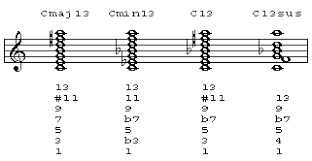
4: “opened out and out-of-sequence”: I mean that instead of an in-sequence run of notes (G, Ab, B, C, D, E, F, say: a scale), you might get a chord like G, B, D, maybe F, Ab, possibly C, then E: the same notes, but in a different order (with unplayed jumps between them, in this instance the jumps called “thirds”). Except of course this too is simultaneously over-schematic and over-simplified. Any reading musician is already shaking their head; as is any non-reading non-musician, very likely, except in despair rather than exasperation. Is there even a way to explain some of this without having to swallow it all? For example, I have to get across right away how easily — “second nature” as the oxymoron has it — a musician has absorbed and processed the fact that a scale functions like modular arithmetic: after eight note-steps the vibration speed doubles, and these seemingly different notes are considered “the same”. It’s called an octave (“octave” derived from the italian for eighth). As for complexity the next level up, a typical pre-bebop jazz chord will contain three or four different sounding notes (not including octaves): in any order, closed up or distant, G, B, D and F make up G7. A bebop chord might well contain more — sometimes six, occasionally even seven (see the Gb913 chord written out at the beginning of the footnote). This footnote is very much NOT lesson one in mastering these symbols, or the system underlying them: definitely go elsewhere for that, and set aside a week at minimum, and get yourself access to a piano keyboard or similar. What it is is an indication of quite how much tangled detail is packed into a player’s head, why it’s such a phenomenal skill to play at speed — and perhaps also why bop deployed a LOT of pre-set runs and devices as part of the game. Of musicians generally spend a lot of time practicing scales — so the realisation that a complex chord identifies exactly with a scale actually helps reduce the information-pressure. And a surprising amount of strong music — and not just out in the super-complex realms — rests on an ability to recast actually existing super-complexity as immediate and affecting (as a reading eye thing becomes an ear thing).
5: Here — for you to read and instantly forget — are the names of the commonest modes discussed: Ionian, Dorian, Phrygian, Lydian , Mixomydian , Aeolian, and Locrian, plus Hypophrygian, Hypolydian, Hypomixolydian and Hypodorian (which is I think the same as the Aeolian?). In modern jazz terms, these can usefully be considered as 18th century category-distortions of Gregorian Chant theory (developed in the 9th or 10th centuries) fashioned out of a very VERY blurred understanding of ancient Greek music theory (from the 1st to 4th centuries BC or so lol). In the scale of the key of C major, the Ionian runs from C to C, the Dorian from D to D, the Phrygian from E to E, and so on (the Hypos are way above my Patreon pay-grade). Anyway, there it is. As I say, I am unpersuaded that getting your head round the entirety of this helps grasp any better what’s going on in this or that Wayne Shorter joint: like a lot of music, you process a small and intricate element somewhere in all this — different elements for different songs or solos! — and it suddenly unrolls into a revelatory shortcut. Writing it up is all too often doubly the long way round.
6: What I’m going for in this piece is some kind of sketch of the mechanisms — often uploaded to muscle-memory from years of practice and study — by which musicians induce in themselves and one another the widest achievable range of intellectual and emotional and what used to be called “sensible” potential, via stuntwork and grind, precision and warp, togetherness and scatter, anticipation, surprise and reference — and a little of the story (in this history of 30-odd years in one type of music) of how it succeeds for a while and then begins to fail. But also to get across — at some level — the fact that bop was meant as a musical fuck-you to mere musicological recuperation, that the speed and the stance were blocks (by choice) to understanding, and that musicology’s painstaking attempts over the decades to recoup its territory are inevitably only as successful as they have been at cost of eliding this deep and difficult social fact.
[If you like this post, please support my PATREON which will help me write more! Also let other people know that you think might enjoy it… ]
]]>
It’s 1971, and here’s Nick Tosches reviewing Black Sabbath’s Paranoid in Rolling Stone. A friend (hi Kerr!) linked it on Facebook, alongside the cheerful question Is this the worst ever review of all time? Almost all of the 500 words are mood-conjuring the look and hideous feel of an occult orgy, little to nothing is said about the LP in question, or any other, and in fact the piece ends by misidentifying the singer as Kip Treavor, misspelled frontman of Sabbath’s rival satanic-themed rock band Black Widow (it’s actually Kip Trevor): “The boy whips out a 10″ personal vibrator, adorned in waterproof acrylics with the image of the Nazarene. He intones the words NUK KHENSU TENTEN NEBU and approaches her intendant fundament… impletion… across the room the fresh corpse of an illegitimate hippie baby is dis-impaled from the ceremonial sword of Baphomet. The myrrh is extinguished with the collected saliva of priests listening to tales of carnal abuse in warm, dark confessionals. The Shadaic numinae are chalked over with the mirrored sign of Ariael, the 11 rubies returned to the vessel of Dione.”
But all the same I’m going to say, no, there are many many MANY worse reviews, and here’s why.
Richard Meltzer, Lester Bangs, Nick Tosches: when James Wolcott dubbed them the Noiseboys, he did everyone (as so often) a disservice, including them, by collapsing them into just one wild-style jerk-store project and mislabelling it to match. They were friends in mischief, to be sure, but they were none of them particularly like one another in style or even tactic. What they did in fact share was a perverse attitude towards deep cultural knowledge, a feel for how to write and how to play and what was out there besides just rock [footnote 1]. Elsewhere rockwrite was already sleepwalking uneasily — so they felt — towards a narrow pedantry, autodidact learning as a mode of borrowed bad authority. One escape route: knowledge as all-purpose bust-it-wide toolkit, as weaponry on behalf of the militant mutant grotesque that was rockthink’s earliest best contribution.
Let’s unpack this a bit. By slightly winding route, the word “grotesque” has the same root as “grotto”: it referred to the old Roman paintings rediscovered during the Renaissance in Italian ruins, and in particular to the unnatural beasts and plant-life found in Neronian pleasure caves, part stag, part shark, part writhing snake, or whatever. Fabulous decoration as objective correlative of perversity, the joy of this and the darkness [2]. The meaning drifted, as meanings do — it often ends up closer to merely absurd-with-an-unpleasant-aftertaste — but as a strategy, a pressure, the Grotesque has always renewed itself. And in its earliest days rockwrite absolutely became a species of the Grotesque, an alt-space symbolic bestiary that recognised (or pled for) the marriage of the trash aesthetic with utopian social transformation. Meanwhile flying music fragment A bred with fleeing music fragment B in the tavern boudoir-dungeons of music survivor C… this was what rock was, in those first days, a militantly irresponsible mongrelism, and also space for just this hybridity.
So: could such a gleeful fusion of inflows be wrangled towards a wider readership? These were smart kids more or less trained to the mandarin manner, after all. With additional aesthetic tics adapted from jazz — music as speculation, music as intensification. How to maintain and cultivate and send these wide? One solution was a species of shitposting, quick-witted and unpindown-able, social and culturally if not descriptively thick [3]: throw open the portals of a lovecraftian quilt-form hell-garden writhing with chimeras. A glitchcore, as my friend Tom Wootton described it, bent on defying (among other things) all the journalistic category shorthands and shortcuts. And it’s catching: I’m at it now, beckoning the giant Wicker Man forward and calling for the torches to be lit…
Back to my friend’s FB thread: the phrase “creative writing” is deployed (hi Sundar!) as explanation with vaguely negative implication: as if to say “It’s not a review really, it’s more an exercise in creative writing.” Now it’s certainly true that the vast bulk of consumer reviews at all times have been the very epitome of uncreative writing: a cliché description, a genre-location, a borrowed evocative indication, a mark out of 3 or 5 or 10. From a very narrow descriptive palette, functionally repetitive compare-and-contrast work that presumes to identify a reader’s pre-existing taste zones and to toss the item in question into same, or else bin it.
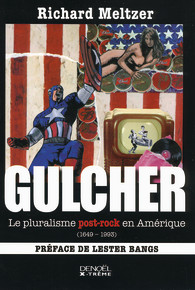
Back in the bold dawn of rock culture, people had higher aspirations. We were remaking the world. A description fashioned merely to the interests of commercial exchange was as far as could be from the spirit of the moment. And not just the spirit: as Frank Kogan wrote of Meltzer nearly 20 years ago, “Yes, spirit is nice (rah-rah), but Meltzer also – once – aspired to the mind of rock’n’roll, chose rock’n’roll as his intellectual activity – chose to do rock’n’roll on the page, since what rock’n’roll did was to mix up, flummox, challenge, test everyone’s sense of what was relevant or irrelevant in the world; to create a space where just anything could be pertinent. (Isn’t this what real thinking is: to test what’s pertinent? To question what matters? To act out your questions? To flummox, test, reinvent social relations? And if you’re a thinker, isn’t testing your own ideas what rocks you?)”
And that acting out, that testing could be (should be?) prankish or weird or fuck-you, or (now and then) a full-on shamanic journey as quest for what a song does to you, enhanced or otherwise — and where you might meet be when you arrived, and who you might by then be too.
And a lot of this writing was bad, of course: a lot of all writing is bad. Even strong ideas can suffer inadequate execution when they’re seen to be popular: hacks will gather in abundance. And bad habits are already in abundance, and the mechanics of magazine production — pressure of speed, consumer-directed conventions and separations pre-established everywhere, with intended and unintended consequences — are a spawning ground for more of the same, and for worse. All the same, “This is a bad review” is an ambiguous sentence. It might mean “The reviewer did badly the job of reviewing” and it might mean “The reviewer disliked a record everyone now knows is great” and it might just mean “This is just bad WRITING whatever the intention”. Those invested in the excellence of the record under review are not unlikely (and often happy) to confuse these meanings. Evidently someone who fails to share their tastes will be an incompetent in every other human dimension: lol this rock hack twerp who didn’t recognise greatness in real time, we so much know better now…
Of course nothing will have ambushed the likely prank here [4] more than the turn in Sabbath’s critical fortunes. And it’s sadly true that few US rock-writers took the Sabs particularly seriously at first — and that that’s what this squib is about, intentionally and also inadvertently. It’s a description of what a Black Hippie Sabbath might entail. By taking seriously the idea of “taking the idea seriously” it ramps up the absurdity: it gets the gap between [band name] and [pretentious rape-murder drugs party] down on the page.
So is this done well? If (here 50-odd years later) we don’t feel fully clued in to this move, is this his failing or ours? Does “us” include the many readers at the time also shut out of the possibility of satire? Well, even Flaubert’s Salambbô sometimes seems to need to have the word “parody” slapped on it, to ensure it doesn’t just get folded in with every other excess-ridden orientalist historical romance, and ditto Eyes Wide Shut for the ways it gets maybe (justly?) misread — and no one even tries with Gérome, who this probably reminds me of most, at least till the moment when Tosches slides out of the perfectly held pose into the final-para reveal.[5]
Another way bad works is as implied transferred epithet: “This is a nasty piece of writing — making the writer a bad man.” As Appalled of Upper Park Slope avers, “For moral reasons, this kind of scene should not be depicted” (and “depicted in this context” slides into “depicted anywhere ever”). So yes, Tosches is calling Black Sabbath’s bluff, and Black Widow’s too, and the bluff of anyone casually or cheaply invoking satanist ideas and imagery, not that many months after Manson. But the grotesque is as much aesthetic tactic as moral spasm: a movement towards the things in the world that go unseen, because we so busily (not least per journalistic conventions and separations) avoid looking, including juxtapositions always right there in front of us. As with “creative writing”, “satire” is often a get-out clause — a loaded and anxiously dweeby act of attempted redemption and in fact content-gutting — and the only thing that stops the “Grotesque” being the same is maybe the embedded admission that it remains, in fact, grotesque. It combines and deliberately confuses “This is what a Sabbat orgy actually is — and you who flirt with it should take ownership” with (at the opposite pole, morally speaking ) “In the cultural space we share, this is where we could be taking these dreams — why are yours so meagre?” [6]
The task of the review is a path-determined set of constraints: some writers will use these creatively, and some will consciously push out beyond them, and a few will now and then be able to act as if they don’t exist. It’s also — by definition — border territory. As an editor, I absolutely want reviews that find and activate the imaginative spaces the music took the writer into, or pushed them away from — even (or especially) when these are fragmented or contradictory or short-lived. Even in pure consumer guide terms it’s a ton more useful than a million “nimble basslines” and “angular guitars” and “heavy riffage” and (obviously worst of all) “influenced by”. In terms of the read experience, more imagination is just so much better than less, and if it risks occluding the record under review — however great that record — well, better yet.
Footnotes
1: Meltzer, free jazz nut, fresh from the Fluxus-mindfuck 60s New York conceptual art world, Allen Kaprow his mentor, had his roots in Yale philosophy, absorbing it all before he pushed against it. Tosches the future novelist is a scholar in deep early R&B and country cuts. Even Bangs had his vast secret librarians’ dream: that cellar full of all archived riot, plus every other record ever made.
2: It’s worth reading in full, so definitely click thru, but here’s a taster: “And it was through Rome that a Dionysian grotesque became incorporated — based on the dynamic Nodier introduced to the theatre — into Hugo’s aesthetic of modernity. The story behind its appearance depends not on writers, artists, or philosophers, but Roman boys at play on the Esquiline hill where the earth opened beneath them and one fell into a cave, a grotta, realm of Plouton, that is, Dionysus. The boy, rescued, brought back news that the cavern walls were covered with strange signs. The cavern turned out to be Nero’s pleasure palace, the Domus Aurea, hastily buried along with all memories of the despised tyrant. The fantastic decorative elements unseen in 1500 years attracted subterranean visits by Raphael, Michelangelo, and other Florentine artists working in high-Renaissance Rome, initiating a fashion for the grotesque. The grotesque established several expressions, one concerned bands of playful graphic elements, arabesques, often organised by cartouche-delineated nodes, linking fantastic forms, vegetable, animal, human, and divine, through orgiastic swirling tendrils that seem possessed of sexual energy. Another concerned surfaces that were encrusted with lumps and bumps, pumice and sea shells, called spunga and scali. A passion for spunga-covered artificial caves consumed the high and mighty. Both tracks of grotesqueries became essential parts of the Neoclassical counterpoint to the Romantic and Gothic, and continue to thrive. Both effects are notably Dionysian and emerge from a classical pagan, not a Gothic, imagination.”
3: “In the fields of anthropology, sociology, religious studies, human-centred design and organisational development, a thick description of a human behaviour is one that explains not just the behavior, but its context as well, such that the behaviour becomes meaningful to an outsider.” Except what I’m getting at here is probably very unlike the texts this extract has in mind. Mine assume (and fleetingly indicate) relevant behaviours and contexts, surface details and potential responses — that is, they are aware of them — without actually ever getting bogged down in setting out the connections publicly, or doing more than cheekily gesturing in mid-flight at the doors you’d have to go through to understand more.
4: Yes, it’s certainly a prank. The Masked Marauders episode is a slightly laboured example of the RS reviews section under Greil Marcus in the late 60s. In the early 70s (can’t lay my hand on my copy of The Rolling Stone Story, so I’m not sure exactly when), Marcus handed over to Jon Landau, certainly a more sober-minded chronicler of rock’s dadrockish essence (he became Springsteen’s manager) — but both were entirely committed to critical professionalism and factual accuracy on the page. Right down to the deliberate misspelling of Trevor’s name, these aren’t errors.
5: All of which is a roundabout way of acknowledging that where this review doesn’t work — where it fails to engage with Iommi et al’s strengths — is that it’s kind of an élite joke, pasting the ethos of a film like I guess Performance (with all its in-set hints and Bowlesian-Borgeisan depths) over the junk-heap Hammer Horrors and Dennis Wheatleys that Sabbath and its then UK audience shared as unquiet tonal reference. So yes, in the end Tosches does trip over his own knowledge a bit, because he just walks serenely away from what it is that Ozzy and chums know that he doesn’t, about not-so-well-read midlands UK life during cultural wartime.
6: I guess my judgment here is that the shared imaginative space in which musicians, listeners and critics lived — actual and potential, unified and fracturing, always evolving, always contested — was potentially much wider open and less constrained in the late 60s and early 70s than it is today. Routinely you see the fans of challenging music so-called becoming hotly offended when the necessary non-rule-breaking layers don’t conform to their consumer rules. Fan-logic: [A] “Most Rolling Stone writers didn’t get Sabbath” hence [B] “Rolling Stone didn’t get Sabbath” hence [C] “This Rolling Stone writer didn’t get Sabbath”. But Tosches was a standout writer in the context of Rolling Stone exactly because he spotted what other writers were doing and, hugely bored with its demands. pushed in other directions. He really didn’t approach the task of writing about music the same way many others did. Even if this perhaps no longer achieves what it aimed for, and maybe never did, the extent to which it might even be considered a “very bad review” is really just the extent to the open possibilities narrowed and congealed.
[If you like this post, please support my PATREON which will help me write more! Also let other people know that you think might enjoy it… ]
]]>— remembering roy carr"]]>
Putting together a collective history for a project like this, of something you were at one time near the heart of, inevitably ends up being a series of missed opportunities. Roy Carr, late of NME, died at the weekend [edit: this was first posted elsewhere last year], aged only 73 — and I’m sad because I knew him for a while and he was a nice man, always friendly and funny and just boundlessly enthusiastic. He ’s emblematic to me of a time I have complicated feelings and personal regrets about, and now I find myself wishing I hadn’t taken his talents and his presence for granted when I worked alongside him. Even in the 80s he was an institution: I should have grabbed my chance and sat him down and got some stories out of him. Everyone in journalism has stories of course, but he had a thousand, going right back into the early 60s, and they were generally hilarious and scurrilous and some of them could never be told publicly.
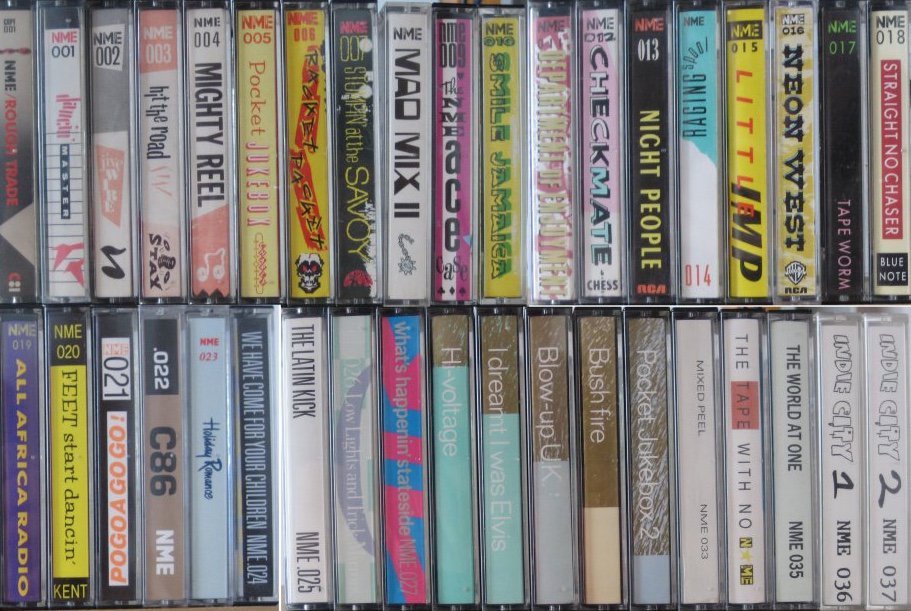
He’s also very much emblematic — as compiler-curator and the person who organised the permissions — of the world glimpsed in the image above: that amazing little wall of excellence. These are the nearly 40 cassette tapes that NME readers could obtain via the paper in the course of the 80s, as guides to whole worlds of music. As a writer, I’m entirely committed to the idea that words can open places up for you — but I don’t think anyone would deny that many of these collections were worth pages and pages of prose to a music paper, simply to establish its unimpeachable ambience of expertise and its remit to cover everything, past and present. The fashion was shifting — some rivals had already tossed both ideals overboard, wastefully and clumsily, and niche-marketing and nervous over-attention to narrower reader demographics were pressing everywhere — but for a few key years, Roy’s contribution helped NME stand invaluably stubborn against this tide.
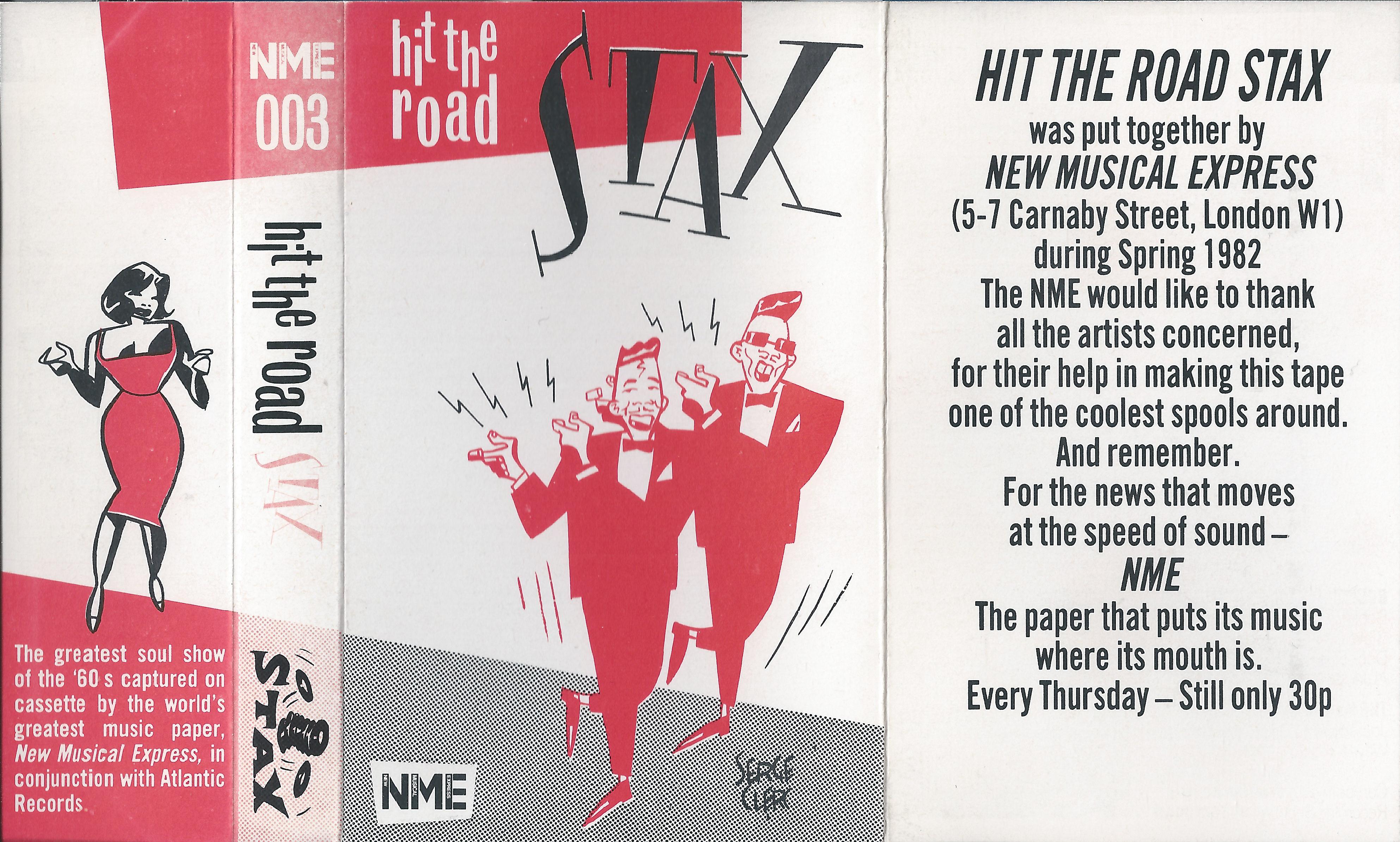
Some of them were this-here-now critical snapshots, C81 the first of a more or less annual tradition of perfectly designed punning samplers: Mighty Reel in 1982, Mad Mix II in 1983, Raging Spool in 1984, and so on, setting Ornette Coleman alongside Robert Wyatt alongside Haircut 100, introducing you to Trouble Funk, to XMal Deutschland, to Orchestra Jazira and Benjamin Zephaniah and Dr John. And then (perhaps even more important) there were the guides to jazz and reggae and Northern Soul and African pop, to fuzzed-out proto-psychedelia and melancholy alt country and classic 50s R&B. If you want a time-sink of the loveliest kind, as a response and a thank-you, then maybe go blog up a song-by-song breakdown of the contents — though others got there before you, here and here and here…
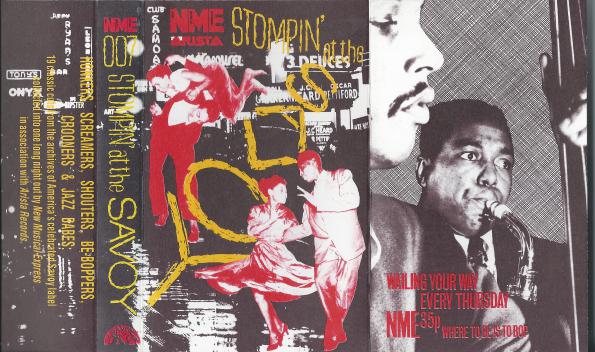
And I see that I seem these days to be missing fully 10 of them, when once I owned them all: because items this good go walkabout as the years pass. But what I’m lamenting right now, alongside fond memories of a one-time colleague, are the untold tales of all the backroom deal-making that also went into this, the horse-trading and the arm-twisting and the tantrums. All the questions you don’t think to ask until it’s too late.
RIP Roy Carr (1945-2018)
[If you like this post, please support my PATREON which will help me write more! Also let other people know that you think might enjoy it… ]
]]>titanic to iceberg, and from iceberg
to titanic again…"]]>
[This post originally went up at my PATREON: subscribers get to read posts and hear podcasts early — and help offset costs and time and help me do more of this kind of thing]

Hazel asked me in podcast 3 (the punk one) to name two pieces of punk writing that had had an impact on me as I first began to buy and read the music papers, so naturally I plumped for two pieces that ran somewhat before that (meaning, I suppose, that though I wasn’t thinking of this as I named them, that the impact was as large as it was despite being indirect). One was Tony Parsons’ ‘Thinking Man’s Yobs’ NME cover story on The Clash from March 1977, a key marker in punk’s evolution: from here on, the music mattered because it was political, the voice of unschooled dole-queue youth — or at least you had to push back hard if you wanted to read it another way) [Footnote 1]. The second is from nine months early, same paper, June 1976: Mick Farren’s polemic ‘The Titanic Sails at Dawn’.

Parsons is well known today, of course, if increasingly regrettable — and The Clash piece doesn’t currently seem to be on the internet (even under subscription lock-and-key at Rock’s Backpages). The ‘Titanic’ piece is at RBP, and The Guardian (link above) and elsewhere, and I’ll talk about it in a minute. The cognoscenti (= the very extremely old) know Farren’s name perhaps, but he’s fallen out of the rockwrite pantheon — to the extent that the path his life took seems a little unexpected, given what we think we know about rock and its aftermaths. So here’s a quick resumé.
Born in 1943 in Cheltenham, he moved to London in 1963 to study at St Martin’s College. He formed The Social Deviants (later just The Deviants) in 1967, as the voice of the Ladbroke Grove underground scene — their activities as much (anti)social as (anti)musical — and recorded the LP Ptooff! that same year, a strikingly unapologetic white-boy blooze-lout whatchumacallit statement. Its producer Steve Sparks once called it the “worst record in the history of man”; certainly it was the start to a long (if sometimes intermittent) recording career which continued till the year of Farren’s death.
And he wrote and he organised and he made mischief. Wrote: 23 novels (genre=Hawkwindish SF mostly), plus 11 other books and lots of poetry. Organised: 1970’s Phun City festival (no fences, no entry fee, hells angel security; for line-up see footnote). The chief (and possibly the only) activist for the UK wing of the White Panthers (possibly as a result also briefly questioned after the first Angry Brigade bombings). Mischief: bringing a chaotic lawless absurdist free-speech overthrow-everything energy to the underground paper IT — the original Thinking Man’s Yob goosing that magazine’s somewhat posh and nerdy and nervous boys towards trying something a bit more exciting, sometimes. He would also shepherd its comix offshoot, Nasty Tales, through a UK obscenity trial to a historically important not-guilty verdict. (This in 1973, the year he began writing for NME, a rock paper largely read by teenagers…)

By the 80s, when his idea of the underground was already distant and dispersed, he would flee to the US and Hollywood, of all places — where legend says he made a fortune scriptwriting, before losing it all and returning to the UK to live out his last few years. He died of a heart attack on 27 July, 2013, aged 69, while singing on-stage with the Deviants (as the band played ‘Cocaine and Gunpowder’). More than any other event his death catalysed this project — because I realised the people I needed most to talk to weren’t all going to be around forever.
And also because, at a heightened moment in among all this, he had had a fling with a much younger Julie Burchill — he was 34, she was half that — which ended in tears (for him) when Burchill’s lusty future husband Mr T. Parsons spotted kink-derived bruises on her arms and bloodied Farren’s nose there in the NME office [2]. Farren quit the paper, quit punk, and shortly quit the country [3].
So that’s the before-and-after of ‘The Titanic Sails at Dawn’, which warns that the ideals of the late 60s, at least as ferried on the vast expensive well-accoutred engine of the entertainment industry, were not safe! Because said engine is about to hit an iceberg! Said iceberg being (apparently) the exasperated NME readership — well, like dinosaurs, the Titanic is rarely a metaphor that bears up under examination.

Most of all, despite its rep as the rabble-shout that sparked the revolution, its tone is a long strange way away from the kinds of rescue-wreckage mission-invasions he had visited on IT (or the Isle of Wight festival). Earnest and melancholy, it’s a summary of a confusion: how did we get to where we are (and where actually ARE we)? How did a “vibrant, vital music” made in “small, sweaty clubs” become The Stones at Earls’ Court (May 76), The Who in Charlton Football Ground (ditto), Bowie at Wembley Pool (June) — not to mention Rod and Mick schmoozing with the Royals and Bowie seemingly flirting with fascism? Farren does worry at this last (his good friend and NME colleague Charles Shaar Murray was close to Bowie) — but judging by the shape of the piece, it’s the encroachment of these glitzy showbiz layers that actually alarms him. Bowie, he notes sardonically, is at least thinking ahead: and the ritzy white spectre stalking rock is Liz Taylor-shaped. Via the upper moneyed layers of the rock aristocracy, Princess Margaret has somehow simply absorbed his beloved anarcho-scruff people’s movement.
Let’s dig into the argument a bit.
QUOTE 1: “From the blues onwards, the essential core of the music has been the rough side of humanity. It’s a core of rebellion, sexuality, assertion and even violence. All the things that have always been unacceptable to a ruling establishment. Once that vigorous, horny-handed core is extracted from rock and roll, you’re left with little more than muzak.” This was the most basic rock and roll ideology: the idea that sex and dance and music-noise can shake the wall of the citadel, and cause princes to tremble. Just two years later, younger writers (as goaded by pranksters like McLaren) were no longer at all so sure. The call to untrammelled sexual freedom was often — at a minimum — problematic, and couldn’t the noise be turned into a distraction, a palliative even? Yes, the Las Vegas lounge crowd might wrinkle their nostrils, but did those who actually ran things care either way?
QUOTE 2: “One major lesson can be learned from the 60s (…) is that the best, most healthy kind of rock and roll is produced by and for the same generation” (my itals). Again, a tale rock very routinely comforted itself with: that only within the solidarity of a narrow age-range can the best attitudes flourish. Except for Farren, it’s stopped being a comfort. It probably wasn’t entirely evident to him at the time, but this op ed declaration is him quietly stepping away from of the ship’s bridge. Enabling his own immolation by handing control of the ship’s wheel to the, erm, wellm the iceberg (this metaphor is so bad!)
And thus everything will have to be remade anew, and by youngsters, to be good again. Bcz nothing says “smash the system” like planned obsolescence, right? Youth über alles was arguably the worst mind-habit of the counterculture – which of course punk happily swiped (because when you’re 20 who doesn’t want to hear that you can’t be wrong about anything).
LAST QUOTE : “[I]t is time for the 70s generation to start producing their own ideas, and ease out the old farts who are still pushing tired ideas left over from the 60s. The time seems to be right for original thinking and new inventive concepts, not only in the music but in the way that it is staged and promoted.” I mean, yes, he’s absolutely opening a space for something, and something that he’s just announced the old farts can’t possibly deliver, and yes, a change took place. But original thinking and new inventive concepts — what does it say that that this now reads like every push a tech start-up makes when it’s about to “disrupt” an industry? (What if buses, but not paying the driver?)
Punk, Greil Marcus once wrote, broke rock in half. Right or wrong (and fascinating and difficult and in retrospect strange and even alarming), rock culture was widely still assumed in some sense undivided up to this moment: certainly by Marcus, certainly by Farren. Hence perhaps its apparent ability to (and will to) swallow up in its unfolding variety even its cultural and political opposites — an ability Farren was now declaring his absolute doubts about (the swallowing would go the other way). Which meant this was not a mind-set that could actually heal the world: since — apparently — it had entirely to cleave itself in twain with every new generation. You can blame this conundrum on Boomerthink if you like – Boomers is largely who it came from – but that only turns its overthrow into its reinstatement. The price the successor generation paid, for being enabled and enthused by this abdication, was to be utterly locked into this same insurmountable doubt. With time itself your chief enemy, and ruin cemented into all your schemes…
He was sane and sanguine about it all to the last, I think. Certainly he was posting on his blog until a few days before he died – it’s here, and it never stopped being him (and Elvis and Marilyn and… ). And unlike pretty much everyone else in his milieu in 1977, he never cut his hair.
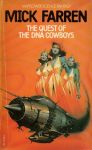
Footnotes
1: I seem to be moving backwards here, but the previous post is among other things a map of the forms the pushback took — not least because it takes the form of a map.
2: This is how the tale runs in the early versions of the kinderbunkerlied anyway. Latterly Burchill very much rescinded Farren’s moral doom, reaffirming her own teenage agency and fascination with him — perhaps as an eye-catching way to underline how unexciting and uninteresting her first marriage had turned out to be.
3: In the end he returned to the UK and to punk. Here’s some of Black Vinyl Dress, released in 2013, its bluesier stretches as out of time as trad jazz had been in the mid-60s, when he first arrived in the Underground Press to tell them all to get with it.
4: Phun City line-up = MC5, The Pretty Things, Kevin Ayers, Edgar Broughton Band, Mungo Jerry, Mighty Baby, Pink Fairies (who stripped on stage), and of course Steve Peregrin Took (sometime of Tyrannosarus Rex) and his band Shagrat. Attendees included a young Billy Idol and a young Mick Jones. The circle is not broken… (except it would be, and was).
[If you like this post, please support my PATREON which will help me write more! Also let other people know that you think might enjoy it… ]
]]>of true punk"]]>
[This post originally went up at my PATREON: subscribers get to read posts and hear podcasts early — and help offset costs and time and help me do more of this kind of thing]
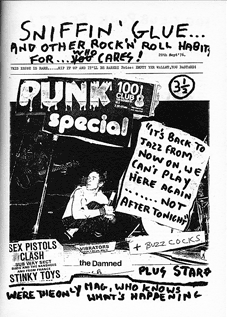
A fun thing about the podcast is the way Hazel’s questions rattle away inside my most ancient, unexamined opinions — things I think that I no longer quite remember starting to think. When I pop-quizzed her on the groups that played in the 100 Club Festival, 20-21 September 1976, I wasn’t surprised she’d heard of almost all of them: it was a tiny two-day event more than a decade before she was born, but (a) she is knowledgable and full of curiosity and obsessed with music past and present, and (b) it was the founding event for “rock at the end of rock”, when you were required, as an index of your commitment to the necessity of the splintering, to take implacable sides within your own splinter. To this Shropshire-based punk noob — I didn’t move to London for another six years, I hadn’t yet started reading the music weeklies — the festival mapped what punk had been in its first (some say only) year, and what it was going to have to become as it expanded and divided and dissolved. Above all, it’s the moment of division, forming lines that can just about still be traced, if you look carefully in the right places.
100 CLUB PUNK SPECIAL, 100 OXFORD STREET W1D 1LL: SET LIST
Monday, 20 September 1976
• Subway Sect (first ever show, some prior rehearsal) [1]
• Suzie and the Banshees (first ever show, no prior rehearsal) [2]
• The Clash [3]
• Sex Pistols [4]
Tuesday, 21 September 1976
• Stinky Toys [5]
• The Vibrators (first ever show, some prior rehearsal) [6]
• Chris Spedding with The Vibrators [7]
• The Damned [8]
• Buzzcocks [9]
FOOTNOTES
1: Oblique songs, flatness of affect and style, militant refusal of clichéd stage habits: “Off the course of 20 years and out of rock and roll” is how they went on to put it in ‘A Different Story’ (Rough Trade B-side to ‘Ambition‘, 1978). Punk as an end to something — itself and what went before — which we were some of us young and naive enough to pretend was an end to everything. Even if the Sect sorta kinda (to be very mean) invented indie, I love love love Vic Godard, the way he looks, the way he thinks, the way he sings…
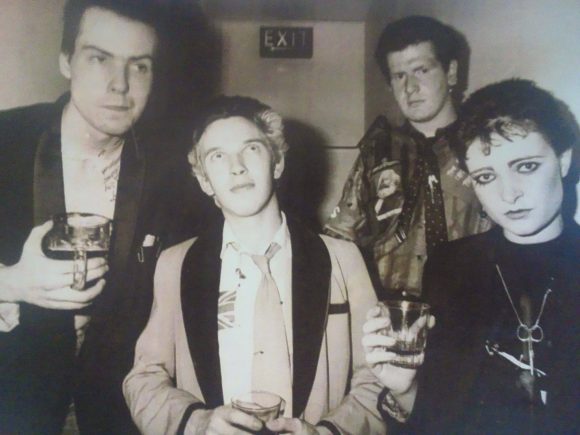
2: Strong Women versus the Desedimentation of Stupid. That first year was a compressed tale of extreme opposites: it’s emblematic that the Banshees — who became one of the longer-lasting non-retread units — debuted by stepping up across the footlights out of the crowd, the archetypal fan-turned-challenger move. Sid Vicious on drums, a volatile mix of bored headfuck game and moronic violent cartoon; not yet a Pistol. Viv Albertine (to this day a loyal friend to the best of Sid’s memory) says he had a lively mind, at least until the character he chose to cosplay sock-puppeted his entire life. Might-have-beens: until he quit them for this one-off, he’d been a Flower of Romance, alongside Albertine and Palm Olive (soon of The Slits) and Keith Levene (ditto Public Image). As for Sioux, all 1920s flapper frame and expressionist make-up, I likely thought of her then as a tomboy. As a term it’s probably more suffocating than accurate, looking back, but it was absolutely meant approvingly: gender was on the move and we didn’t yet have the words, only the inexpressible excitement…
3: There was beef on the night because Sid and Sioux were still sporting swastikas: The Clash wouldn’t let them use their nice pink-sprayed guitar amps because of this. Left politics would be a core element of one wing of punk, and The Clash — brandishing a radio-set instead of between-song chat, tuning it to discussions of bombs in Northern Ireland — made the earliest running. With its ruthless excludings, with their horrible entourage, Clash politics itself was maddening, and many ended up not liking it or them much: for all their energised leather-clad sexiness and finger-stabbing, for every friendly or human gesture, there was always something pointlessly ugly or self-regarding or obfuscatory, or, well, rock and roll. Rock and roll was bad. In the podcast, Hazel rightly celebrates the strain of doubt and unmacho confusion that’s also there, under-emphasised and under-utilised. But if you wanted to think yr way through and out of the tangles around us, the weird-left contradiction-led pranksterism infesting the Pistols seemed much more valuable to some (to me). Too much Clash self-mythology was a mask against the mess they actually (and more interestingly) always were. The contradiction is the hook: and so here among the rest of it began (to be more unkind still) the Blairish “Only Way is Up” multicultural dad-rock posture…
[ADDING: OK i’ll unpack that last sentence some other time lol. The other thing I shd add abt The Clash is that they REFUSED TO GO ON TOP OF THE POPS, and this is yet another reason why they weren’t and aren’t punk…]
4: In a month or so’s time, when ‘Anarchy’ is released, McLaren will somewhere announce that “The REAL fans aren’t buying the records” — a declaration of authenticity that’s a riddle and a paradox and a fuck-you. Till now a writhing muscle-knot of distinct social layers and friction-difference within 2nd-Gen Mod Pop, held together by irritability and inertia, The Pistols will shortly deliquesce from fascinating conflicted local focal point-source into one-note National Tabloid Outrage. Their purpose and value in (music-press) print had been to be a clot of gurning louts, who somehow — in the right minute, and without McLaren’s approval — always also mixed intellect and discernment into the aggression. As Self-Destructo the Cartoon Bassist, Sid will be the capstone of McLaren’s not understanding rock culture (and not even slightly caring). [Adding: Glen Matlock is of course on bass tonight.] As the media canvas abruptly changes after Grundy, as the scale of the game switches and McLaren switches with it, residual traces of countercultural resistance flatten into unusability for him. For Lydon, the only way out is back and down into a fully refashioned version of the prog underground. For Sid, it’s upward into the pantheon of uselessly dead young idiots.
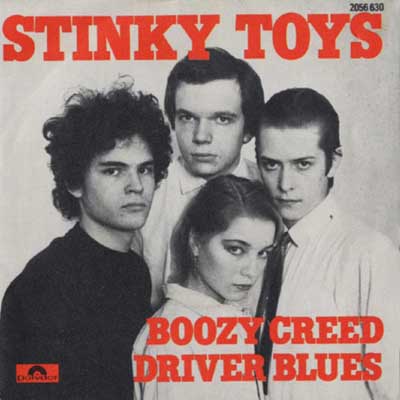
5: Meanwhile, one-time 68-er McLaren invites over some young Parisians to demonstrate that punk is international (lead shrieker Elli Medeiros is from Uruguay). Due to play after the Pistols when everyone’s gone home, Stinky Toys refuse, are bumped to first slot second day, and more or less vanish from history. Tho actually two LPs follow, the second a pleasingly sophisto-scratchy world-pop type thing. On the night, however, Stinky Toys (so legend says) mainly played Stones/Dolls/Bowie knock-offs and covers. But The Banshees had utterly upped the ante…
… pausing to note that according to the Sniffin’ Glue special 100 Club issue write-up, The Damned played before The Vibrators. I’m working with the running order in Wikipedia, more fool me…
6: I kind of like that I have nothing at all to say about The Vibrators, my dislike still impressively crisp despite being based on almost nothing at all. For whatever reason, they were fake punk. Singer Knox was 31, had been knocking around the pub rock circuit for years. They had formed just for this event. They are OLD: if nothing else, the time for the past is past. The demand in the air was that we pick Yays and Nays and fiercely stick with them (no one imagined it would still shape things 40-plus years on). So yes, The Vibrators are bad not good (because someone had to be and it was them). Sorry Knox, sorry all — it’s not you, it’s er structural is what it is.
7: Instant counterpoint: Spedding is a year older than Knox, a grizzled session man whose resumé includes Mike Batt’s Wombles, the Alan Parsons Project, Harry Nilsson, Bryan Ferry, Elton John, Art Garfunkel and (possibly relevant) the early Pistols demos, had had a single in the charts in 1975: ‘Motorbikin’. It’s OK at best and he too has more or less vanished from history, but — even with The Vibrators as his backing band — in some ineffable way far more honourably.
8: Has anyone ever tracked down or talked to the girl who got bits of smashed beer glass in her eye during The Damned’s set? The Damned were the third of the original punk trinity, in the wake of The Pistols wake-up call, an offshoot, just like The Clash, of The London SS. Goofy, harmless, a bit clownish, a bit arsey, they were somehow the first to get records out. Drummer Rat Scabies had a v poor rep with women, possibly a reason there was already beef with The Banshees. Like The Clash, they too had beef with The Pistols, except it seemed (at the time) somehow second-tier, neither calculated nor world-historical nor consequential. Now I kind of like their silliness and hapless lack of cultural import (also tbf some of their songs). Of course the beer glass was thrown by Sid Vicious.
9: From Manchester, three gentle boys and one egghead (Howard Devoto). More even than the Banshees and Subway Sect, Buzzcocks were a glimpse of the immediate future — the thing that came (anachronistically, unhelpfully) to be called “post-punk”. They were from Manchester and for reasons this mattered tremendously. In a movement that deplored love songs they wrote little else. Of course they were modern and non-gender-specific bcz hurrah (Pete Shelley was bisexual and so — as far as I was concerned then — was everyone else). Their sound had this gleaming bevelled edge, like bauhaus furniture made of controlled pop noise. Their high-colour sleeves would be designed by the peerless Malcolm Garrett, and somehow for a season they embodied everything fluidly anti-hierarchical about this time. New Music Night and Day, as the Bowie LP hadn’t ended up being called…
So yes, these were the maps…
… laid cross-ply across one another at subatomic size — diachronic AND synchronic, as the clever kids learned shortly to say (I was one, and proud to be). Here, squirming against one another were history and psychology, geography and gender: here in the distributed space after this teenytiny Big Bang were all the forces in play (for an obsessive reader to pick up and glom onto and decode in the months and years to come; for outsiders to remain entirely baffled by). I was a quiet-souled Buzzcocks boy, to be sure — but I always had eyes for the harsh glamour of the hard-body Banshee type, imperious and witty and non-nonsense. Here was youthful year-zero impatience and rigorous democratic praxis, kindness and curiosity and nihilism, damage and surprises and (now and then) fun. As a great monkey once wrote, It was the best of times, it was the blurst of times.
If you like this post, please support my PATREON which will help me write more! Also let other people know that you think might enjoy it…
]]>lennon’s REVOLUTIONS 50 years on"]]>
“The blues are beautiful because it’s simpler and because it’s real. It’s not perverted or thought about: It’s not a concept, it is a chair; not a design for a chair but the first chair. The chair is for sitting on, not for looking at or being appreciated. You sit on that music.” (John Lennon to Jann Wenner, 21 January 1971)
 When Jack Hutton quit Melody Maker in 1970, to set up what became Sounds, he told Richard Williams, who stayed behind, that it would be a “left-wing Melody Maker”. Hutton’s no longer with us, so I suppose if I get the chance I’ll have to ask Williams one day what exactly was meant by “left-wing” here. My guess — based on what Sounds actually turned out like — is that Hutton meant the new paper would be centred on rock. Even though both papers covered rock and pop and everything else, MM’s moral centre was arguably still jazz at that point. Even though the jazz fan-base always had a left-wing in the UK, with old-school communists solid among its supporters and chroniclers, it was a music (or so many seemed to feel) whose time was past. Rock was new and rock was now, the very voice of youth — but beyond this, rock had had, for a while by then, a tangled relationship with politics, radical left politics in particular.
This tangle reached to the very top of the charts. In 1968, as the tremors spread from the May insurrection in Paris — when everything turned upside down, and pop became art and vice versa — three versions of the Beatles song ‘Revolution’ were recorded. The first and last (the long musique concrète Bonzo-skit sound poem ‘Revolution #9’) were on the White Album, which came out in November. The re-recorded version of the first came out a little earlier, in August, as the B-side of ‘Hey Jude’. Perfect for exploring street politics as a fact and a possibility, and post-split the song was still being picked over three years on, in editor Jann Wenner’s gargantuan two-part interview with John Lennon for Rolling Stone (some 36,000 words long in toto) and in Tariq Ali’s Red Mole. The former was exactly what “the Stone” had been devised to do. The existence of the latter, a serious-minded conference with actual frontline radical activists (Robin Blackburn joining Ali for the occasion) is more surprising, an index at the very least of how wild and mixed up the times actually were.
Wenner always saw his role as chief courtier to the big new voices in music, less cautious investigator than loyal amplifier : which means Lennon is nowhere pushed or tested. It also means he’s comfortable: he unwinds deep into confessional mode, hinting at the worst of the group’s untold stories. Clean-cut to all the world, the real Beatles on the rise were “bastards”, he says — “you can’t be anything else in such a pressurised situation” — and the tours were “like the Fellini film Satyricon”, orgies and “junk and whores and who-the-fuck-knows-what…”
This is no longer virgin terrain, of course. Freighted with his huge authority for rock-readers at this complicated, confusing moment, swathes of this much-cited interview have simply entered pop history’s DNA. “The dream is over,” he sang on John Lennon/Plastic Ono Band, his disenchantment with the counterculture at large growing as much anything out of his own personal exhaustion, and how we all feel when a relationship fails and a fellowship breaks. With Rolling Stone at the centre of how the music was started to understand itself critically and politically, Lennon’s many stances in this conversation were a deep permission as well a disenchanted retrenchment. Pre-Beatles rock and roll is the truest, best music, he now appeared to insist, and if we followed his charismatic lead, we’d be shunning McCartneyish Pepperish pop artifice on one side, proto-prog jazz-muso virtuosity on the other, ideally so as to re-enter a space of of undeluded unadorned therapeutic naturalism.
The most immediately startling thing about the Red Mole piece, from today’s perspective, is that it happened at all: startling that Lennon agreed to it, even more startling that the revolutionary organ of the International Marxist Group — a Trotskyist splinter maybe 1,000 strong at its peak — decided so publicly to engage with the thoughts of a colossally well off former frontman of a recently dissolved boyband-stroke-chartband. It’s a clue to how tiny and village-like the London scene still was, of course (despite Lennon’s recent relocation to New York) — but it’s also a clue to how much music and changes in the music mattered to the underground then, political or otherwise. Quotes from Beatles, Stones and Dylan songs routinely supplied headlines and speed-read slogans: this was a lingua franca and a badge of identity; not just a shared backdrop but a speed-read signal where you thought things were at, and the ways you belonged — or didn’t — to any relevant micro-constituency.
The Red Mole encounter began in late 1968 with anti-war activist John Hoyland’s disgruntled Beatles fan-letter (scroll down) to Black Dwarf (the paper Ali had helmed before Mole, which is to say before a micro-sectarian split in the relevant editorial). As a Beatles B-side. ‘Revolution’ was sour and suspicious and not at all in step with the movement: “if you’re talking about destruction/minds that hate/Chairman Mao… count me OUT!” Fanboy Hoyland was dismayed: a former idol was misperforming, the song closer to Mrs Dale’s Diary than to the Rolling Stones [Footnote 1]. Hitching from Keele to interview Lennon a few weeks later, students Maurice Hindle and Daniel Wiles show Lennon this letter, which clearly nettles him. He reads and rereads it more than once, shows it crossly to Ono, and in early 1969, he sends an angry reply (scroll down)…
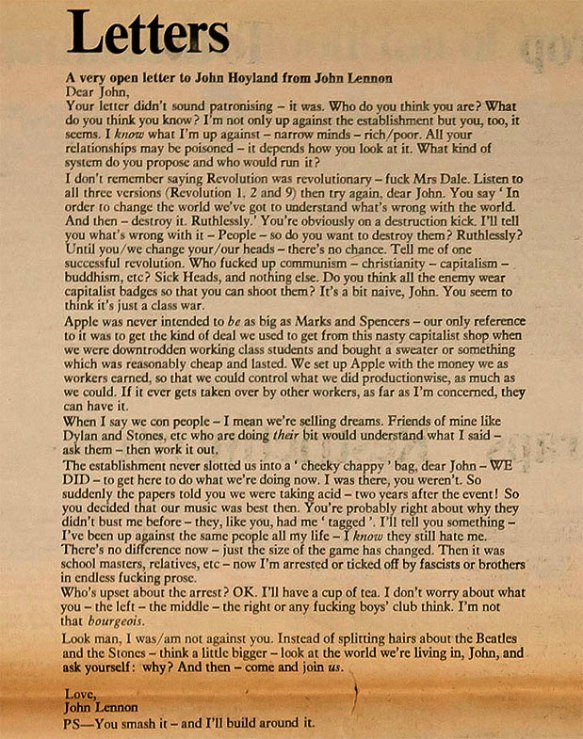
That set the stage: in the wake of the final two-year Beatles meltdown and then the Wenner juggernaut — which is cited in the opening Red Mole question — the showdown. No fireworks, though: Lennon handwaves his way around current world politics unchallenged (Ali earnestly corrects him on Yugoslavia and Tito, but tolerates his apparent renewed enthusiasm for Mao’s Cultural Revolution). As for shifts and values in music in recent years, Blackburn in particular pads gamely through the critical nostra of the day, and – as the seasoned professional in this area — Lennon doesn’t challenge him. Much of it is commonplace stuff, but — in among all the busted myths, unmoored generalisations, snap judgments, settled scores and dick moves — these two conversations platform a wounded musician busy quilting a revised aesthetic from the rubble.
How to sum it up? Pop is bad and you should feel bad: let’s get naked and rock and roll! Naked emotionally, naked intellectually and politically, naked, well, yes, kit off for the LP sleeves lads, and fuck the squares if this bothers them… Rock and roll, especially black rock and roll, speaks urgently to the white working classes precisely because it comes from a soulful place of unrepressed, undiluted honesty and self-knowledge free of all possible bullshit. We have forgotten to know ourselves and act accordingly; this music is revolutionary for teaching us to turn once more to both — and this is happening and that’s the way forward.
(Narrator’s voice: it was not and it was not.)
And yes, it’s very easy to mock all this now! And to read it as early mass-cultural steps — disguised as urgent critical recalibration — down the long road to centrist dadrock and the present-day so-called authentocrat hegemony blah blah. Blackburn’s and Ali’s credulity seems a bit of a shocker, from our wised-up times — but Amiri Baraka had not yet published his rueful tales of the Black Arts Movement, and the contradictions within cultural nationalism were still confusedly working themselves out in 1971. Black Power was still a concept that amazed and enthused people, white and black — and of course “Black is beautiful” remains a counterstrike today against disabling self-hatreds and self-erasures.
The excitement of the encounter with rock and roll had begun with the shock of realisation that you can learn as much or more from people far outside your own neighbourhoods: that cultures not your own are not by dint of this lesser than your own — a valuable discovery — and that it’s good to choose to be encouraged to enjoy life more and to be a better deeper person in your understanding and actions. But the inspiration had gradually congealed into a habit and even a religion, of the projection of the desired angelic image (of pleasure and depth and goodness) onto these same cultural others. It’s no fun at all to be trapped at the other end of this projection— made a cultural-political saviour without being asked — and doubly grim when the projection insists that being your natural self is the only acceptable forward-looking politics. This was the high era of the method-acting delusion, in which — unless truth comes from deep within your own personal pain— everything is just lies and fantasy.
Some of the time, Lennon knew better. And so, as long-time operators in the flyspeck viper-pit of far left politics, did Ali and Blackburn now and then. They knew that performative ambiguities are essential to coalition-making and keeping different interest groups onside together. But 60s revolutionary socialism was still very much under the moral spell of Sartre’s existentialism, a philosophy never especially smart about the value of drama and of fiction beyond simple agit-prop. Besides, British class identification in the borderlands between lower and middle class is the murkiest of kaleidoscopes at the best of time, and neither Blackburn nor Ali was well placed to gauge this, let alone push back [2]. When Lennon titles a song ‘Working Class Hero’ (and despite things he casually claims in both interviews), it’s as much angry disavowal as self-declaration, and in any case it’s ambiguous: is he a hero who’s working class himself, or a pop-star hero to the working class? (Ans acc.him = combination neither and both…)
Either way — despite his unimaginable wealth — it’s allowed to stand both times. And yet there’s so much here to ask hard questions about. As Wenner allows him to demonstrate, letting him talk on at such length without interruption, he’s anything but a natural soulful authentic angel undivided from himself and free of bullshit, but rather a torn and hurting mess of complexity, contradiction, evasive cunning, irony, play-acting and, well, self-misdirection. Free to explain himself, to present a self-portrait, he’s at once bolshy and timid, arrogant and bewildered, confident in his snap-summaries yet still beguiled by curiosity — and, like every bright pop-star, unendingly caught between the will to rile and the will to please (including pleasing revolutionaries who should be quicker to spot this).
 And stripped of all this, he might have been happier — except he’d also be unknown, not to mention poor. In an era when more people of working class background were entering tertiary education than ever, the Beatles counter-narrative was by contrast one of ferocious self-education and mastered expertise, very much an alternative and anti-official model for intellectual self-mobilisation. His dismissal of almost the entire trajectory as myth — we were best on-stage, he says, before we ever came into the studio — is also a kind of a disavowal of any of this possibility. And — as upper middleclass college kids themselves —his interlocutors seem to embrace it, though it’s surely strangely antipathetic to the politics of possibility they want him to sign on to, to manifest and broadcast. Again — profoundly unsure of what they want from the exchange — they decline to challenge him, to follow through where he’s half-pointing.
 The Lennon/Ono LP ends, or nearly ends [3] with a list of things he no longer believes in — Jesus, Buddha, Elvis, Beatles — and the plain declaration: “I believe in me, Yoko and me, and that’s reality.” It’s like coming home, he tells Wenner: “I’ll never change much from this.” The leisure of space and time to become uncomplicatedly yourself, to feel and and believe in and know home this way, is afforded very few people — and this, if you like, is how a mark of how far his stratospheric wealth has taken him from his birth-town, his roots, his class. Meeting Yoko as the breakthrough key to self-discovery in this best of matching companionships — of course it’s a tell that she’ was from the other side of the world, the other side of the arts, from a comfortable Japanese family, well travelled, well schooled. The many claims don’t add up — and neither interview presses him on any of this.
Epilogue: An LP a year until 1975, and his collection of rock and roll standards, then a five-year sabbatical — long aeons in 70s pop time — before Lennon returned to recording in 1980. By now the conversation that began when Sounds split off from Melody Maker in 1970 had changed deeply (not least as a consequence of these exchanges). There’d been wide revolt against the the leisured, over-wealthy aristocrat entertainers who’d shaped the recent past and seemed to clog up the present: punk rock, the revolt was called. Radical politics still had a toe-hold in the pop press — but the critical factions closest to it mostly took the line rock is now bad and you should feel bad. The lingua franca was increasingly contested. Lennon was still welcome, unconfronted, in the pages of Rolling Stone, but his long absence from the UK conversation ensured few was overawed by his re-emergence. In the post-punk and new pop years, almost everything he had seemed in the early 70s to stand for would be questioned.
And then of course in December 1980 he was shot dead, by someone deep-lost in the labyrinth of a megastar’s unkeepable promises. Suddenly changeless in death and embalmed in grief-stricken nostalgia, he was removed from all useful reassessment, as everything round him went cold and congealed. Home, he’d said, but just as he set out once more, he was stopped. There are clues where he might have gone; how he might have evolved. His recording with Bowie, for instance — because he too was always a kind of proto-glam quick-change artist, forever negotiating the obstacle course his own throwaway comments had strewn before him. As for the blues, its potency was never of course a function of its unadorned primitive simplicity. Quite the opposite: it always involved reflection, and its energy and value came from the sheer layered density of all competing histories hurtling through it.
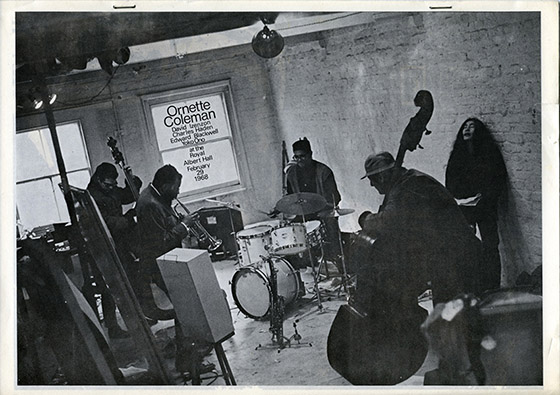 And of course there was the work Yoko had made with him in the late 60s, the be-ins and the bed-ins and the bag-ins, these high-visibility celebrity stunts whose purpose was to import go-slow bafflement and blockage into the flow of mass-media communication: the spectacle, but discursively on strike. The most heartening surprise twist in the Wenner conversation — in both conversations — is his belief in Yoko as artist-musician, his commitment to the idea that everyone should take proper note of her. Besides Warhol, that ineffable blank, he celebrates Fluxus and nods to Ornette Coleman as two unimpeachable stages in Yoko’s past, her rock and roll.
Warhol aside, the prankish avant garde before 1968 had seemed an individualised, out-of-reach luxury, supported by and therefore aimed at the wealthy and the over-educated. Pre-Beatles rock and roll is the truest, best music, he may have been arguing — but to say so and to foreground her, he has also to argue that she’s rock and roll — which complicates and expands the definition, to say the least. By refashioning the story to include her — even in a sense to re-begin with her — Lennon was quietly re-weaponising his art-school inventiveness and tossing it out into the wider world, the widest world thinkable, in topsyturvied form. He opened the doors of imagination and possibility even in the pop music trade press: no intellectual luxury is too good for the working class… this would after all be a pretty good motto for the toughest strands of post-punk…
Footnotes 1: It’s weird to recall how much of a free pass the Stones still had with the most rigorous 68-ers. Though of course they were carefully solicitous of this touchy part of the market: the song ‘Street Fighting Man’, about the May riots in Paris, was widely enough thought to refer to Tariq Ali himself that he brazenly named his memoirs for it.
2: Ali is from the higher-born Pakistani aristocracy, and extremely engaging and perceptive about it (subscription needed).
3: Actual closing song: 52 seconds of ‘My Mummy’s Dead’ sung down a telephone to a nursery-rhyme style tune (which isn’t ‘Three Blind Mice’ even though everyone for some reason says it is).
If you like this post, please support my PATREON which will help me write more! Also let other people know that you think might enjoy it…
]]>