A few weeks back, Marcello asked if I had any thoughts on this TPL post (about, among other things, Johnny Hates Jazz and The Wire as it was in 1986/87). Well, I did and I didn’t: I did because this era of my mentor Richard Cook’s project is very much the making of me, and I absorbed an enormous amount of his sensibility and thought a lot how to advance it best (whether or not I did is for others to judge; sadly he’s no longer with us for his perspective). But I didn’t (at least tactically, for now) because I have for most of this year been organising a conference on UK music-writing in the 60s, 70s and early 80s, trying to focus on how things had evolved from roughly 1968 (and the discussion of rock in the underground press) through to maybe 1985, when (in my judgment) Live Aid hit the inkies hard sideways, and changed their political ecology for good (Geldof’s revenge, you could call it). The serious social potential of pop began to be more and more of a topic for the tabloids and the broadsheets: the inkies began more and more to fold in into their own niche, exploring less and less. In this they were reflecting changes in the world, to be sure — but they were also amplifying and accepting these changes.
Richard’s was (to me, then) the smartest part of the counter-response to these shifts — The Wire considered as a magazine about all possible music and indeed all possible ways to write and think about music, including the free play of the most scholarly anti-philistines against pop’s and punk’s cheerful teenage school’s-out yawp (not to mention a phalanx of more studied anti-music and anti-art stances). Max Harrison alongside Val Wilmer alongside Biba Kopf alongside, well, me.*
Anyway, looking too long and hard at (meaning reassessing) all this right now means not just distracting me from a rolling reassessment of the earlier era — as I chat to the various likely participants in my conference, and recalibrate my understanding of how things were — but probably undermining my entire current provisional grasp of what I need to be grasping. So for now**, you should be boiling what I am (possibly) thinking out of here (where I outline the purpose of the conference and name the participants) or here (a Facebook page you can like and also share) (share it!) or here ( tumblr with some nice pictures and also rolling thoughts on what organising a conference entails) (grief! also joy! so far much more joy luckily… )
Here’s who’s confirmed (reverse alphabetical): Val Wilmer, Richard Williams, Mark Williams, Simon Warner, David Toop, Bob Stanley, Hazel Southwell (nee Robinson), Laura Snapes, Mark Sinker, Cynthia Rose, Penny Reel, Mark Pringle, Tony Palmer, Charles Shaar Murray, Paul Morley, Toby Litt, Esther Leslie, John (aka Jonh) Ingham, Barney Hoskyns, Jonathon Green, Beverly Glick (aka Betty Page), Paul Gilroy, Adam Gearey, Simon Frith, Nigel Fountain, Tom Ewing, Kodwo Eshun.
(Not quite confirmed but definite interest shown: Tony Stewart)
 Panel topics not entirely coalesced yet but will likely include: what the undergrounds knew that the mainstream was missing; rhetorics of outsider style; the changing make-up of bohemia; handling pressures on the playpen, professional and commercial; the rock press as a species of agit-prop samizdat; and legacy and lessons today…
You’ll need to register/book here but it’s free!
*Me (that is) as in the me just today delighted to be in receipt of the intelligence that (OMG LOL) Daphne & Celeste (@Daphne_Celeste) is now following you on Twitter!
**My rule-of-thumb back in the late 80s and early 90s, on ways to ensure The Wire really actually did have the widest possible scope, was to think of it as the mini-arena in early 80s NME jostled with mid-70s MM, allowing strategic space for sensibilities like Musics and Collusion, the late 80s Village Voice (a revelation to me) and even (bcz I have never not been a bit of a goth) Zigzag.
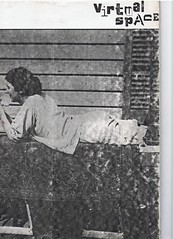 It was called Virtual Space and there was just one issue, “issue zero: place-kicks”. We made less than 20 copies, mostly by hunting round town for a photocopier with an A2 bed. It was an experiment, a mockup for a magazine, and it had no date appearing anywhere on its pages. (But it was early 1989, I’d just quit NME and wasn’t on-staff yet at The Wire.) We were serious: we went looking for funding. The other of the two being designer Paul Elliman, who’d just left The Wire. (Note to self: I haven’t seen Paul in an age and must call him up.)
The media momentum in the mid-80s was very much towards the elective affinity niche: people who took themselves to be anti-system dissenters* had pioneered the communication micro-cluster as a supposed zone of resistance (the indie label, the avant-garde movements, the specialist journal, the theoretico-critical discipline), but the system they declared they were resisting was actually not at all unhappy with this development. Self-balkanised geometries relocate (and quickly muffle) dissent. Freedoms of choice; freedoms of association: knowledge and intelligence arrive and evolve as a consequence — of course — of a degree of unfreedom in both choice and association. There was a knot here, a contradiction inside a conflict inside a conundrum: fuzzily but very strongly, I wanted start from the established reactive niche to push in another, much wider direction, against the encroaching self-quarantine around me; to shake up all the little comfort zones of specialisation. What would a magazine look like that covered everything, from every perspective? What would its production routines and technical shortcuts be? How would this ethos shape its editorial tactics and strategies?
(I should write this whole story up properly. Actually I have been writing it up properly, in the guise of a review of a record no one likes, including me and its makers. Read it when I finish it aka THE INDEFINITE FAR FUTURE dot dot sigh #smh)
Anyway, like Paul I too left The Wire, my project not at all finished — luckily with a few professional skills I could barter into a (much less ambitious) working life. For a decade or so, from c.2000, I had been giving a good part of my time — and surely more significantly my emotional energy — to my parents’ welfare: they were increasingly old and increasingly ill, and I owed them the best of me. Now that this duty is properly discharged, I’ve been returning to the projects of my youth, and wondering again — pretty ludicrously, given all the changes in media and how you get paid — about running some kind of magazine. Knowing full well that I have neither the resources (time/money) nor (in certain basic ways) the temperament, lessons I learnt the hard way the first time round. What should I be doing instead? The internet very much suits my temperament and habits, in good and bad ways. How can I shape these into a thing that’s useful — or anyway beguiling — for others (as I like to believe I briefly did, long ago, in the aftermath of Virtual Space issue zero, which helped get me an editorial role at The Wire).
At a minimum, I’d like to be pointing readers to the various writers that I routinely turn to, and see what transpires. If I could even get people squabbling debating in the comments-threads here, and attract traffic as a consequence of the smell of blood in the water quality of the discussion…
Have fun starting arguments? Light the blue touchpaper and lean in? No: those may have been my mottos at The Wire more than 20 years ago, but I don’t think they helpfully apply any more. Firestarting is hardly the problem on the internet: it’s how to bring together mutually inflammatory material and not set off exhausting flamewars. It’s something patiently grown-up, not something cheekily adolescent. Grown-up but enticing; catching, even. Hmmmm.
Let’s pick a scatter of who I might mean, and you the reader can do the math. Bearing in mind that my attentions will shift from month to month — I read a lot, and I likeread more a lot more than I hateread (though as you’ll see this somewhat means I merely hateread vicaroiously). I’m a magazine journalist: by definition I honour my boredom as hidden critique. If the butterfly-brained refusal to settle is the manifestation of one kind of symptom, incessant re-appearance at the same spot is another. This would be a very rough sketch of a possible ground; let’s just say that, and not pay attention to the clangour of everything that isn’t here.
• Marcello Carlin (here being nice about me). We are pals, of course. Whatever the thing is that I’m building, it can’t be hostile to fellowship or intimacy; and so must take into account the issues that can arise from this.
• Frank Kogan: here with an oldie that adverts to a tradition of writing and thinking which is not so distant from what I have in mind. Aside from the late Richard Cook, the two figures whose aesthetic I most wanted to fuse at The Wire (or clatter against each other, as a way to talk about all kinds of music) were Greil Marcus and Frank. I wasn’t really there long enough (and also hadn’t entirely had my head round Frank’s thinking, I suspect).
• Seth Edenbaum, and a PDF of a work-in-progress. In some form this should already have been a published book (for several years). As with Marcello and Frank, a friend — and I feel a slight squirmy degree of embarassment that I’ve haven’t been able to do more to draw proper attention to his work, and to him. I used to be good at this; or at least, I once briefly had a platform I hoped to do this kind of broadcasting with. Which some people remember fondly.
(Already we possibly recognise an underlying question: what is wrong with the cultural world we face, that these three are all basically outlier minds, their marginality less a function of their own often daunting rigour than of the failure of what — further up — I termed the routines and shortcuts and tactics and strategies of editorial practice and production?)
Plus some more (rather younger) names: outsider I’d guess more by choice than unspoken decree.
• Alex Harrowell, the Yorkshire Ranter.
• That Tasmanian Devil of prose Hazel Robinson (who is also my extremely close friend off the net as well as on).
• isabelthespy, writing a streak on Britney just before xmas.
And for now I’m stopping at just six. Because I’m imagining even just these guys in a room, debating I don’t know what, and I can no longer hear myself think >:D >:D >:D Though the project would certainly also include the blog I started with Tallita Dyllen, if we work out a way to encompass doing it while living in London and Beirut respectively; and any material that Victoria DeRijke writes, once she frees herself from the horrible clutches of academia. sadface emoticon.
I’d only want to do it — but do what? I literally have no idea how to realise this practicably — if it could be a space bending towards curiosity, generosity, mischief and so on. Is it doable? Is it something you’d like to see, or be part of?
]]> As much as anything as an act of expiation, grief and guilt from safe exile — as if to say ‘Wish you were here’ — Adorno begins his Philosophy of Modern Music (1948) with a long crabbed mouthful of a quote from his dead friend Walter Benjamin, on the history of philosophy “viewed as the science of origins”, as being “that process which, from opposing extremes, and from the apparent excesses of development, permits the emergence of the configuration of an idea as a totality… ” The book that follows unfortunately merely juxtaposes Schoenberg and Stravinsky, only the extremes of development of “modern music” if your view is really quite intellectually parochial — certainly it’s hard to envisage Adorno writing well about (say) Jelly Roll Morton or Bessie Smith, but there you go. Still, the idea of attempting to juxtapose extremes — at least as a technique or habit — is pretty good critical practice, I think. We work with what we know; to get what you need from it, you have to peer through what we pretend it is, and a clear declaration of our own idea of the relevant cultural extremes gives you a not-bad guide to the skew of our interests…
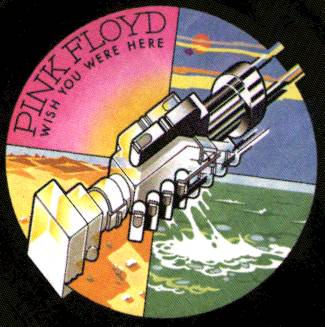
My own first experience of Pink Floyd was almost certainly visual: little stickers from the packaging of the mid-70s LPs suddenly blooming on school noticeboards and fellow pupils’ folders and bags. I was enough out of the loop of pop in my early teens — I’d grown up a very quiet rural backwater — to be fascinated: no such thing as a tabula rasa, of course, but I really wasn’t having to battle against any thickets of borrowed childhood assumption. Within a couple of years, I’d been saturated with DSotM and WYWH: and never — I absolutely admit — been captivated. This wasn’t teenage me reacting against something; this was something simply not reaching me, and it still — in itself — doesn’t. Like Philosophy of Modern Music, Wish You Were Here is an act of expiation and grief and guilt; like PMM, WYWH seems dislikeably flawed to me, or anyway one-sided. But I’m not going to argue (here!) in defence of my intolerance: instead I’m going to point you, with some delight, to Marcello’s use of it as a portal across to music perhaps no one but he would think to juxtapose — music, as he makes entirely clear, linked socially and historically and of course in emotional purpose, but music (at least to my ears) of a very distinct sensibility: Robert Wyatt’s version of Charlie Haden’s “Song for Che”; the Blue Notes’ LP Blues Notes for Mongezi, Michael Mantler celebrating Edward Gorey. Opposing extremes? Only as a means of crystallising a very particular moment, in its potential and its limitations — and this is not Marcello’s aim (at least not in this one review). Obscure and difficult music presents one kind of obstacle to the newcomer: a good deal of music writing muddleheadedly expends the wrong kind of effort to overcome this. But hugely popular and well known music can also congeal on the ear and heart, for bad reasons: and this too needs to be overcome, and in some way that task is a lot harder, and generally more thankless. I don’t always like Marcello’s most-loved music — and doubtless vice versa — but I think his solution to both these problems is often exemplary.
]]>