 For a while now I’ve been wondering about the feasibility and the need for a project: which for want of a better term I’ve been calling the “co-operative archive”. When my friend Martin Skidmore died last year, his wish was that those who knew and loved him gathered at his flat and divided up whatever of his collections — of comics, records, books, art catalogues and more — that we variously wanted. It struck most of us that day, I think, that there was something more than just sad about splitting up what he’d put together so carefully, over many years: he was a highly intelligent man, a scholar, in fact, especially when it came to comics. Was there a way this archive could be maintained?
But there wasn’t time: the practicalities — where could we find to store it all? — intervened. His colleagues in the comics world were adamant that his comics be rescued as an important resource, but much of the rest, inevitably, was scattered to wherever unwanted books and CDs go.
Anyone my age, in my trade, will have experienced something similar, I imagine, when that friend passed on who’d filled his flat or house with curiosities, sometimes going back decades. And sometimes it’s a collection that’s focused and specific enough that official institutions — museums, libraries, universities — can be persuaded to take it, preserve it, make it available for future study; especially if the collector was an artist or author or anyway a “person of note” whose work will likely generate research. But these institutions are all under enormous funding pressure — public libraries especially — and what I suppose I’m getting at anyway is material that would tend to fall outside an ordinary museum’s or library’s archival remit. Or — to put it slightly more polemically — would possibly stretch the institutional or bureaucratic imagination beyond its (fund-finding) limits.
One person I chatted with was semi-seriously wondering if his large collection of obscure films taped off the telly wasn’t a resource — and of course it probably is. Yes we live in a time of apparent cultural plenty, with “everything” in instant reach — but it really ISN’T everything, quite a lot has quietly been left out of the easy-access cornucopia. And the cornucopia is only possible through quite rigorous formatting and pre-emptive categorisation, and both these can strip out historical context and (for want of a better term) the traces of social curation; the why of the original gather, the principles of use-value in the first quirky instance. And it’s the latter that nags at me: that put in mind the idea of the co-operative archive. Of some sort of resource of this kind of material, “curated” — in the sense of gathered together and kept safely, somewhere where it could be accessed when needed — in some kind of (yes, massive handwave here) crowd-sourced fashion.
The basic problem for orthodox public archiving is space: suitable buildings are expensive, and need extensive staffing. Because space and funding is limited, there’s a constant process of triage — things not being selected, things being deselected, prey to exactly the streamlining decisions, about value to the public and such, that will cull the material I’m imagining being archived. My tentative proposal is what’s already having to happen be what’s further encouraged and enabled: that these collections, though they have to be dispersed physically, will be moved into spaces owned by friends, colleagues, admirers, and looked after there.
But they will all also remain linked on a centrally maintained database: which contains details of the original collector, what’s being held and where. The masterlist of items would be public searchable and accessible — the specific details of where held perhaps to subscribers, along with message-boards for information exchange and discussion, and potential for enquiry and suggestion — ways people can be put in touch with one another. There’d be a cost to maintaining it, certainly — accurate inputting is dreary and timeconsuming and should be appropriately reimbursed, but this cost is nothing to the problem of housing the material. There’d be issues of security for some items perhaps — though the point I’d stress here is that this is largely (by self-selection) material which has value in the setting provided, but very little once split away from it.
Could this be kickstarter-funded? Would it be a charity? How would it work? Could it work? Does it already exist? What haven’t I thought of? Who would be interested in participating? Do people know of material that might fit this? (Tell me in comments!) I see it as a map of eccentric passions, a crowd-sourced network of minor wunderkammern — inevitably incomplete, partial, skewed towards the relevant interests of those likely to become involved (the self-documenting classes?) but this would be a strength rather than a weakness. Not excluding records or books or quite ordinary items, if there was something interesting about the mind behind the collection, and that mind’s world, that’s apparent in the collection. Is there something to this?
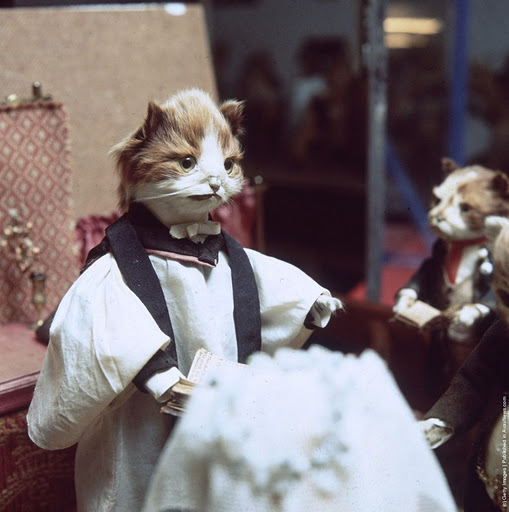 (Kitten’s Wedding (detail), from eccentric Victorian taxidermist Walter Potter’s Museum of Curiosities: my friend Dr Vick took me to this in Cornwall a few months before it was closed, its items unexpectedly split up and sold off — Damien Hirst had wanted to buy the whole collection and keep it in one piece, but for reasons both melancholy and unclear this didn’t happen.)